Bagian ini belum diterjemahkan, jadi ditampilkan dalam bahasa Inggris.
Sejarah
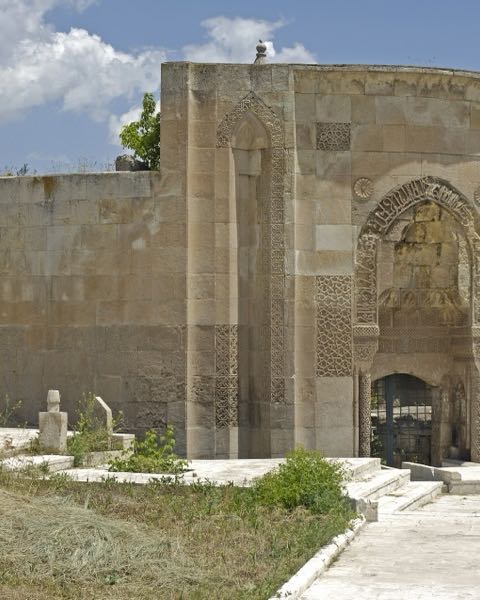
The kümbet stands at the eastern edge of the Seljuk cemetery of Gevaş, across Lake Van from Ahlat1,3. According to the inscription over its entrance, Melik İzzeddin had it built in 1335 for his daughter Halime Hatun1,2. A second inscription, on the south side, names the builder: “the work of Esed son of Pehlivan Havend of Ahlat”2,3. Yelen and Sarı count Esed among the masters of the Ahlat school and note that he also signed 26 gravestones in Ahlat and Gevaş3. Faruk Sümer, however, held that the inscription had been wrongly transcribed and read its date as Muharram 760 of the Hijra (December 1358)4.
Sümer also rejected the older view that the tomb was built under the Karakoyunlu, since that Turkmen dynasty did not rule the Gevaş region in the 14th century, and noted that the lords of Hakkâri in the middle of that century belonged to the family of İzzeddin Şir4. The cemetery around the kümbet was registered as a first-degree archaeological site in 19882. Ercan Çalış describes it as the largest Islamic cemetery in Anatolia after that of Ahlat; preliminary work under the Van Museum in 2022 recorded 670 historic graves and 31 newly found ones, and restoration of the stones began that year2. The General Directorate of Foundations restored the kümbet itself between 2014 and 20181.
Arsitektur
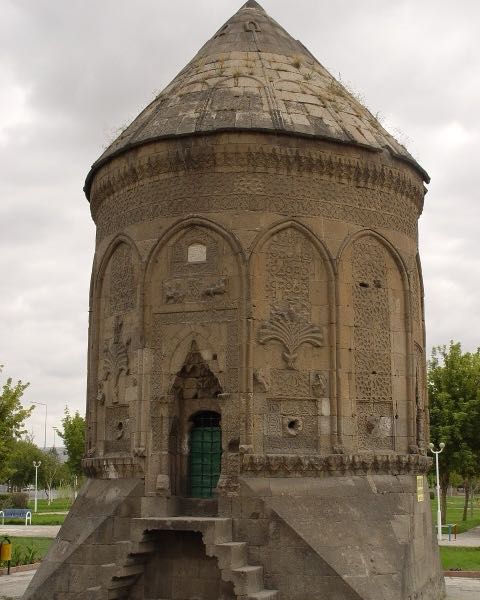
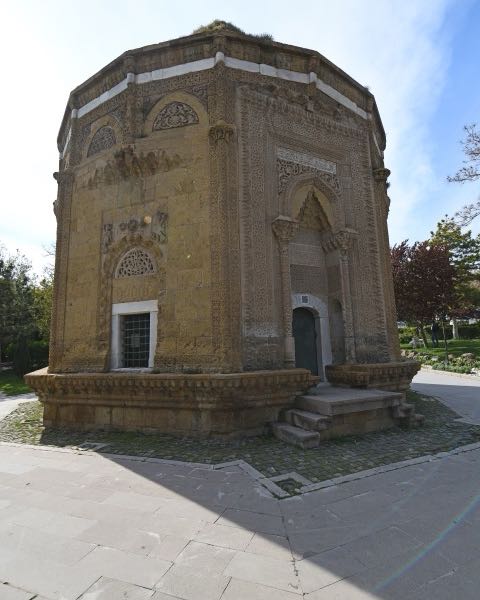
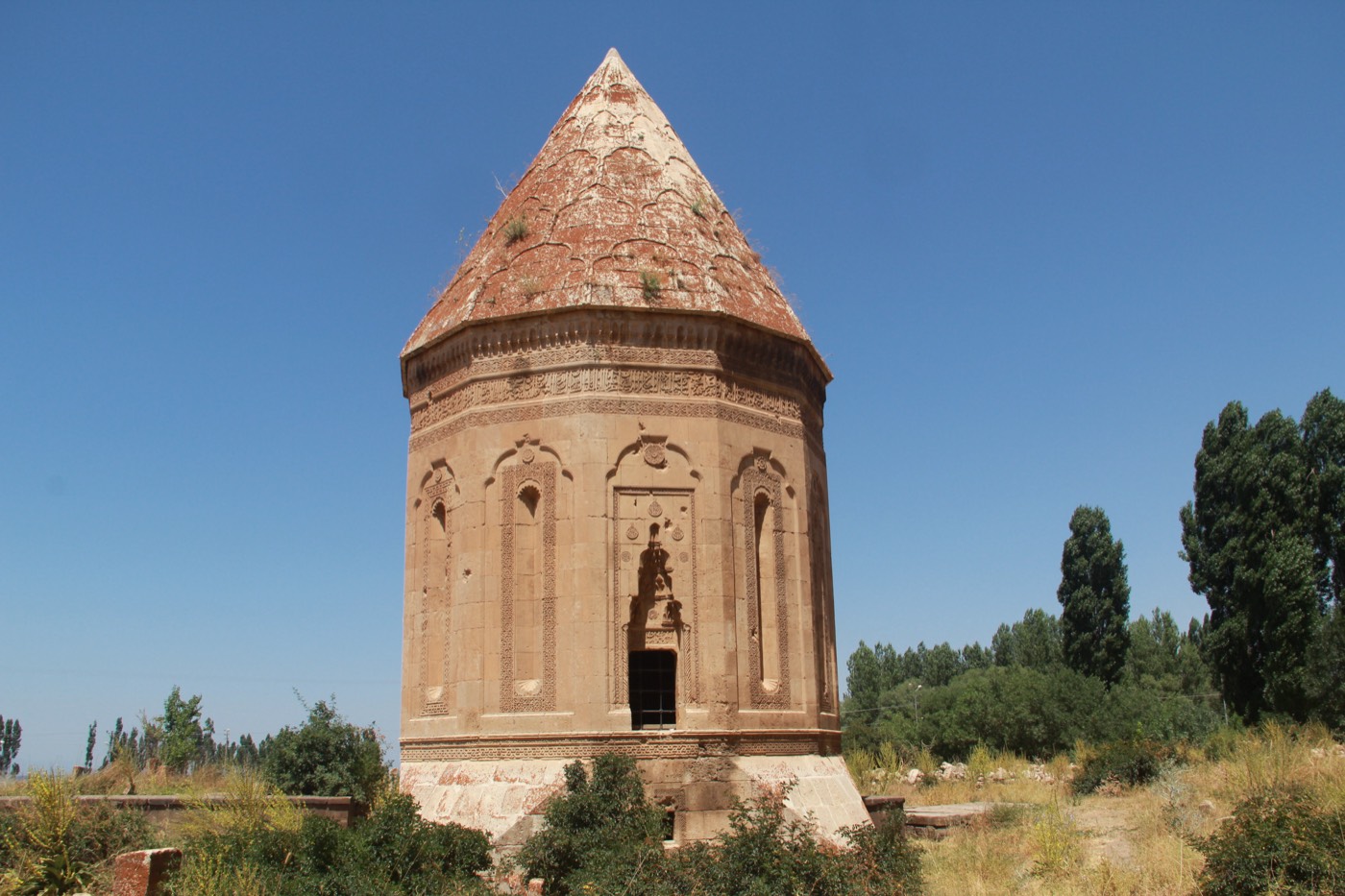
The kümbet has two storeys1. Its square crypt, under a mirror vault (a vault with a flat central panel), is entered by a stair down to a door on the east; above it a square base with chamfered corners carries a twelve-sided body, domed inside and covered outside by a twelve-sided pyramidal cap1,3. It is built of finely dressed cut stone1. The portal is on the north side and windows open to the other three directions, while triangular niches enliven the faces between them1. Yelen and Sarı note that the interior is twelve-sided too, and they pair the building with the Erzen Hatun kümbet in Ahlat (1396-1397), which TDV also describes as closely similar3,5.
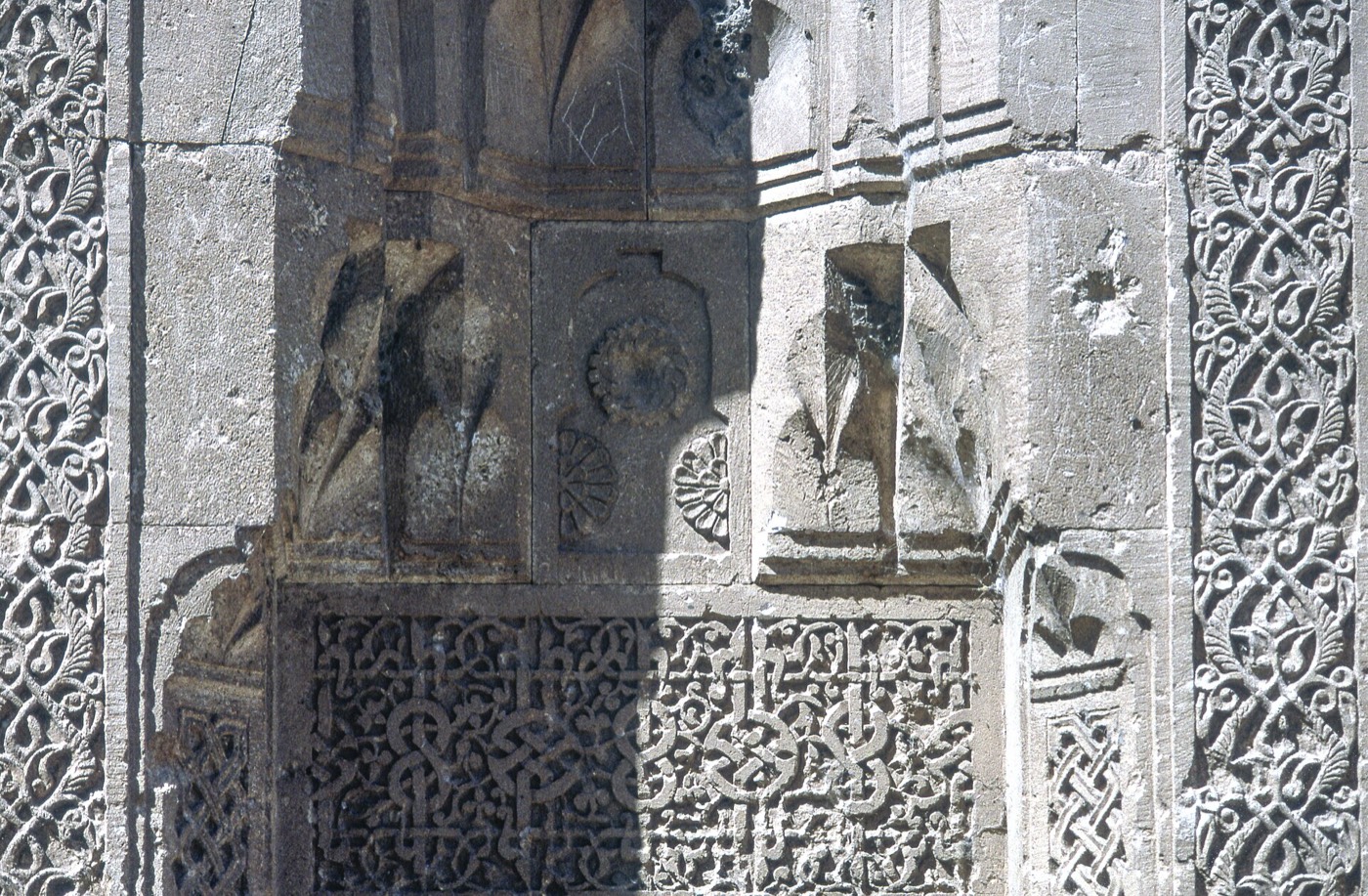
Every face carries bands and medallions of plant, geometric and epigraphic ornament1. A band of large thuluth script runs around the whole building with the first thirteen verses of Surat al-Fath1. The patron's inscription is on the lintel of the north door, and the builder's on the lintel of the mihrab window on the south side; Yelen and Sarı see in this placement the architect's wish to give his own name prominence3.
Interior
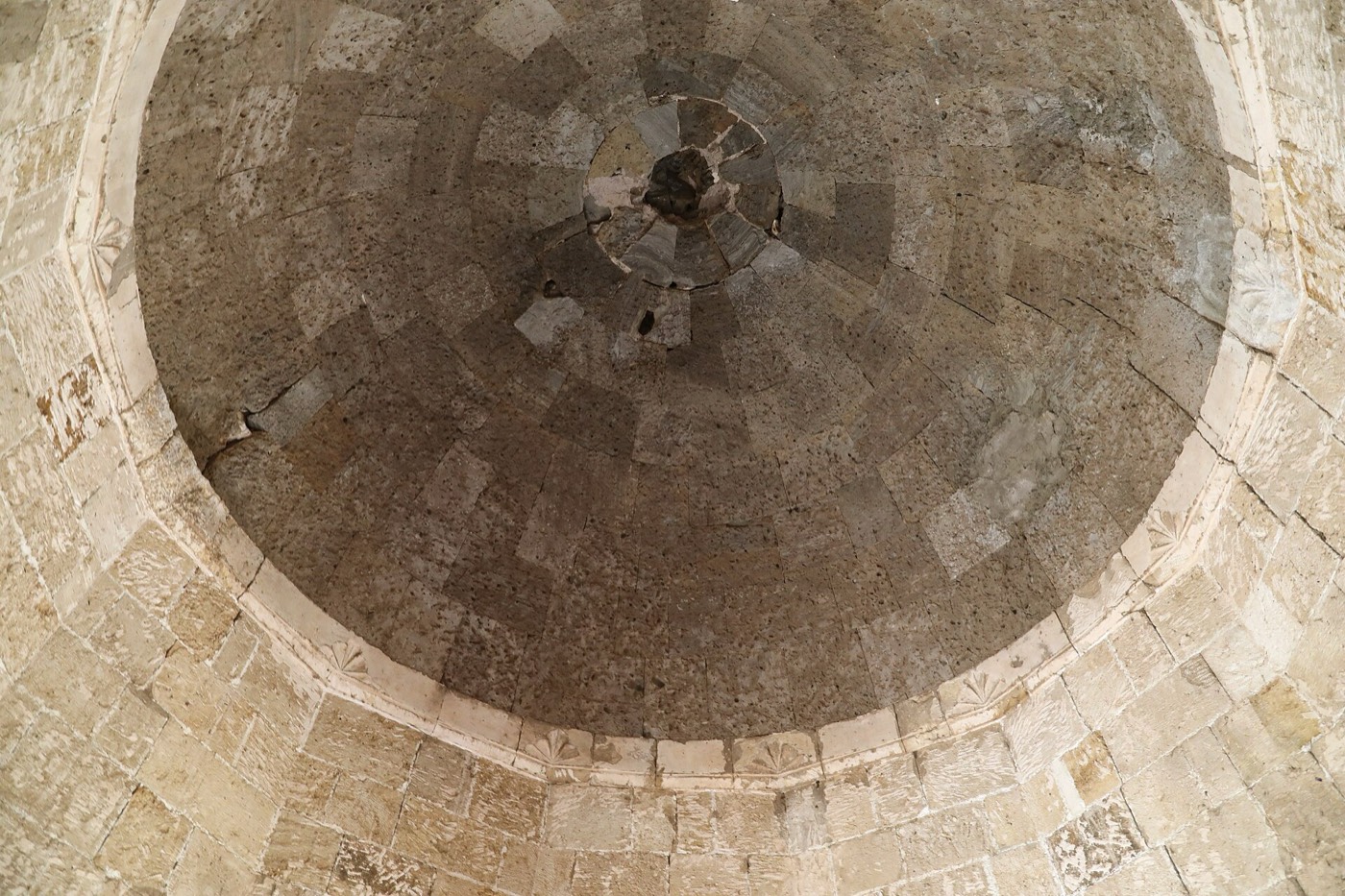
In the upper room the walls follow the twelve sides of the exterior and rise to a dome with simple shell-shaped forms at its foot, and the south window is framed as a mihrab3. The crypt below has its own entrance: a stair leads down to a door on the east side, and the chamber is covered by a mirror vault1,3.
Yang perlu diperhatikan
- The band of Surat al-Fath in large thuluth letters that runs around the whole tomb1.
- The builder's signature, Esed son of Pehlivan Havend of Ahlat, over the south mihrab window2,3.
- Triangular niches between the twelve faces, and medallions of plant and geometric ornament1.
- The crypt door on the east side, reached by its own stair1.
- The surrounding cemetery of carved gravestones, with 670 historic graves recorded in 20222.
Kunjungan
- The kümbet stands on the eastern side of the Seljuk cemetery in Gevaş1.
- The cemetery lies at Hişet in the Karşıyaka quarter of Gevaş and is a registered first-degree archaeological site2.
- Restoration of the gravestones began in 2022 under the Van Museum2.
Informasi resmi: Republic of Türkiye Ministry of Culture and Tourism, Van Provincial Directorate of Culture and Tourism; the kümbet was restored by the General Directorate of FoundationsPetunjuk arahBuka di OpenStreetMapTur berpemandu di Gevaş