Dieser Teil ist noch nicht übersetzt und wird daher auf Englisch angezeigt.
Geschichte
The mausoleum stands in the village of Aisha Bibi, formerly Golovachevka, about 18 km from Taraz1,2,4. Taraz lay on one of the routes linking Central Asia to China; the Samanid ruler Ismail captured it in 893, and under the Karakhanids it minted coins and was a major market for Turkic nomads and Muslim merchants2,5. No foundation inscription survives, so the date rests on style: the national museum-reserve and most researchers place the building in the 11th–12th centuries1,3. In 2002 Monique Kervran argued that its Chinese-style peony motifs point instead to the 13th century, when Taraz belonged to the Mongol Chaghatayid khanate, and proposed the regent Örqina Khatun as its patron2.
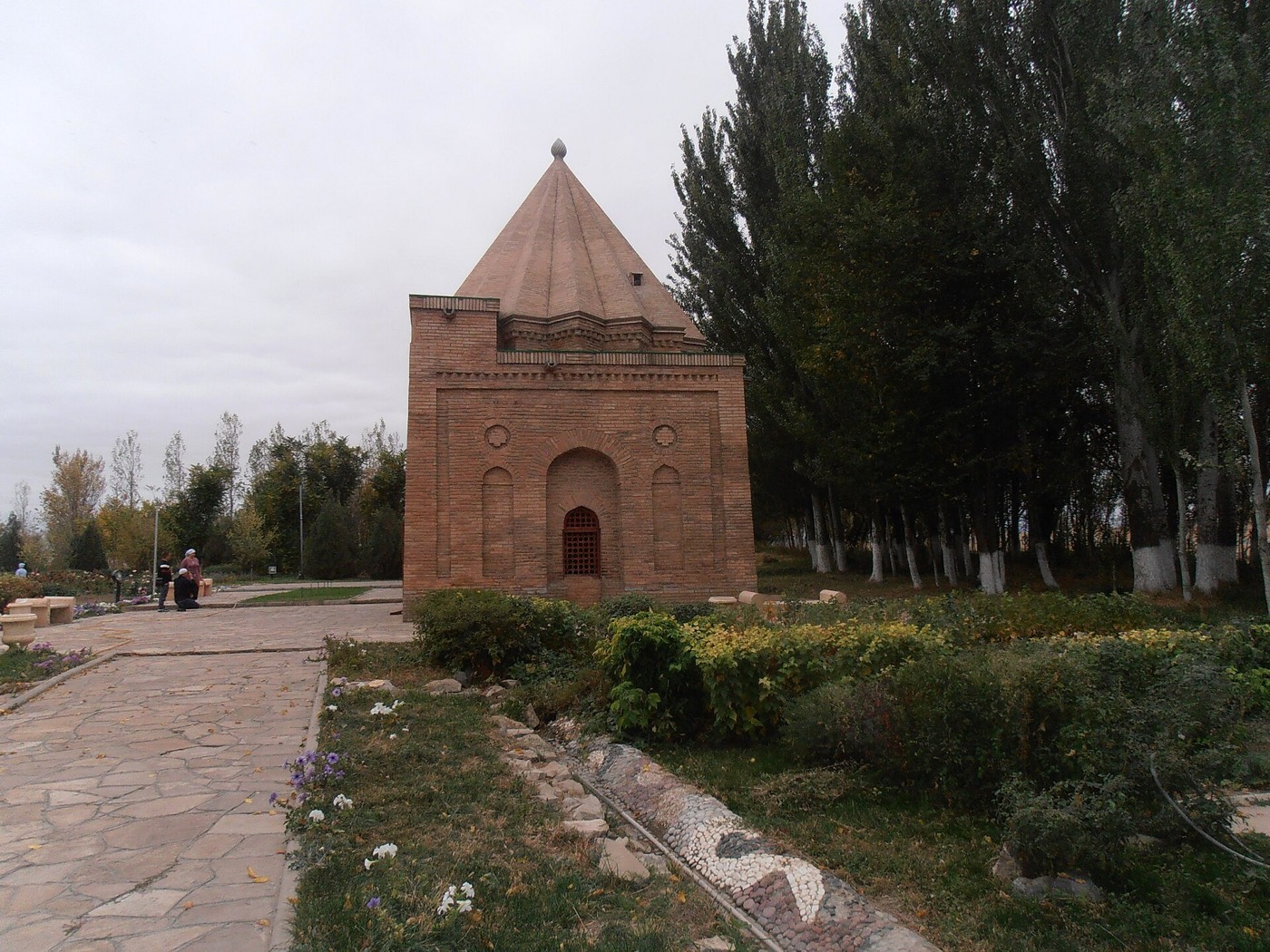
Who is buried here is unknown; only legends survive1. In the version told by the museum-reserve, Aisha, daughter of Zengi-baba and Anuar-begim, died of a snakebite while travelling to her beloved Karakhan, ruler of Taraz, who then had a mausoleum built over her grave1. Versions recorded in Russian-language publications make her Hakim Ata's daughter3. V. V. Barthold took the first photograph of the mausoleum in 18932. In the 1960s it was covered by a protective glass structure, and a Soviet restoration begun in 1984 was hampered by poor-quality materials2,4. The present building is largely the product of a 2002–2005 restoration; only the west facade wall and a few fragments survived from the original1.
Architektur
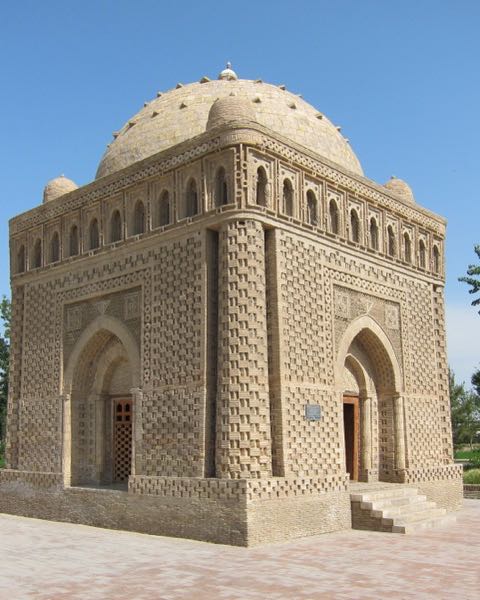
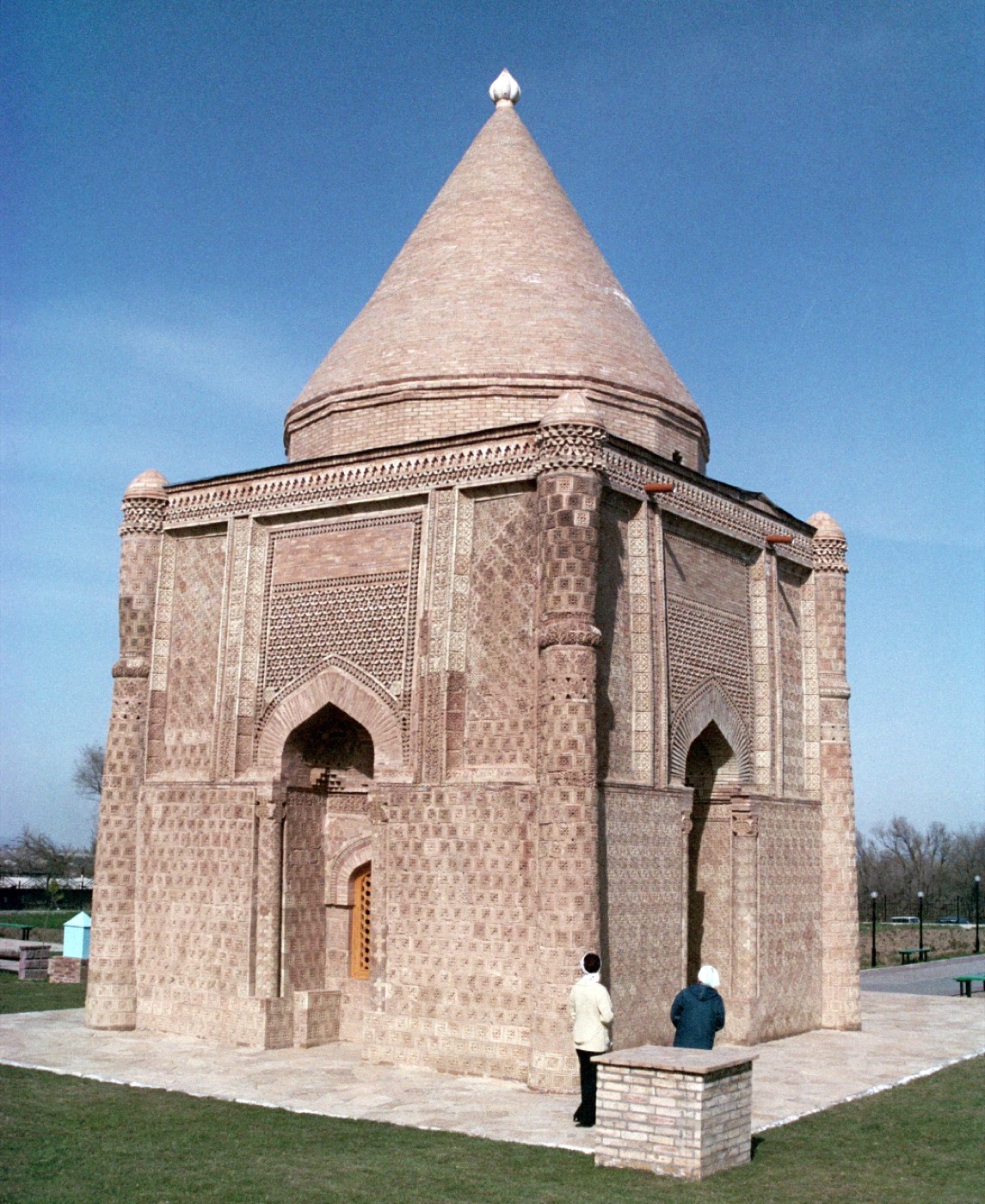
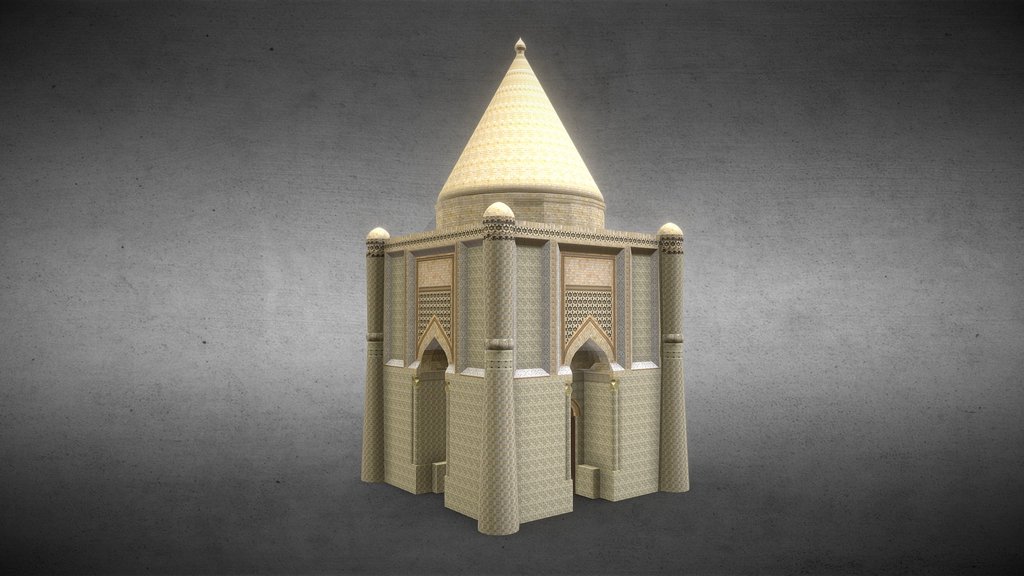
The tomb is a single domed chamber on a square plan, built of fired brick3. At the corners stand stout columns that taper upwards and flare again at the top, with a carved collar at the narrowest point1,2,3. Kervran, like the Soviet scholar G. A. Pugachenkova before her, relates this profile to Central Asian wooden columns such as those of the Zerafshan valley2,4. Each facade has a central niche with a pointed arch; the doorway opens in the east niche, while the others hold windows1,3,4. Kervran describes the building as in many respects a replica of the Samanid Mausoleum in Bukhara, sharing its plan, elevation and horizontal division of the facades2,4.
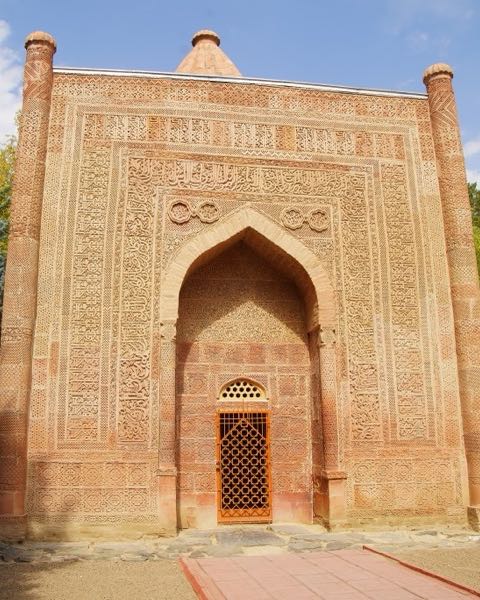
The outer walls are faced entirely with carved terracotta tiles in more than 60 designs, combining geometric and plant patterns, so that sunlight and shadow give the surface a lace-like effect1. Eight- and six-pointed stars, crosses and lozenges interlock across the facades2,3. Kervran distinguished four strands in this decoration: Central Asian Islamic star patterns, a tile facing of Buddhist origin, Chinese peony and lotus flowers on the capitals, and stylised motifs from steppe art2. Short inscription bands circle the western corner columns about 3.4 m above the ground; they have been read as 'Autumn… clouds… the earth is wonderful', identified as the opening of a couplet by the 13th-century Persian poet Saadi, or judged undecipherable1,2,3.
Innenraum
The interior is plain compared with the richly faced exterior3. Deep pointed squinches in the four corners turn the square room into an octagon beneath the dome, with a rectangular recessed panel on each side3. The museum-reserve describes the vault as corrugated with a double curvature, and notes juniper-wood ties at its base as an anti-seismic measure1. Pointed-arched windows open in the north, south and west walls, and the doorway is on the east3. At the centre lies a large cenotaph, about 3 m long and 1.4 m wide, aligned north–south3,4. Much of the chamber is reconstruction: the dome had collapsed before the 2002–2005 restoration1,3,4.
Besonders sehenswert
- The west facade: the only wall that survives from the medieval building1.
- Carved terracotta tiles in more than 60 designs, brought to life by sunlight and shadow1.
- Spool-shaped corner columns with a carved collar, echoing Central Asian wooden columns2.
- Six-petalled flowers on the capitals of the west facade's central niche, which Kervran links to Chinese peonies2.
- Inscription bands on the western corner columns, about 3.4 m up, whose reading is still debated1,2,3.
Besuch
- The mausoleum is in the village of Aisha Bibi, Zhambyl District, about 18 km from Taraz1.
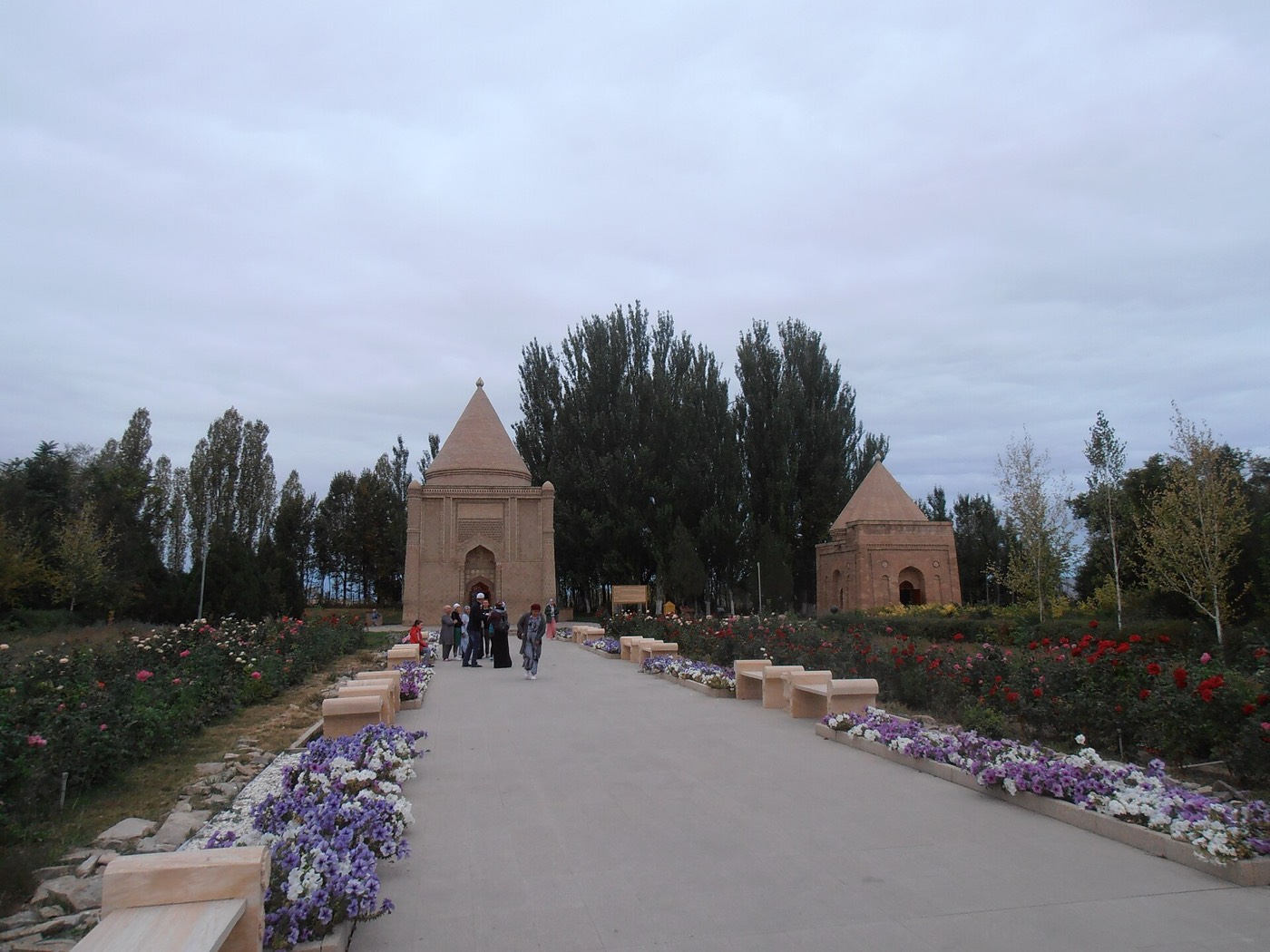
- The smaller Babaji Khatun mausoleum stands about 20 m to the north3,4.
- Most of the present building dates from the 2002–2005 restoration; only the west facade wall and a few fragments are original1.
Offizielle Informationen: "Monuments of Ancient Taraz" State Historical and Cultural Museum-Reserve (Ezhelgi Taraz eskertkishteri)AnfahrtIn OpenStreetMap öffnenFührungen in Taras