History
Baba Taher, known as ’Oryan, was a dervish poet from the Hamadan area, remembered for his do-baytis, quatrains in a simple metre, probably in the local dialect of his day1. His dates are disputed, with estimates from the 10th to the 13th century; the one account Iranica finds convincing, in Ravandi’s Rahat al-sudur (completed 1206), describes his meeting with the Seljuk conqueror Toghril, which would fall in 1055-581. His tomb, where his companion Fatema is also buried, is first mentioned in Hamdallah Mostowfi’s Nozhat al-qolub1,6. Iran’s tourism portal says the old tomb was an octagonal brick tower of the 12th century; it stood on a hilltop on the north-western edge of the city2,6.
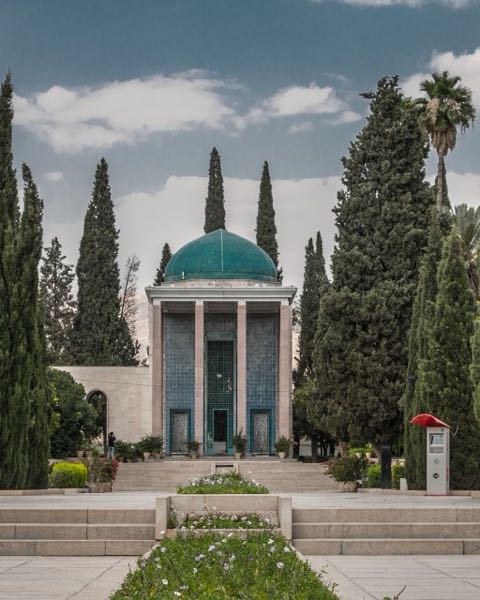
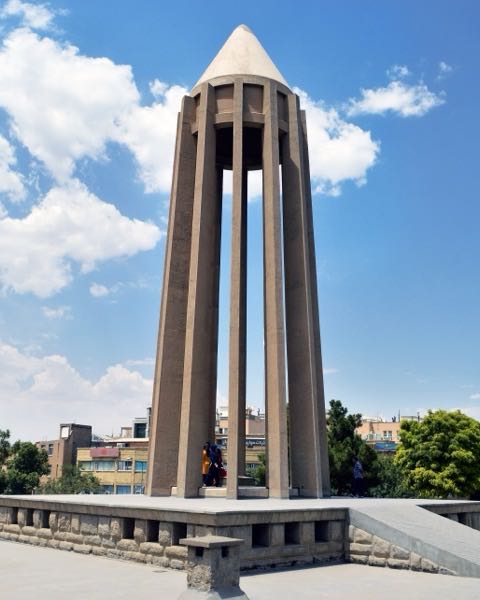
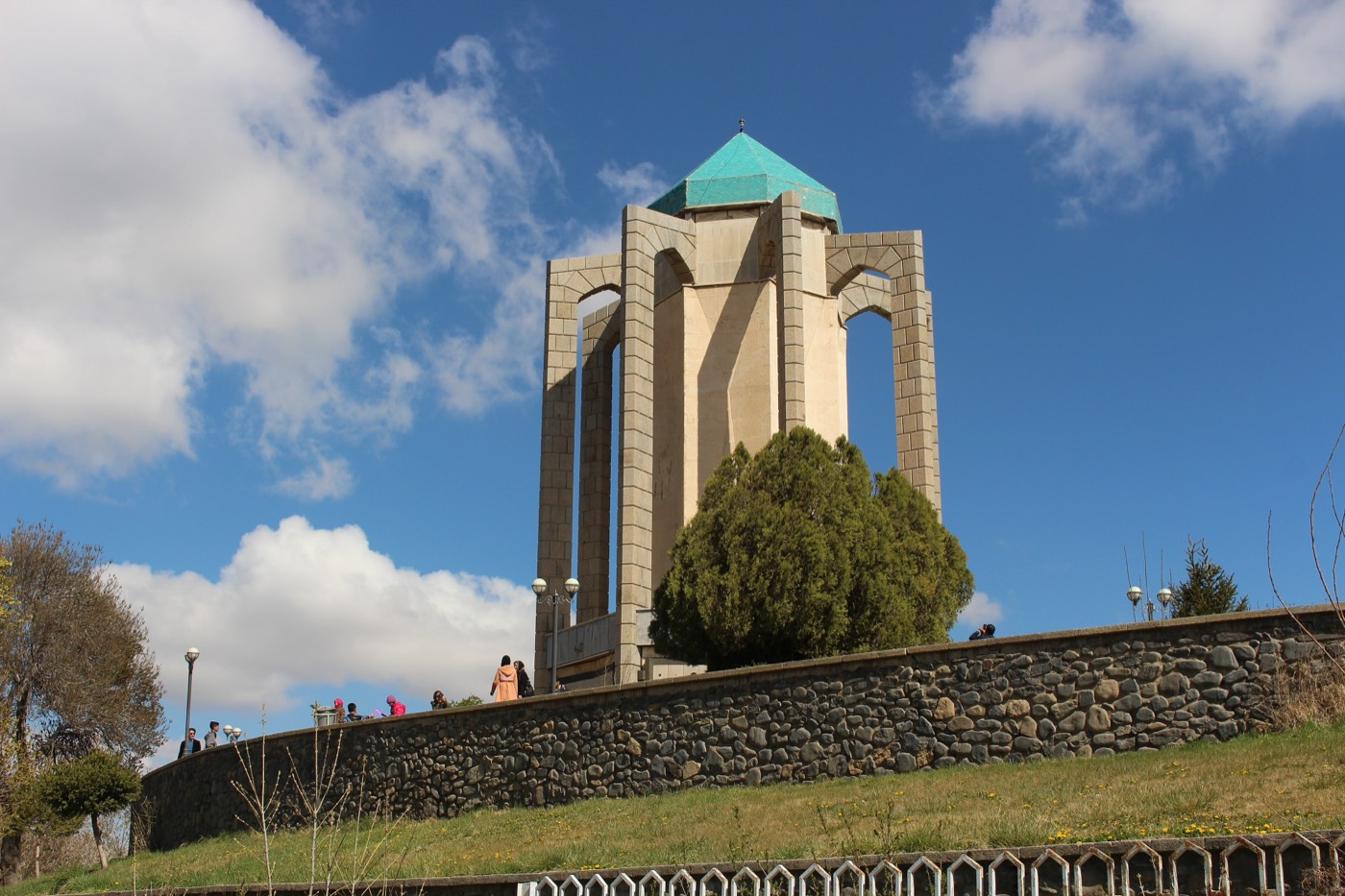
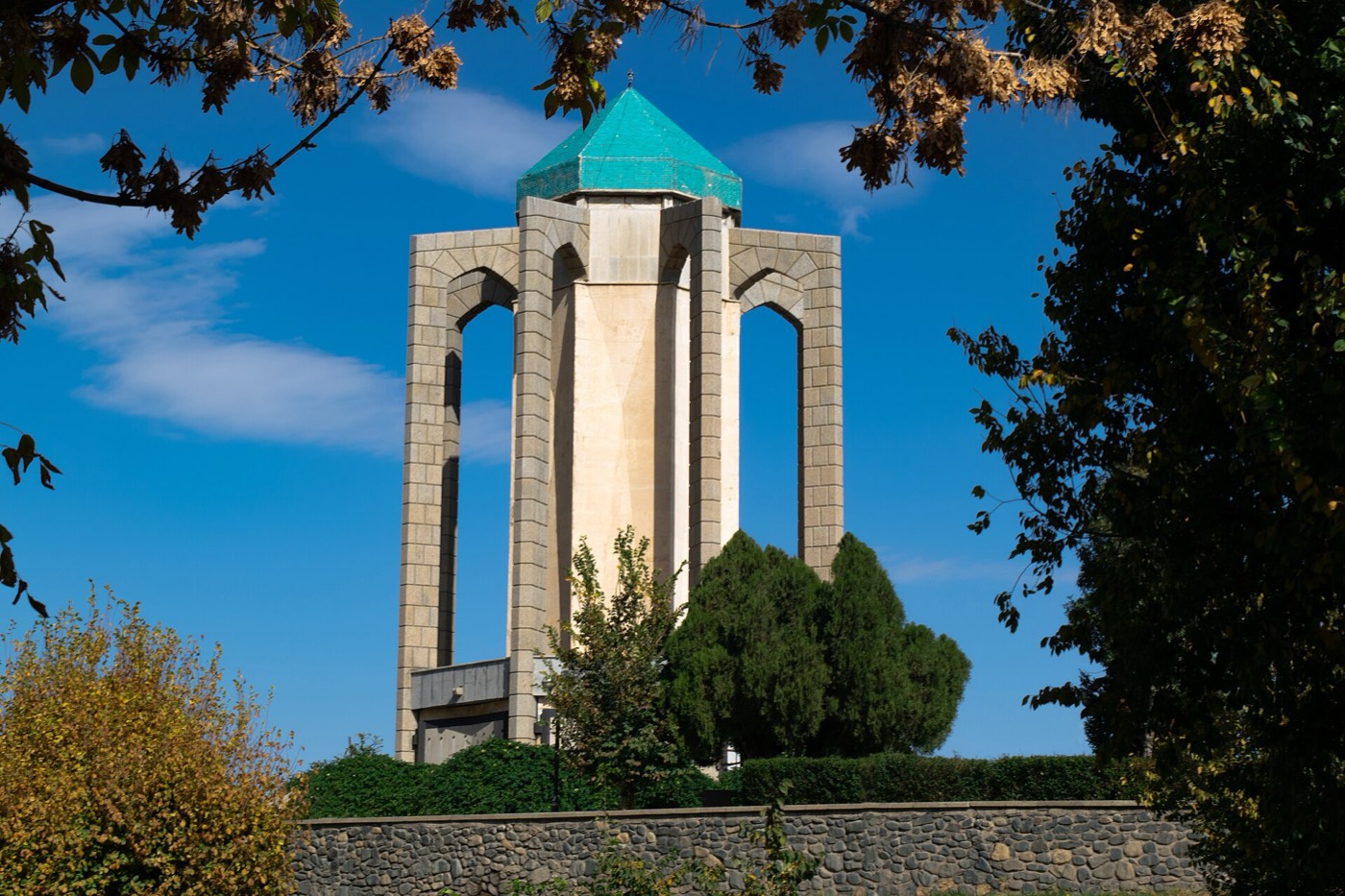
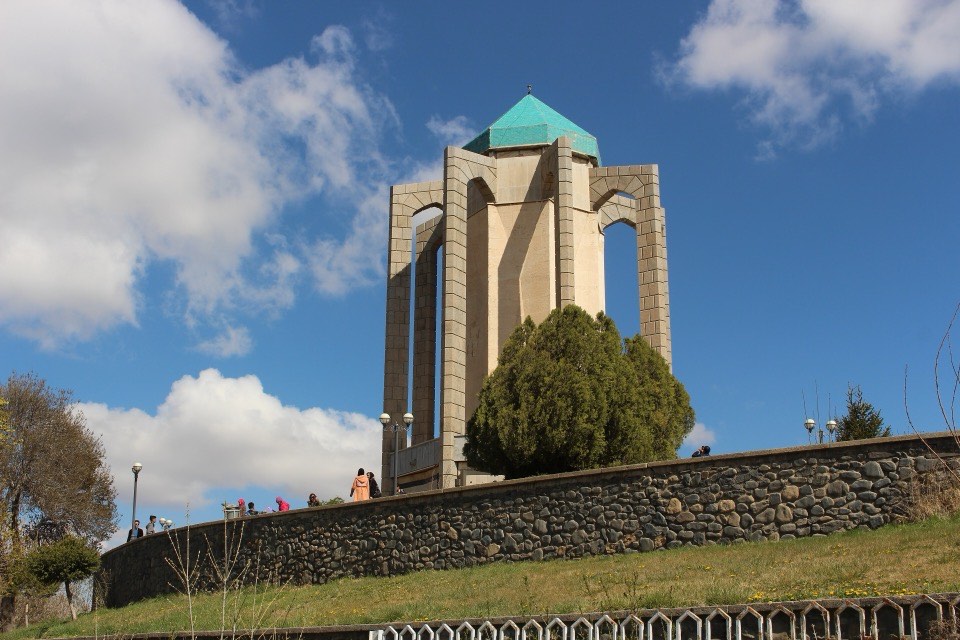
The tower fell into ruin in the early 20th century, and a simple tomb replaced it in 1938-39; it was restored in 1950-521,6. In 1967 the Society for National Heritage began the present monument by order of Mohammad Reza Shah, one of the tombs it built after 19614,6,7. Mohsen Foroughi (1907-1983), who had designed the Society’s tomb of Saadi in Shiraz, drew up the building and the plan of the surrounding square, which Hamadan’s municipality carried out3,4,6,8. The work was completed in summer 1970, on a site of more than 100,000 m²5,6. When the old tower was replaced, a 13th-century inscription in Kufic script was found in it2.
Architecture
Iranica notes that the monument imitates Avicenna’s tomb, rebuilt in the same city in 19512. Iran’s official tourism portal describes a tower on an octagonal base, rising about 25 m above street level6,7. According to the portal, the tower’s eight piers are of carved granite and its outer faces of white stone, while the tomb itself, 10 m by 10 m, is a cluster of prisms pierced by entrances and light openings, built of brick with concrete ties on foundations of stone and lime6,7. The portal adds that carved granite was also used for the steps around the tower, the floor and the gravestone6,7.
Inside
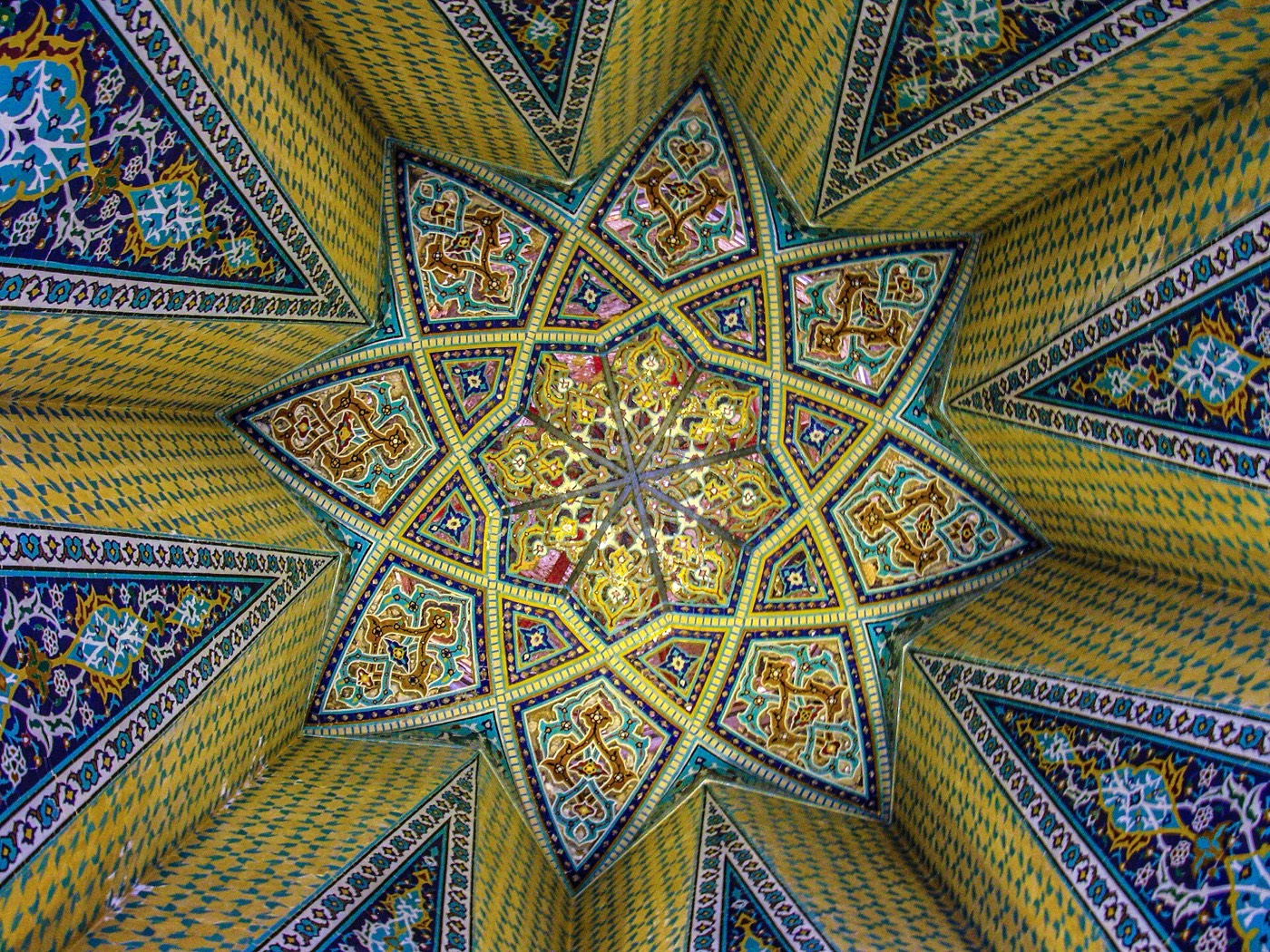
Inside, according to the same portal, the tomb chamber is lined with tile mosaic and fine ornament in the banna’i (mo’aqqal) manner6,7. Twenty-four of Baba Taher’s do-baytis are inscribed on twenty-four marble slabs set around the lower part of the walls, and the gravestone and the floor are of carved granite6,7.
What to look for
- Twenty-four marble slabs inscribed with Baba Taher’s do-baytis around the tomb chamber6,7.
- The tile mosaic and banna’i-style ornament that line the interior6,7.
- Eight carved granite piers in a tower about 25 m high6,7.
- The hilltop setting in north-western Hamadan, facing the summit of Mount Alvand6,7.
- The nearby grave of Seyyed Mir-Agha Kebriyai, the poet known as Maftun Hamadani6.
Visiting
- The tomb stands in Baba Taher Square, a site of more than 100,000 m² on a hill in north-western Hamadan6.
- In the past, dervishes lived in a building of several small rooms in front of the tomb6.
- Avicenna’s tomb is in the same city2.
Official information: Iran’s Ministry of Cultural Heritage, Tourism and Handicrafts (official Visit Iran portal)DirectionsOpen in OpenStreetMapGuided tours in Hamadan