
History
The Chellah lies on the left bank of the Bou Regreg, about 2 km from the centre of Rabat, on a site occupied since the 7th to 5th centuries BC and known to Roman writers as Sala2,3. Excavations have uncovered temples, baths, a basilica, a forum and a capitol of the ancient town3. According to Discover Islamic Art, Roman Sala Colonia was deserted in the 8th century and in ruins by the 10th2. The Marinid sultans later made the site a royal necropolis, built at the end of the 13th century according to FSPCR and surrounded by imposing ramparts3,2. Discover Islamic Art names the sultans Abu Yusuf Ya’qub and Abu al-Hasan as its patrons2.
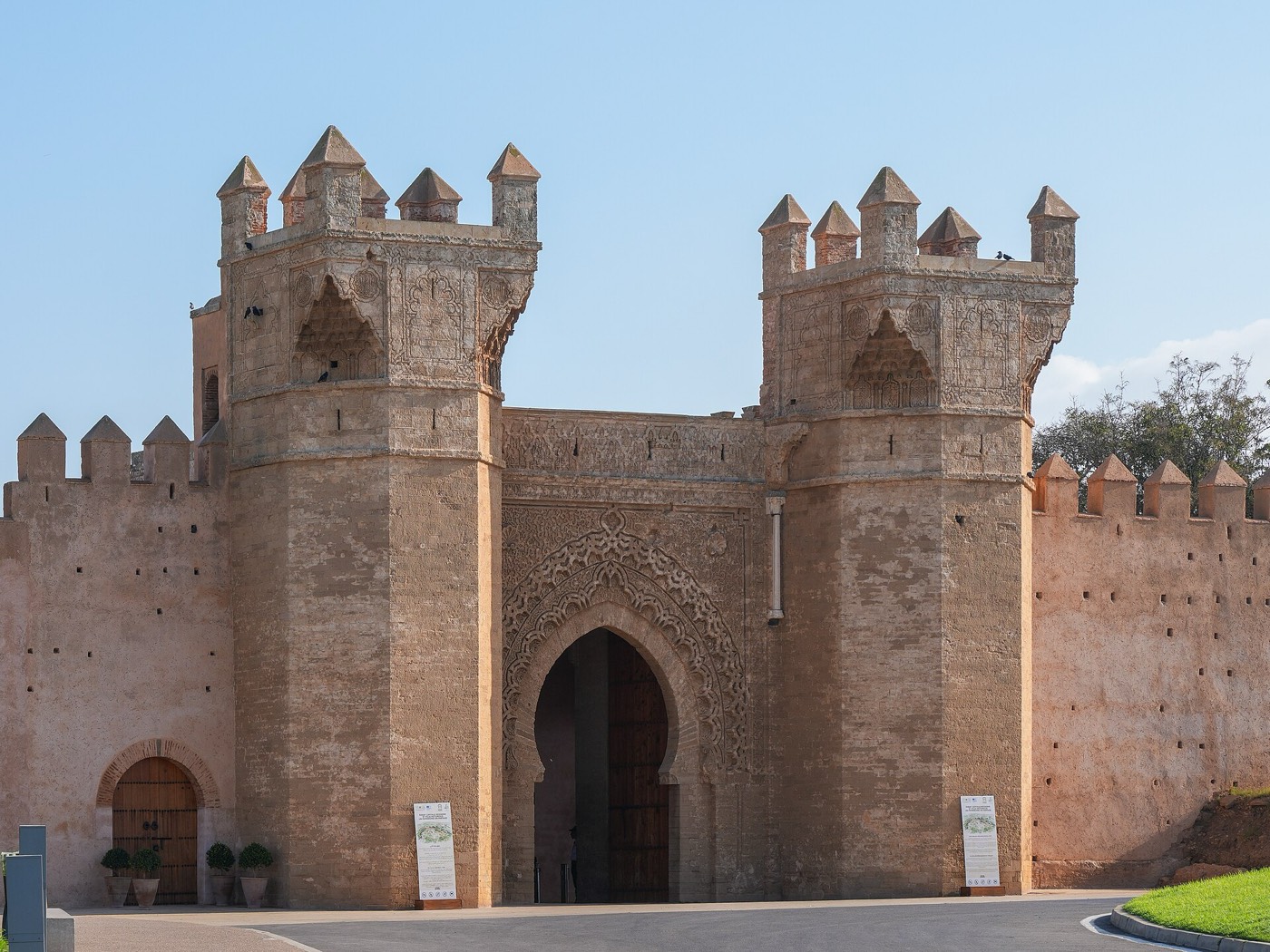
A Kufic inscription on the frame of the main gate records that the ramparts were begun under Abu Sa’id Uthman (r. 1310-1331) and completed by his son Abu al-Hasan in 739 AH (1339)2. Abu al-Hasan (r. 1331-1351), known as the Black Sultan, has his funerary chamber (khalwa) here, near a marble stone dedicated to his wife Shams al-Duha, a European convert2. A study of this qubba by María Antonia Martínez Núñez, Patrice Cressier and two colleagues treats it as a key building in Abu al-Hasan’s programme to enlarge and monumentalise the dynastic necropolis4. The earthquake of 1755 left most of the Marinid buildings in ruins, and the site was abandoned in the 18th century2,3.
Architecture
The necropolis is enclosed by a wall of irregular plan, with sides of about 300 m, entered through a richly decorated gate2. Its two flanking bastions are half-octagonal at the base and turn square at the top through muqarnas corbels, under merlons capped with small pyramids2. The narrow, pointed horseshoe arch has plain voussoirs framed by archivolts of interlaced bands, finely carved floral ornament marked by two shells, and a broad knotwork frieze above the inscription band2. The passage turns once inside, and Discover Islamic Art judges its defensive role slight despite the guard rooms and the wall walk on the ramparts2.
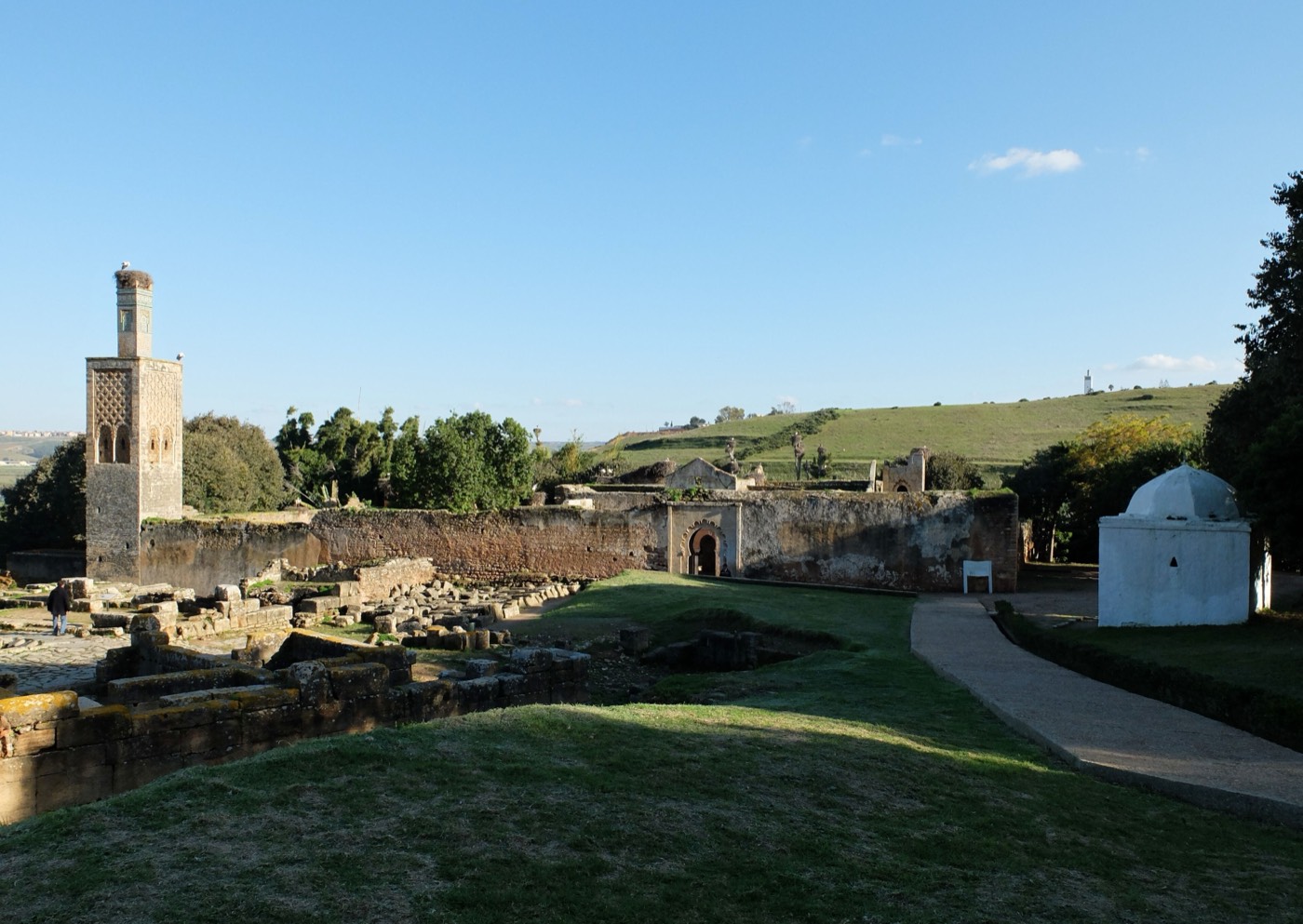
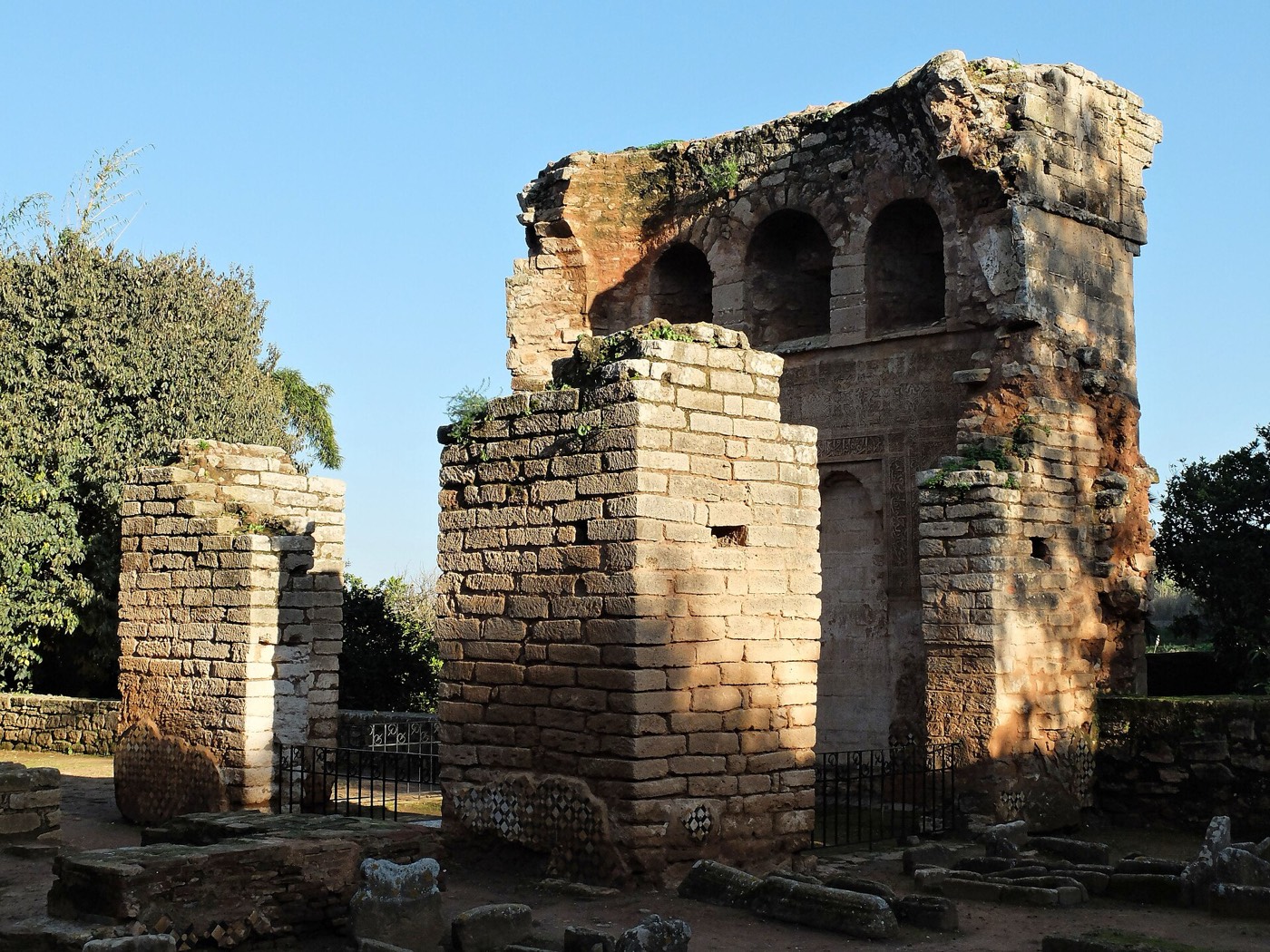
Inside the walls survive a mosque whose gateway is faced with faience mosaic and whose minaret is soberly decorated, the funerary chamber of Abu al-Hasan, decorated outside with a muqarnas canopy, and a zawiya, a house of religious teaching2. The zawiya has a courtyard with a central pool paved with ceramic tiles, ringed by cells behind galleries on marble columns, and an oratory whose mihrab is surrounded by a semicircular passage2. A stele known as Lalla Chella, after the patron saint of the site, also survives2. Excavations uncovered a Muslim quarter with squares, houses and public buildings, which shows that the Chellah was a true funerary town and at times a military post2.
Inside
Inside the Marinid ramparts the remains of Roman Sala and of the necropolis lie side by side2,3. FSPCR describes the abandoned site as a garden of orange trees and wild plants, among which rise the white domes of holy men’s tombs3. The Marinid buildings themselves are ruins: the mosque with its minaret, the zawiya courtyard with its tiled pool, and the funerary chamber of Abu al-Hasan with its muqarnas canopy2. FSPCR reports that a recent restoration has renewed the site3.
What to look for
- The main gate, completed in 1339, its half-octagonal bastions turning square through muqarnas corbels2.
- The Kufic inscription on the gate frame naming Abu Sa’id Uthman and Abu al-Hasan2.
- Abu al-Hasan’s funerary chamber with its muqarnas canopy2.
- The zawiya courtyard, its pool paved with ceramic tiles, ringed by marble-columned galleries2.
- The mosque gateway faced with faience mosaic, beside its minaret2.
Visiting
- The site lies on the left bank of the Bou Regreg, about 2 km from the centre of Rabat2,3.
- UNESCO includes the archaeological site of Chellah in the first component of the Rabat World Heritage property1.
- FSPCR reports a recent restoration of the site3.
Official information: Foundation for the Safeguarding of the Cultural Heritage of Rabat (FSPCR), which UNESCO names as the overarching authority for the World Heritage property, working with the National Heritage DirectorateDirectionsOpen in OpenStreetMapGuided tours in Rabat