Esta parte aún no se ha traducido, por lo que se muestra en inglés.
Historia
The Qutb Shahi dynasty ruled Golconda and Hyderabad from 1518 to 1687, when it was the last Deccan kingdom to fall to the Mughals1,2. Its founder Sultan Quli, a Turkoman from Hamadan who had served the Bahmani sultans as governor of Telangana, built his tomb in his lifetime at the foot of Golconda fort, and was murdered in 15431,2. His successors were buried around it; UNESCO’s tentative-list text counts 30 tombs of the royal family, with a mortuary bath and mosques, dated from 1543 to 16723. Bilgrami (1927) wrote that in Qutb Shahi times the sultans’ domes carried golden crescent finials and the tombs were furnished with carpets and lamps, with readers reciting the Qur’an1.
Muhammad Quli Qutb Shah, third son of Ibrahim Qutb Shah, came to the throne in 1580 in his fifteenth year and died in January 1612, according to his epitaph1. Bilgrami credits his reign with the founding of Hyderabad and the Charminar; he wrote poetry in Persian and Urdu under the pen-name Qutbshah1,3. Later the complex fell into neglect, until Sir Salar Jung had the tombs conserved, laid out a garden and built a compound wall1,2. In January 2013 the Andhra Pradesh archaeology department signed a ten-year conservation agreement with the Aga Khan Trust for Culture (AKTC)6. By the completion ceremony in July 2024, almost 100 monuments had been conserved across the 106-acre site4.
Arquitectura
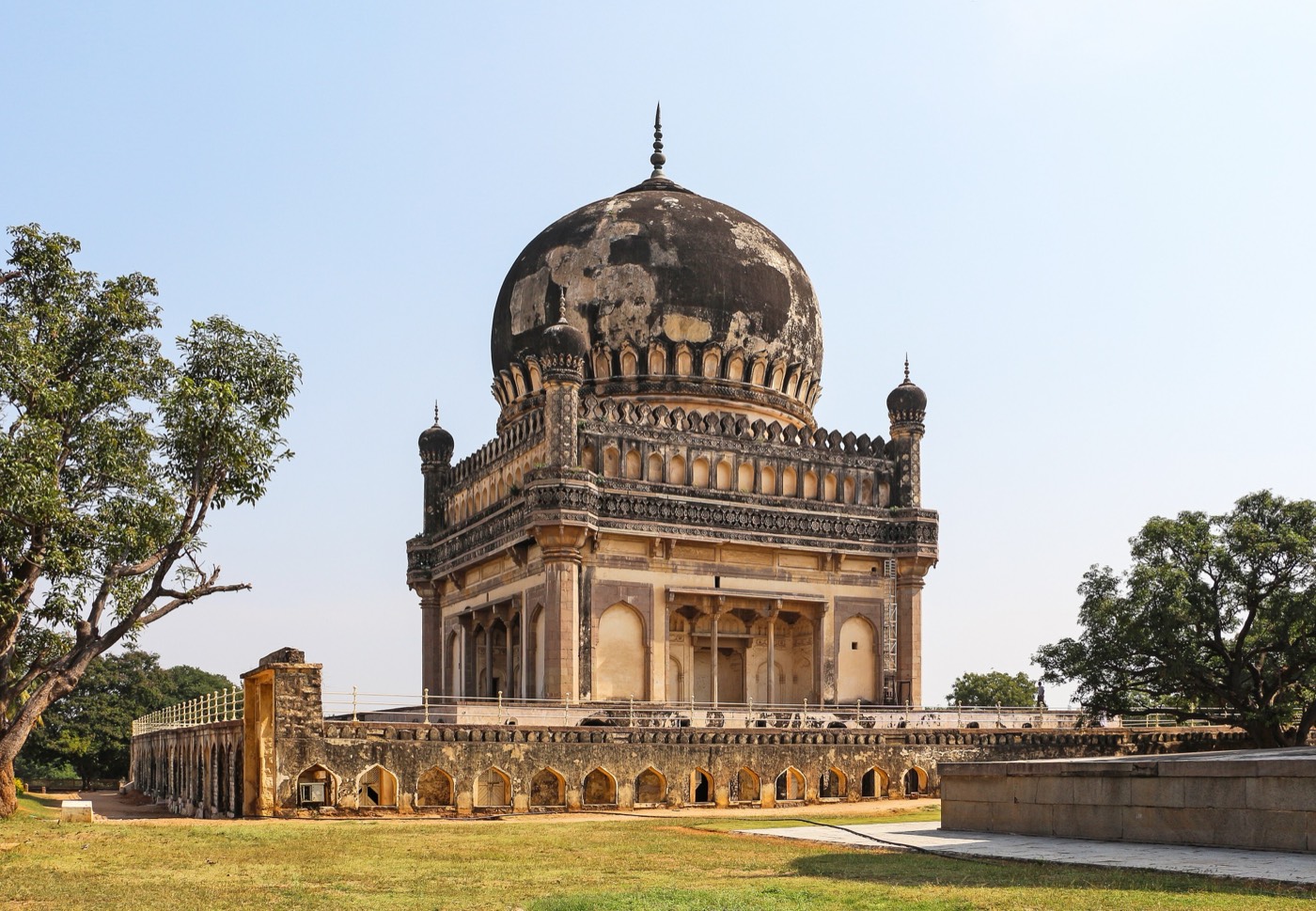
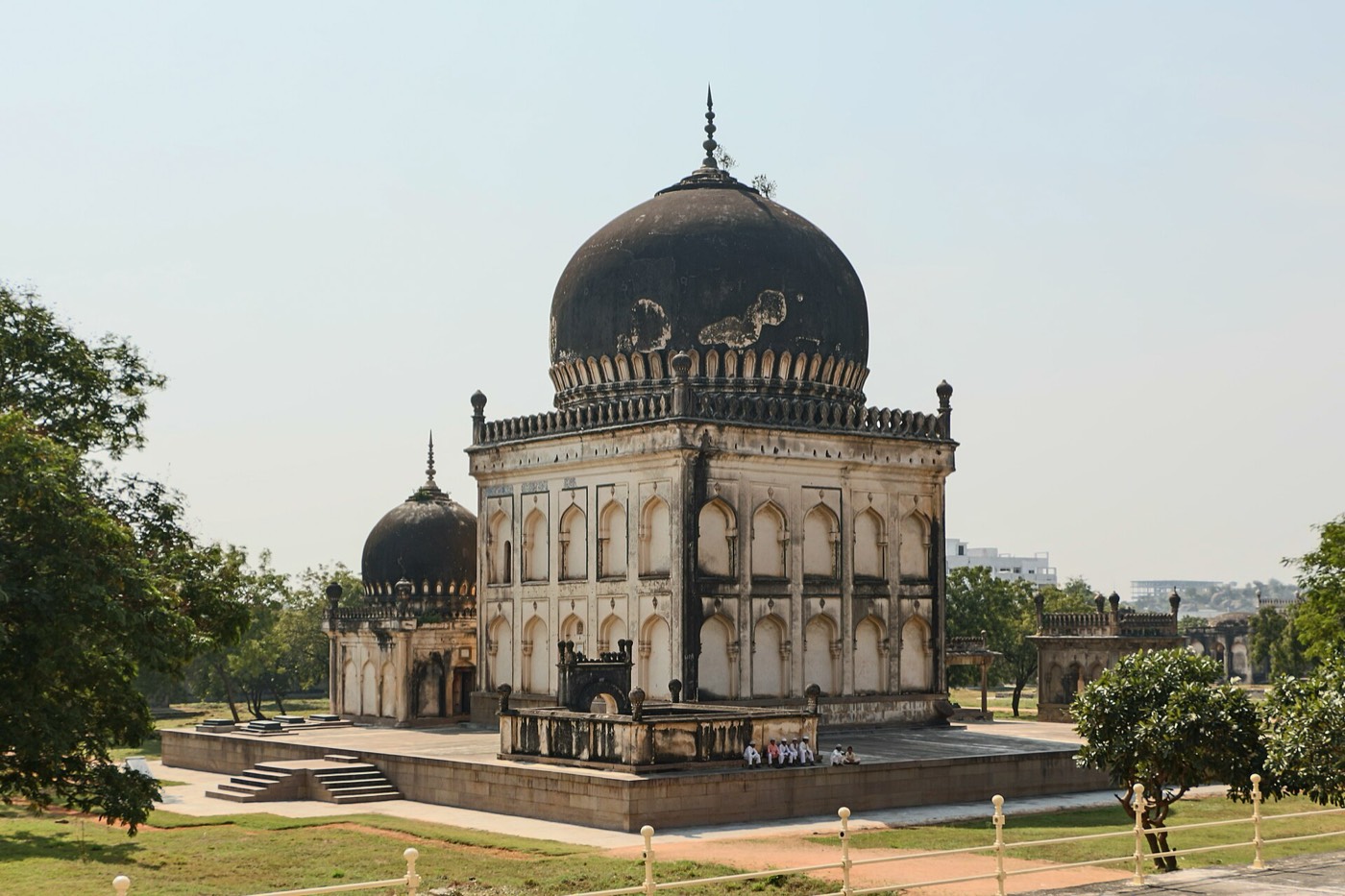
Bilgrami ranked Muhammad Quli’s tomb second to none among the royal tombs1. It stands on a double terrace raised 13 ft 6 in, its two levels 200 ft and 126 ft 3 in square1. The square tomb, 71 ft 3 in a side, is wrapped in arcaded colonnades 22 ft high and crowned by a large dome; doors on the south and east lead into the hall1. Opposite it stands the mortuary bath built by Sultan Quli, where the bodies of the kings were brought from the fort through the Banjara gate to be washed before burial; it has cisterns for hot and cold water and mosaic decoration1.
AKTC describes the Qutb Shahi buildings as granite structures richly finished in lime stucco and incised plaster, a few with glazed tiles, each tomb raised on a wide terrace2. Bilgrami called Sultan Quli the originator of the Qutb Shahi style, which he saw as a combination of Persian, Hindu and Pathan architecture1. The heritage park now covers 106 acres with about 40 mausoleums, 23 mosques, six stepwells, the bath, pavilions and garden structures2,4.
Interior
The hall of Muhammad Quli’s tomb, 33 ft 3 in square, holds his cenotaph of polished black basalt, carved in fine script with the Shiite creed, the Throne Verse and other Qur’anic verses, and with a Persian epitaph in naskh that gives the date of his death, his age of 49 and his reign of 31 years1. A flight of steps leads down to the actual grave in a vault under the terrace; in 1927 Bilgrami noted that the vaults of the other kings were closed1. AKTC has since restored the crypt5.
Qué observar
- Muhammad Quli’s tomb on its double terrace, which Bilgrami ranked second to none among the royal tombs1.
- Polished black basalt cenotaphs carved with Qur’anic verses and Persian epitaphs1.
- The mortuary bath opposite Muhammad Quli’s tomb, where royal bodies were washed before burial1.
- Lime stucco and incised plaster ornament, restored by craftsmen with traditional tools and materials2,4.
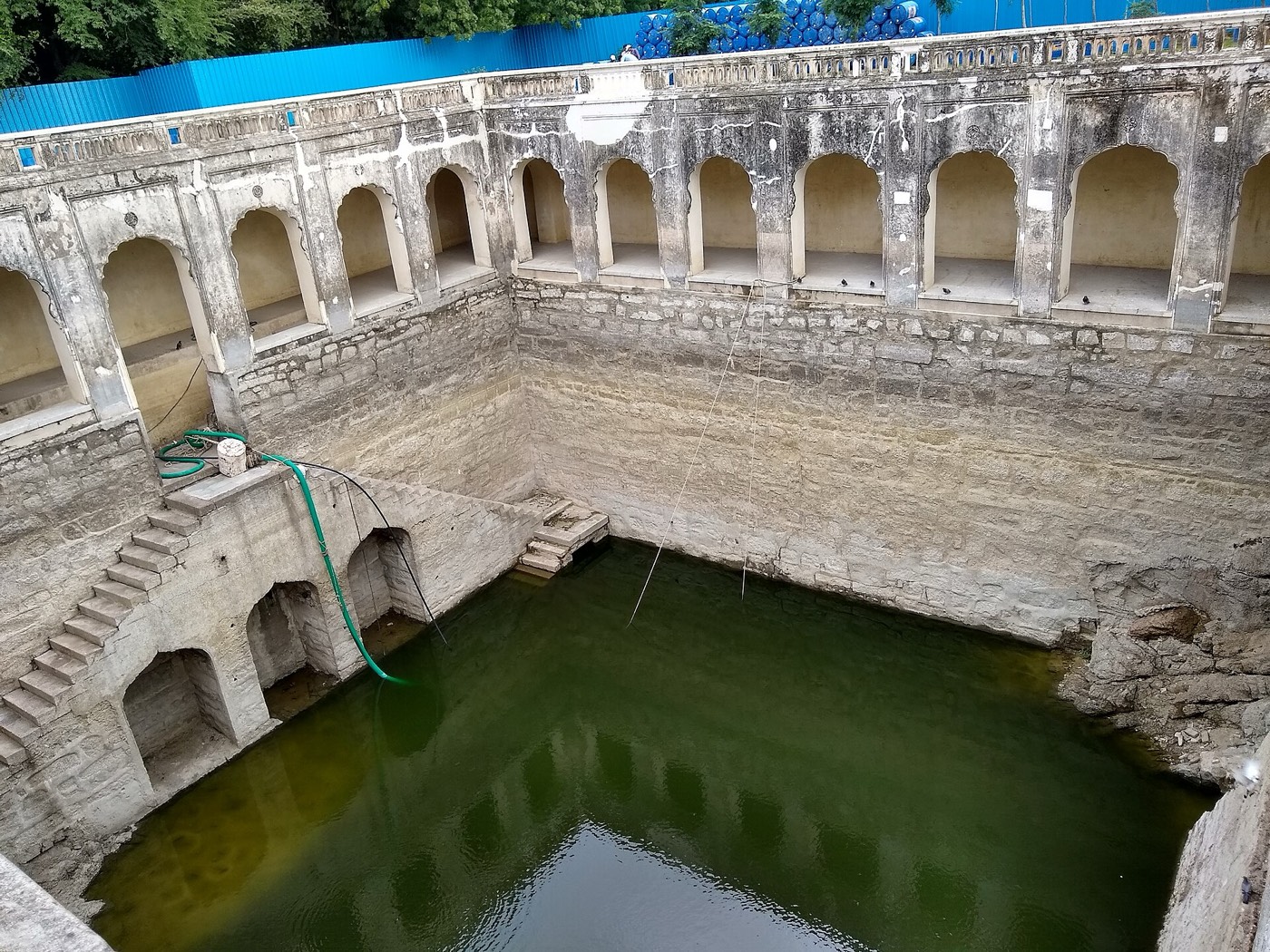
- Six restored stepwells, which won a UNESCO Asia-Pacific Award of Distinction in 20225.
Visita
- The park lies at the foot of Golconda fort; AKTC has planned a site museum to serve both the park and the fort2,4.
- The old mortuary bath stands opposite Muhammad Quli’s tomb1.
- The Qutb Shahi monuments of Hyderabad form one component of “Monuments and Forts of the Deccan Sultanate”, on India’s UNESCO Tentative List since 20143.
Información oficial: Telangana Department of Heritage, with the Aga Khan Trust for Culture (AKTC), which conserved the siteCómo llegarAbrir en OpenStreetMapVisitas guiadas en Hyderabad