Cette partie n’a pas encore été traduite ; elle est donc affichée en anglais.
Histoire
Selim II, a son of Süleyman I and Hürrem Sultan, was born at Topkapı Palace in 1524 and ruled from 1566 to 15743,6. He had the houses around Hagia Sophia cleared and the building strengthened with buttresses by Mimar Sinan, and Archnet notes that the site of his tomb was prepared during these works3,5. According to the chronicler Peçevi, cited by TDV, the tomb was begun on Selim's order in 981 AH (1573-74), but the sultan died in December 1574, before it was finished2,3. He was first buried in a tent pitched on the site, together with five of his sons, strangled on the night that the accession of his son Murad III was proclaimed2,3,4.
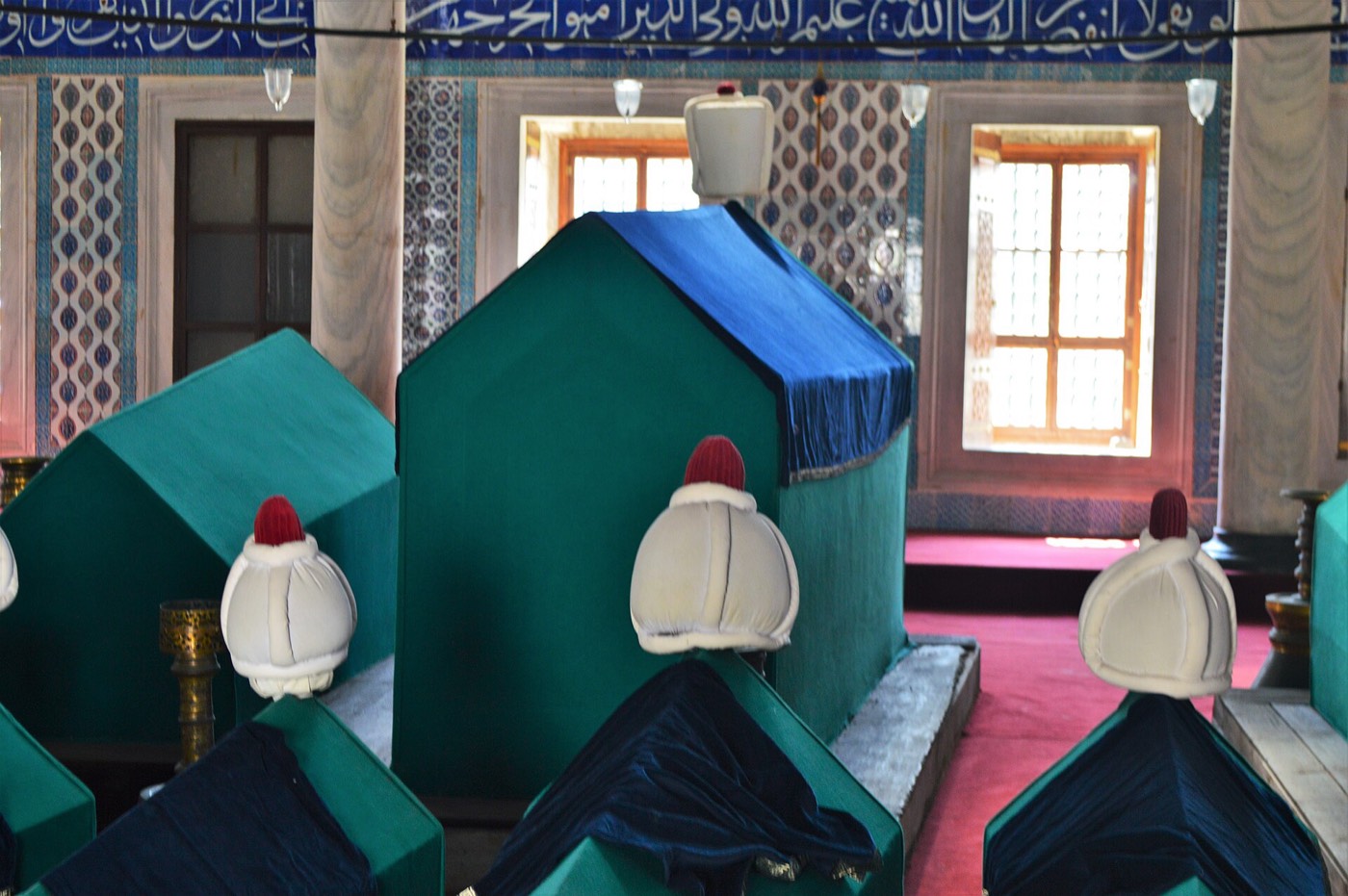
The building was finished in 984 AH (1576-77), under Murad III, and Selim's body was moved inside2,5. It became a family mausoleum: TDV, Archnet and the ministry list Selim's consort Nurbanu Sultan, three daughters, the five princes and children of Murad III, whom Archnet and the ministry number at 21 sons and 13 daughters2,5,6. The ministry counts 41 cenotaphs, while Archnet writes of 44 family members buried besides Selim5,6. The tombs of Murad III and Mehmed III were later built on either side5,8. TDV records repairs in the 1950s, in 1982-1987 and partly in 1996, and a restoration begun in 2006; according to a report by the Anadolu news agency in April 2025, a ministry statement listed the tomb's restoration as completed2,9.
Architecture
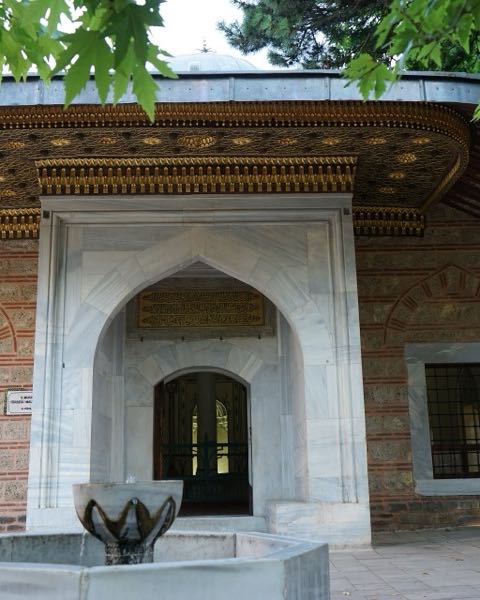
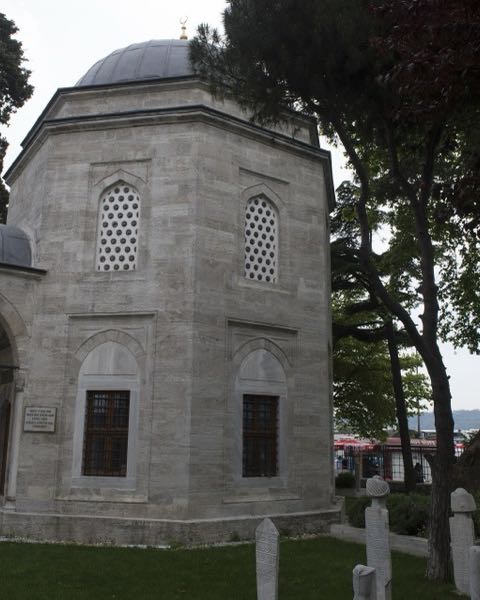
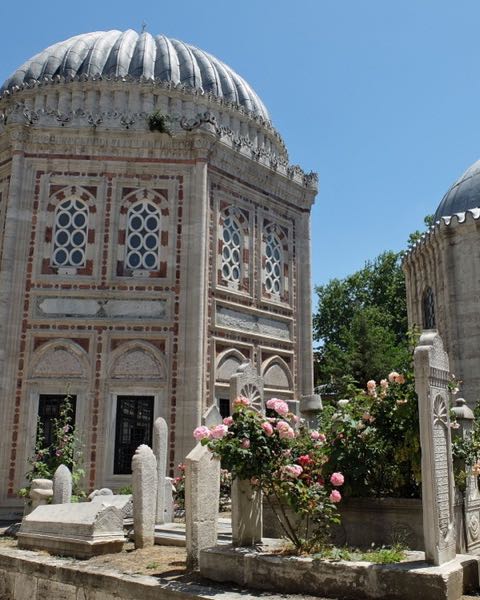
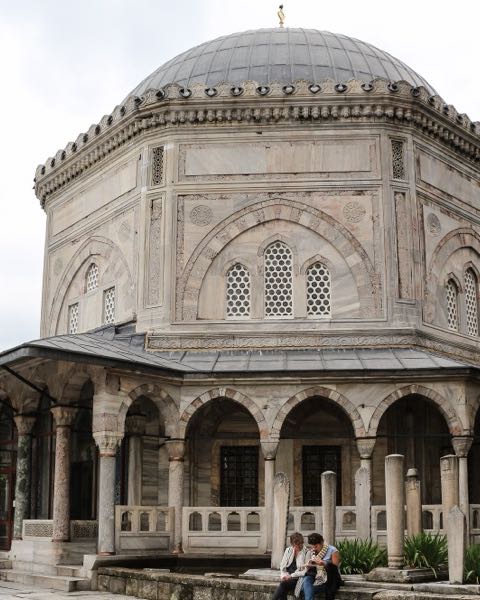
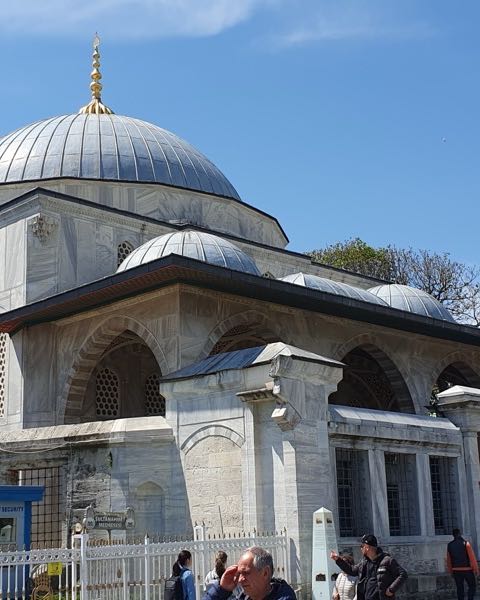
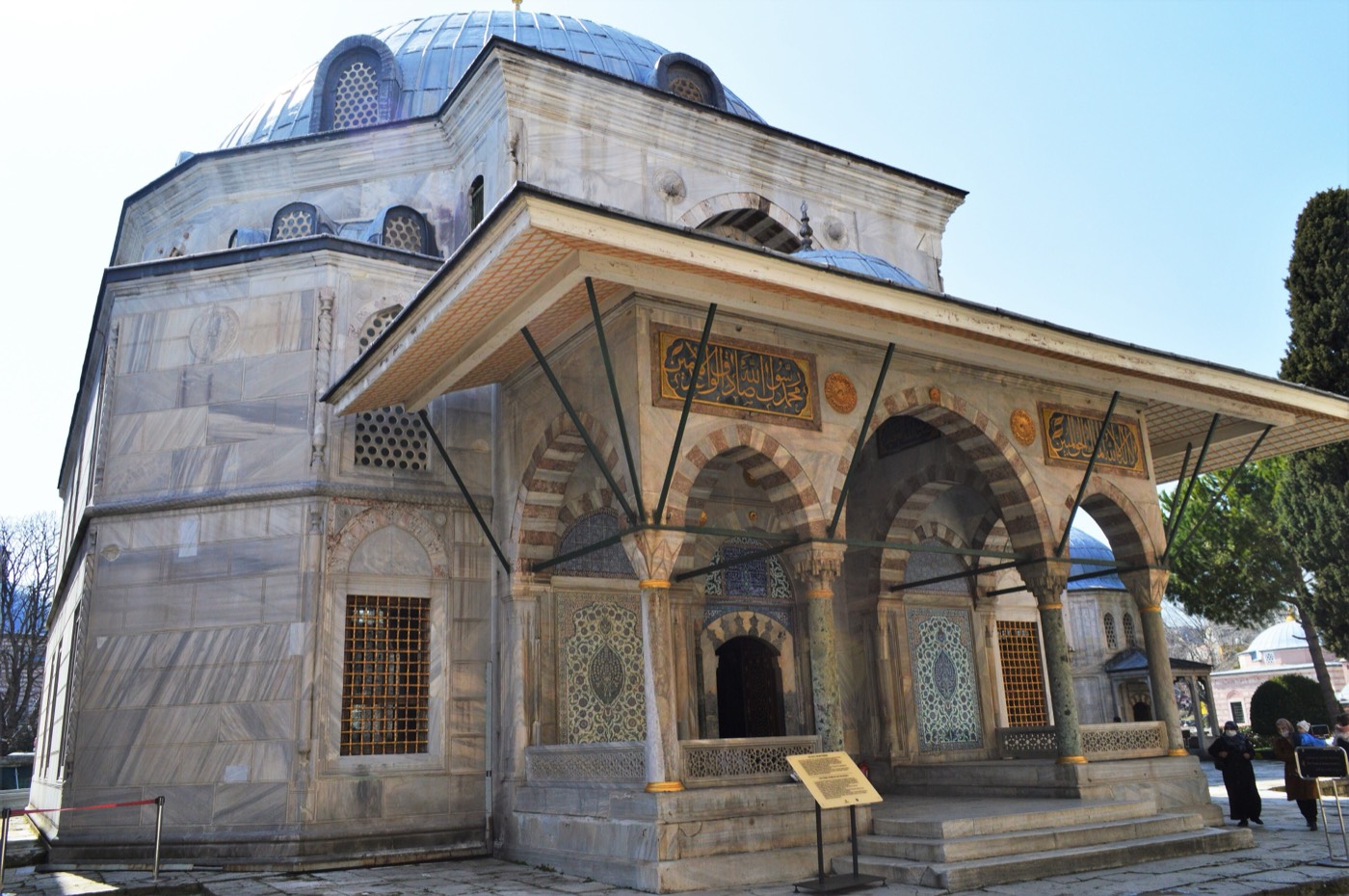
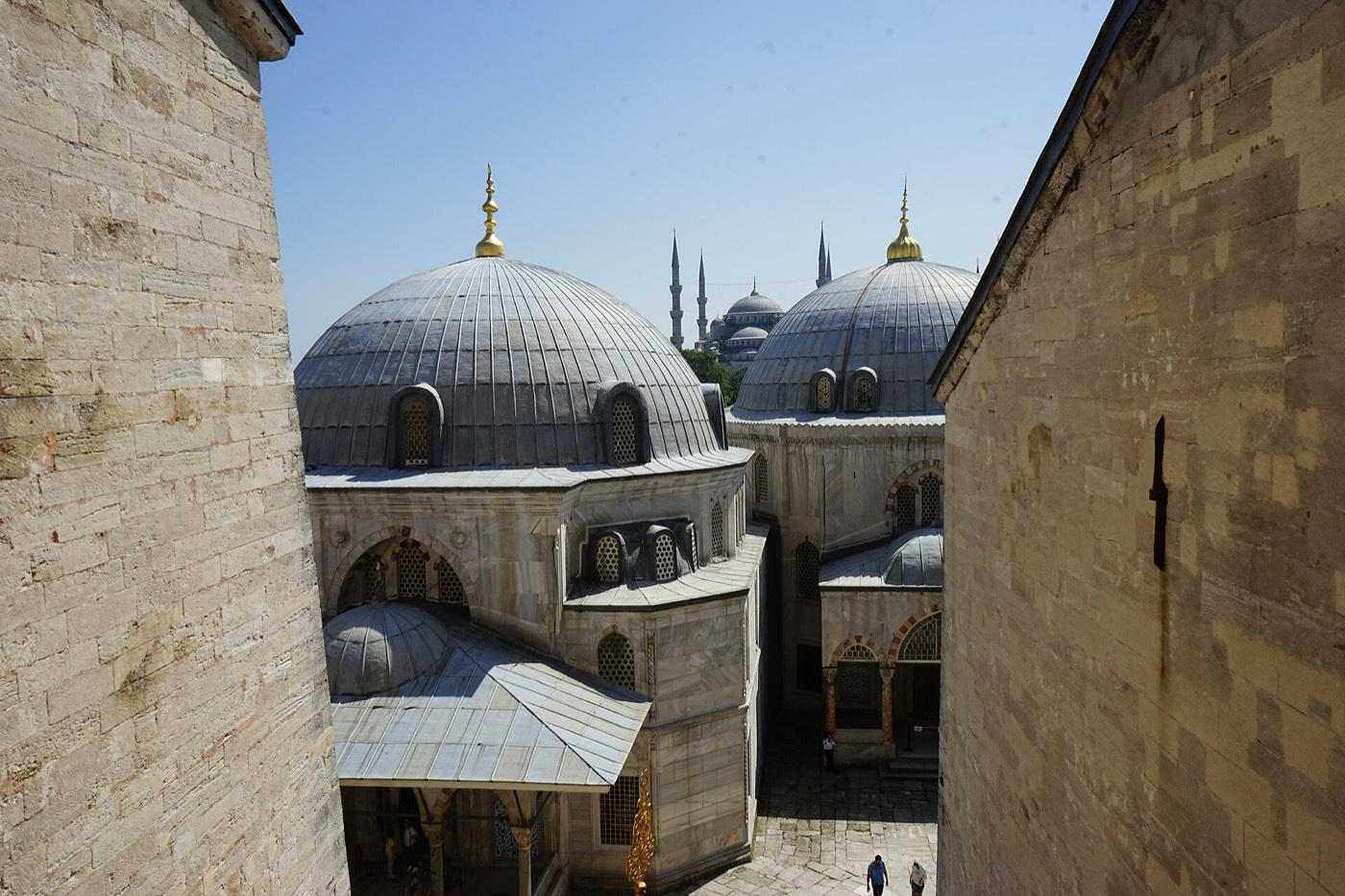
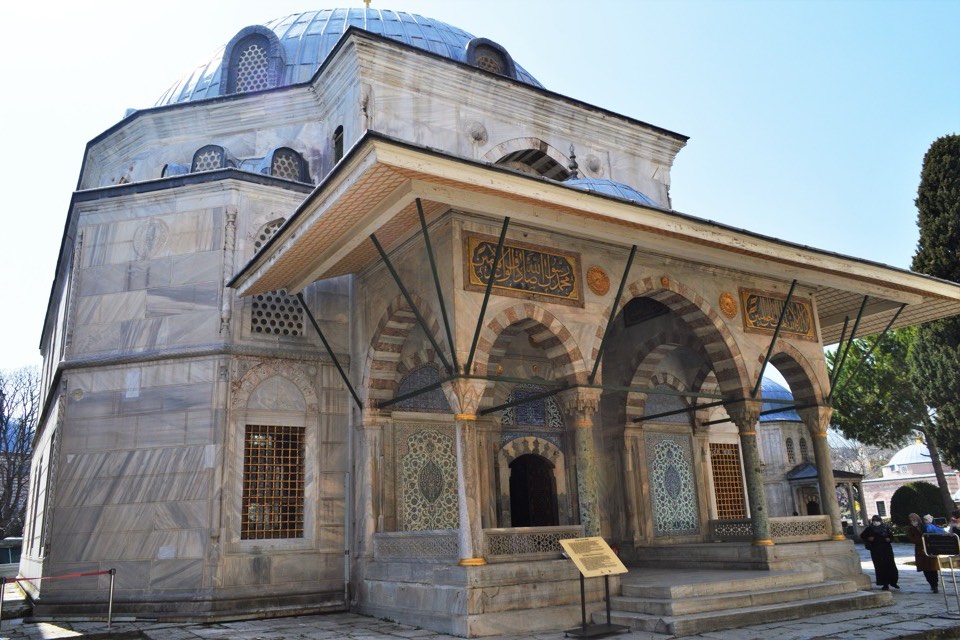
Sinan gave the tomb a square outer shell with broadly chamfered corners, enclosing an octagonal gallery2,5. It has a double dome: the outer one, on a high drum, rests on the walls, while the inner dome is carried on pointed arches springing from columns2. Düzenli places it among seven Istanbul tombs built over some forty years with separate inner and outer shells and double domes, a group that begins with Süleyman I's tomb of 15687. The cut-stone walls are faced with marble and have twisted colonnettes at the corners; two tiers of windows light the shell, with a third row in the drum and eight windows in the lead-covered dome2,5,6. Before the door stands a three-bay porch with a small central dome on muqarnas, carried in front by four columns, the middle two of breccia and the outer two of marble2,5,6.
The porch holds panels of what the ministry calls the finest 16th-century Iznik tiles6. The inscription over the door is itself in 16th-century underglaze tiles, and each panel beside it shows a niche whose spandrels carry white Chinese cloud bands on red, with blossoming branches in a central medallion, under a pointed lunette with a pattern built on ten-pointed stars2. In the 1890s, according to the ministry, a Frenchman named Dorigny removed the left panel, supposedly to complete its missing parts; a copy made at Sèvres was put in its place, and the original is in the Louvre2,5,6. Archnet also notes stone latticework and calligraphic panels of coloured marble in the porch5.
Intérieur
Inside, eight columns with muqarnas capitals, linked by pointed arches, form the octagon, and quarter-domes brace the corners2,6. The walls are tiled up to the upper windows with underglaze tiles in red, dark blue, blue, turquoise, green and black on white, showing flowers, leaves and vases of flowers above a tiled skirting that imitates marble2. A tile band of white thuluth script on dark blue, with verses of Surat al-Baqara according to the ministry, runs around the room; Archnet notes that missing sections were painted in during modern restorations2,5,6. The painted dome has verse 16 of Surat al-Ra'd in its central medallion, and tile medallions on the pendentives carry the names of God, the Prophet Muhammad, the four caliphs, Hasan and Husayn2. Around the cenotaphs are wall cupboards that once held the sultan's belongings, a gallery over the entrance, a plain mihrab niche and the door inlaid with mother-of-pearl2,5.
À observer
- Iznik tile panels beside the door; the left one is a Sèvres copy, its original in the Louvre2,6.
- The 16th-century tile inscription above the entrance2.
- Twisted marble colonnettes at the chamfered corners of the outer shell2,6.
- The white-on-blue thuluth tile band that circles the interior2,6.
- The door leaves inlaid with mother-of-pearl in a geometric interlace2.
Visite
- The tomb stands in the burial garden beside Hagia Sophia, between the later tombs of Murad III and Mehmed III, in the Sultanahmet area of UNESCO's Historic Areas of Istanbul1,5,8.
- It is one of the tombs assigned to the ministry's Istanbul Tombs Museum Directorate6.
- Hagia Sophia's former baptistery, in the same garden, holds the graves of the sultans Mustafa I (d. 1639) and İbrahim (d. 1648)8.
Informations officielles: Istanbul Tombs Museum Directorate (İstanbul Türbeler Müze Müdürlüğü), Republic of Türkiye Ministry of Culture and TourismItinéraireOuvrir dans OpenStreetMapVisites guidées : Istanbul