Cette partie n’a pas encore été traduite ; elle est donc affichée en anglais.
Histoire
The Nasrids, rulers of the last Muslim kingdom in Iberia, buried their sultans in a dynastic cemetery beside their Alhambra palaces, the Rauda (Arabic rawda, "garden")1,3. The founder, Muhammad I (d. 1273), lay in the Sabika hill cemetery1. According to the historian Ibn al-Khatib, Muhammad II (d. 1302) was buried "east of the Royal Mosque, in the gardens adjoining the Royal House"1,2. Ibn al-Khatib writes that Ismail I, killed in July 1325, was buried in the Rauda of his palace garden beside his grandfather, in a tomb decorated with inscriptions, silver and gold2. Muhammad IV, Yusuf I and Yusuf III were also buried here, and possibly Muhammad V1,2. Some scholars credit the foundation to Ismail I, others to Muhammad V1.
After the Castilian conquest, according to documents studied by Gómez Moreno (1942), Boabdil exhumed his ancestors and took them to his wife's rauda at Mondújar, near Lecrín1,6. Excavations carried out there when a motorway was built in 1998-1999 found many graves without human remains but no proof that the royal remains had been reburied there; the Patronato's article concludes that, whether they were destroyed when the old road was built or taken by Boabdil to Fez, none survive1. The Rauda became housing and fell into ruin1. In 1574 the tombstones of Muhammad II, Ismail I, Yusuf I and Yusuf III came to light; Alonso del Castillo recorded their Arabic texts that year, and Luis del Mármol Carvajal printed translations in 16002,5. Later writers placed the royal tombs in a domed pavilion nearby, until Mariano Contreras, then the Alhambra's conservation architect, uncovered the site in the late 19th century: in 1887 according to the Patronato's article, about 1892 according to Álvarez García1,2. Leopoldo Torres Balbás excavated it in 1925-1926, and works in 1999-2000 gave it its present form1,2.
Architecture
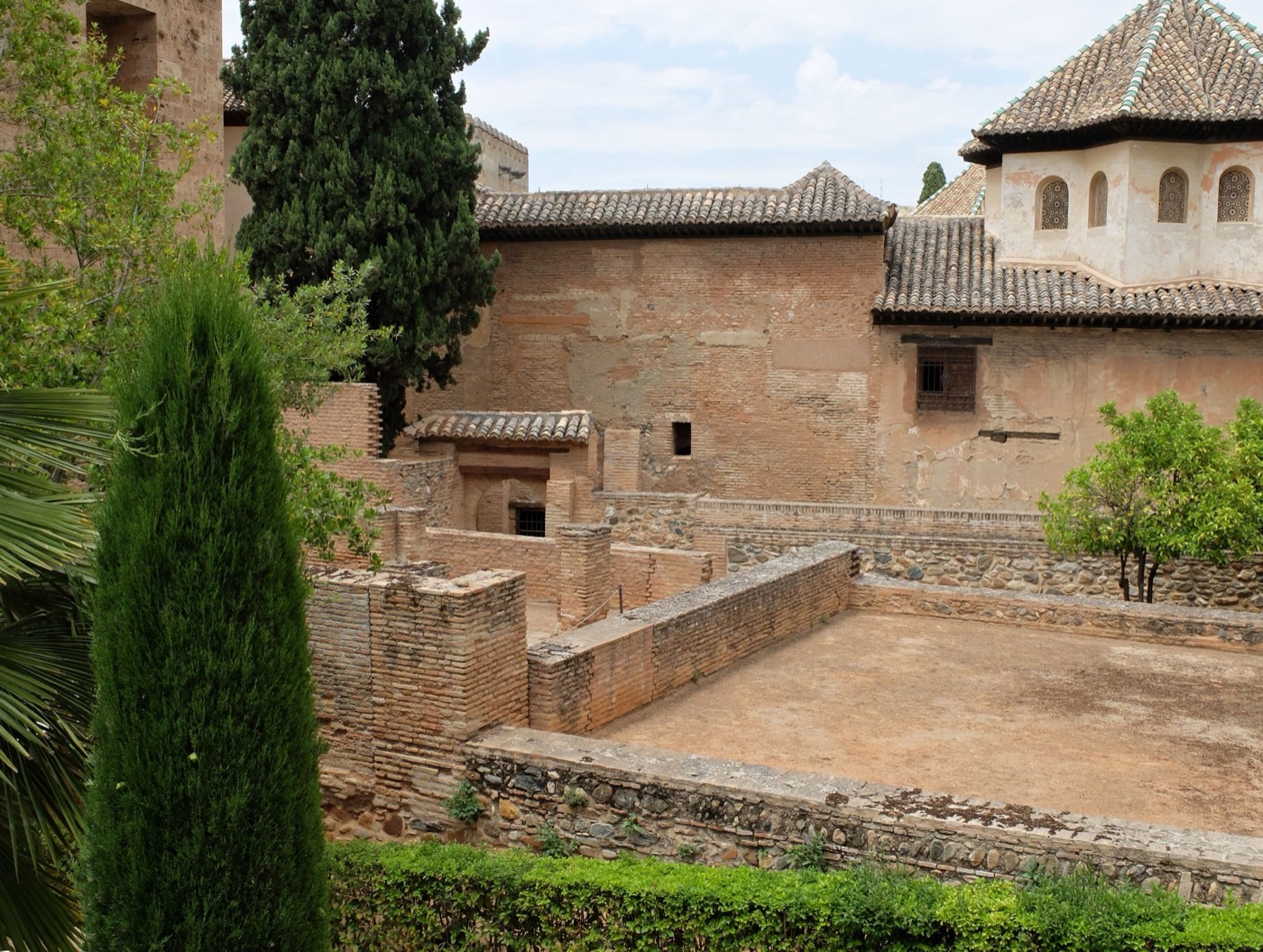
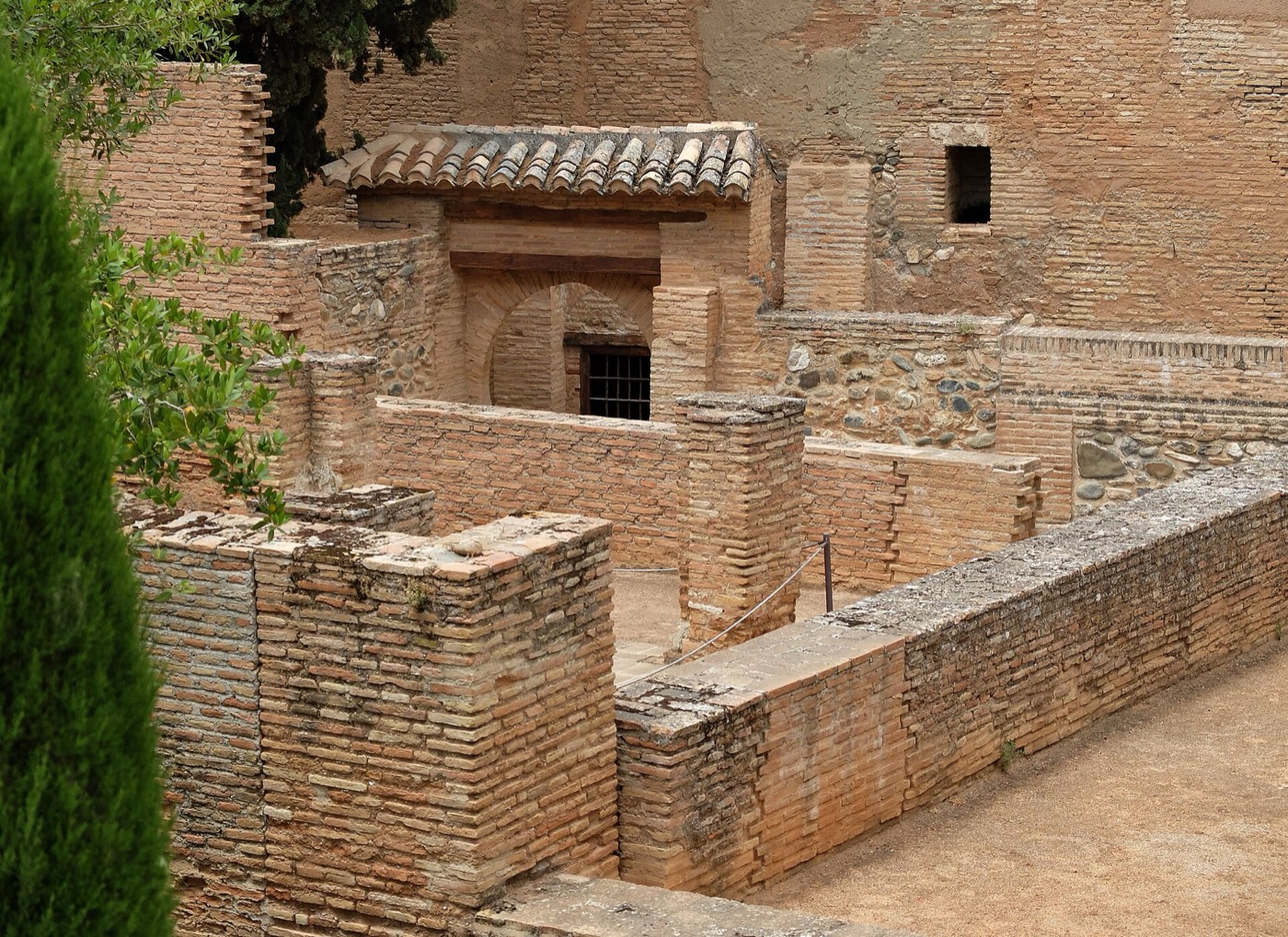
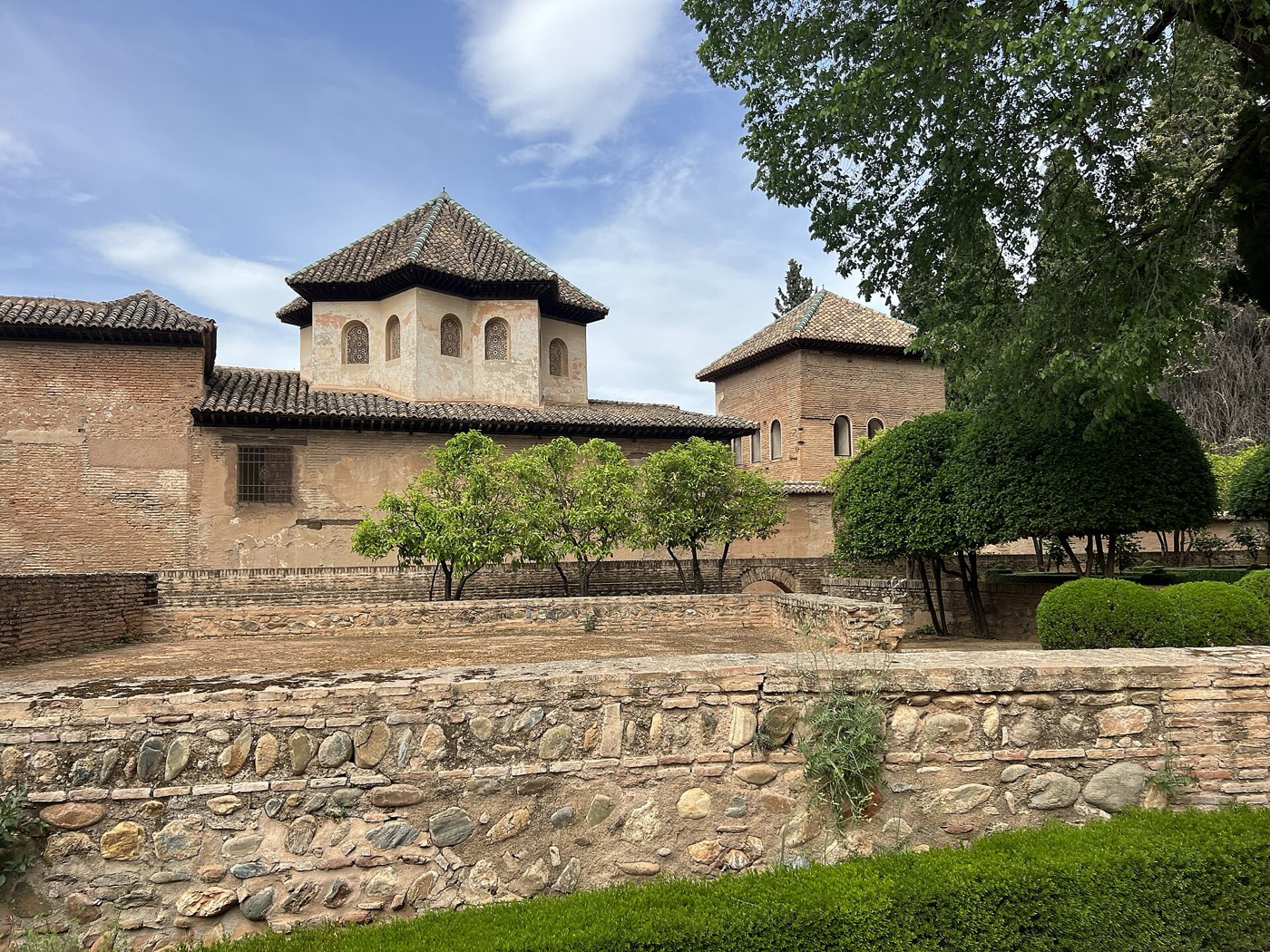
The Rauda lies behind the Palace of the Lions, north-west of the former Great Mosque of the Alhambra, and is separated from the royal palace by the street called Calle Real Baja1,7. It is a rectangular complex aligned south-east to north-west1. From the street, a slightly pointed, scalloped horseshoe arch with brick sebka panels in the spandrels opens into a small vestibule1. At the centre is a square space, probably a qubba open at the sides and covered by a dome, with three graves below floor level; at the north-west end three openings lead into three rooms, the middle one with two graves and the side ones with one each1. This main sector measures about 13.30 by 10.30 m and is built of brick on a rubble-stone base2.
Thick beds of gypsum mortar on the inner faces of the pillars once held the tile mosaic that decorated the qubba, and in 2000 the imprints of its star-shaped pieces were still clear on one of them2. The graves here are rectangular pits with brick sides, rendered inside, with a ledge around the top to take a grave slab2. When Contreras demolished a house behind the Palace of the Lions, he exposed four grave pits, tile dados, fragments of carved plaster and a lattice screen2. South-east of the mausoleum lies a square enclosure that the Patronato calls garden-like; its walls are of river cobbles in bands between brick courses, and its graves are grouped in twos and threes, perhaps by family1,2. Álvarez García, the archaeologist who monitored the 1999-2000 works, counts the Rauda among the few examples of this kind of Islamic funerary architecture in the Iberian Peninsula2. UNESCO describes the Alhambra itself as the only preserved palatine city of the Islamic period9.
Intérieur
The Rauda has no roofed interior today: the dome is lost, and what remains are walls and brick pillars, partly rebuilt by Torres Balbás in 1925-1926 and consolidated again in 1999-20001,2. After the 1999-2000 works the site was again entered through its original gate on Calle Real Baja; the small gabled roof over the arch and its two stone steps date from Torres Balbás's restoration1,2. Those works also marked on the ground the three graves in the central space that, by their position, seem to be of the highest rank, and left visible the graves in the north-west rooms1,2. All the graves were found empty except one, whose skeleton, not laid out in the Islamic manner, may date from soon after the conquest1,2. Some of the royal tombstones, not all inscribed, are kept in the Museo de la Alhambra in the Palace of Charles V, which has shown them in its Room VI; one marble headstone is just over 170 cm long1,3,4. Of the four royal stones found in 1574, Carmen Barceló (2020) counts three that survive: those of Muhammad II and Yusuf III in the Museo de la Alhambra, and a white marble fragment of Yusuf I's, which she traced to the Museo Arqueológico Nacional in Madrid5.
À observer
- The gate on Calle Real Baja: a scalloped horseshoe arch with brick sebka panels in its spandrels1.
- The square central space, probably once a domed qubba, with three graves below floor level1.
- Gypsum mortar on the pillars, which in 2000 still bore imprints of star-shaped tiles from the lost tile mosaic2.
- The south-east court with river-cobble walls, its graves grouped in twos and threes1,2.
- Tombstones from the Rauda in the Museo de la Alhambra, among them a marble headstone just over 170 cm long1,3.
Visite
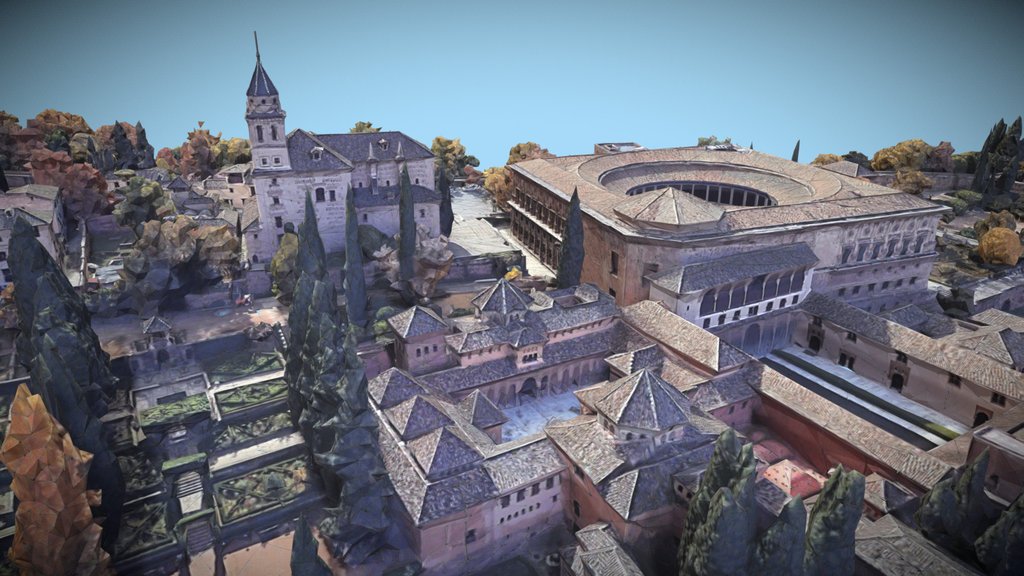
- The Rauda lies on Calle Real Baja, behind the Palace of the Lions, between the church of Santa María, the Palace of Charles V and the Partal2,7,8.
- The royal tombstones are not on site: some are kept in the Museo de la Alhambra, in the Palace of Charles V, and a fragment of Yusuf I's is in the Museo Arqueológico Nacional in Madrid1,3,5.
- Facing the cemetery stands the Puerta de la Rauda, a quadrangular pavilion with a ribbed dome joined to the Palace of the Lions; it is a separate building, named after the cemetery because it stands close to it7,8.
Informations officielles: Patronato de la Alhambra y Generalife (Council of the Alhambra and the Generalife), the autonomous body that UNESCO names as administrator of the propertyItinéraireOuvrir dans OpenStreetMapVisites guidées : Grenade