Cette partie n’a pas encore été traduite ; elle est donc affichée en anglais.
Histoire
Uzgen lies on the right bank of the Kara Darya, on the eastern edge of the Fergana Valley4,5. After the Karakhanid ruler Nasr ibn Ali took Bukhara in 999 and ended Samanid rule, Uzgen became the administrative centre of Fergana, and captive Samanid princes were held there4,12. According to TDV, the sources describe it as the first capital of the Western Karakhanid state in 1046-474. In 1141 Fergana came under Qara Khitai overlordship, but a Karakhanid khanate centred on Uzgen lasted until 12124,5. The three tombs stand in a row on a necropolis in the eastern part of the town’s fourth shahristan (walled inner town)1.
Archnet and TDV date the middle tomb to about 1012-13 and link it to Nasr ibn Ali; UNESCO’s tentative-list text dates the earliest tomb to the turn of the 11th and 12th centuries1,3,4. The northern tomb (547 AH, 1152-53) is associated with Jalal al-Dunya wa’l-Din al-Husayn; the occupant of the southern one (582 AH, 1186-87) is unknown to Archnet, and TDV suggests al-Husayn’s grandson Muhammad ibn Nasr3,4,8. UNESCO’s tentative-list text says inscriptions show that Karakhanids of the Uzgen branch and their commanders lie in the northern and southern tombs1. A 2023 archaeoseismological study proposes that two strong earthquakes, the first apparently between 1152 and 1187, damaged the northern and southern tombs and wrecked the middle one7.
Architecture
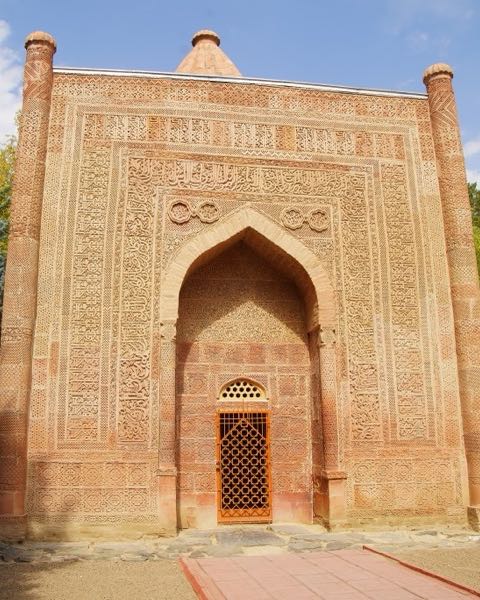
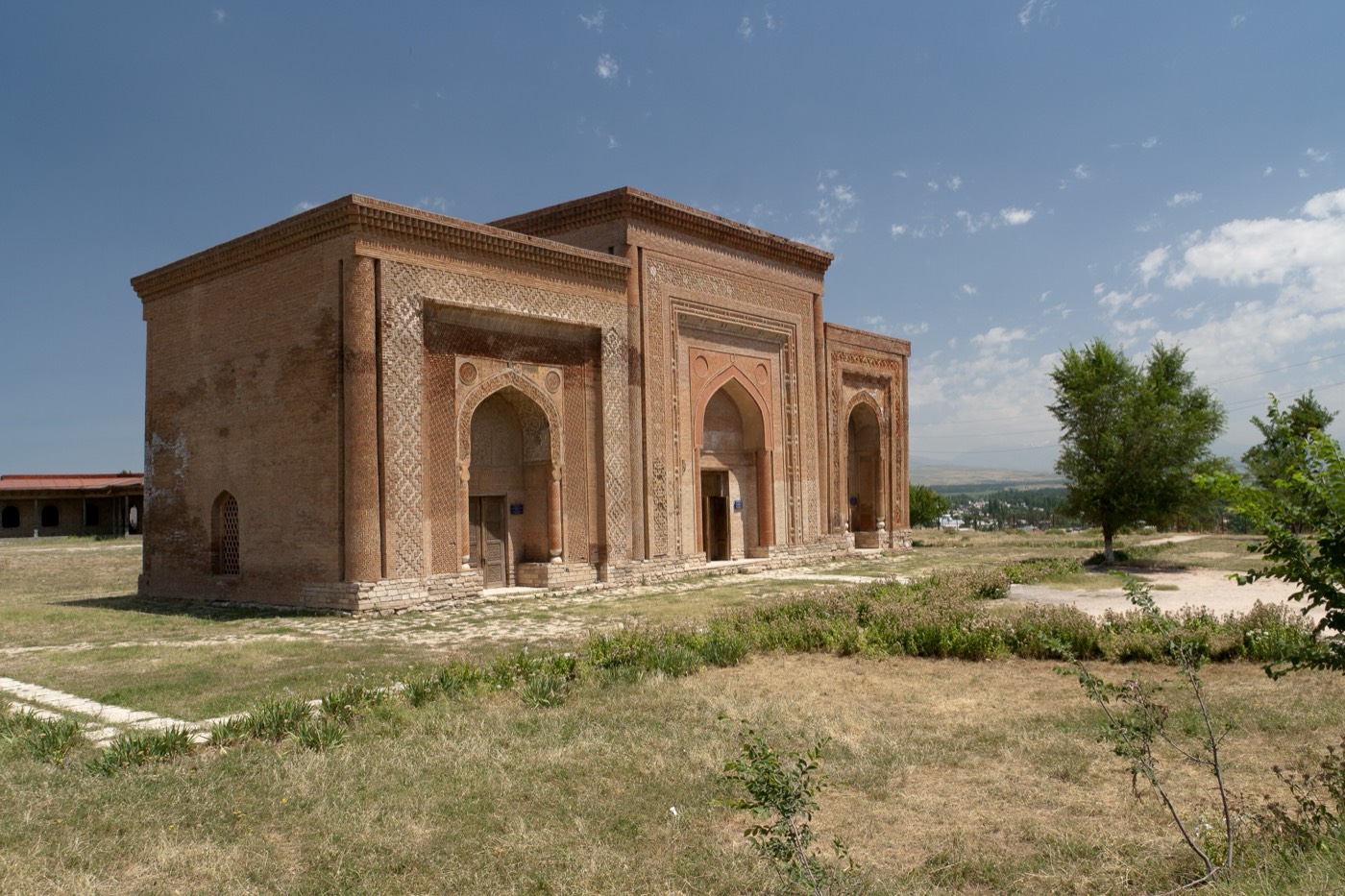
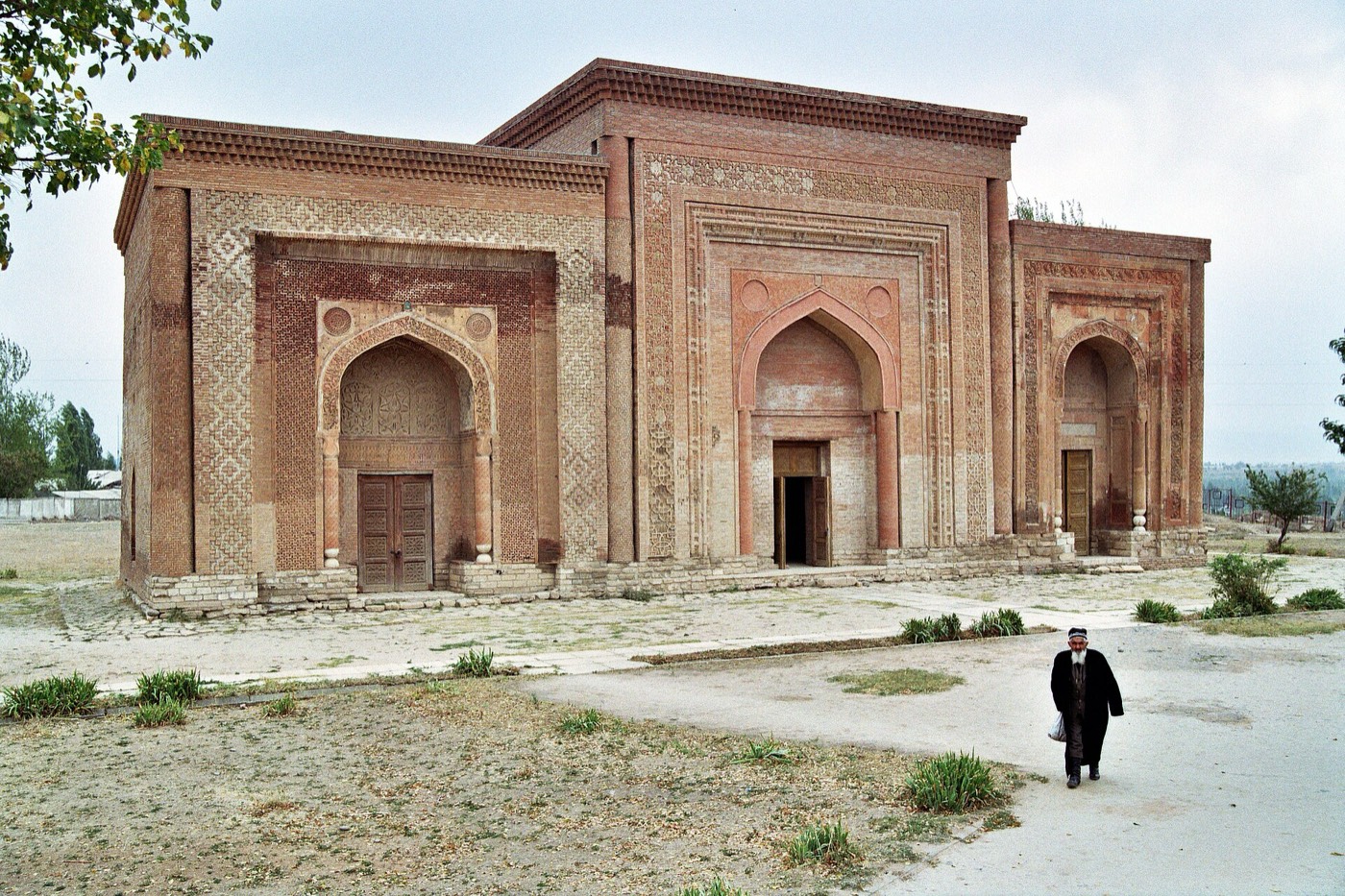
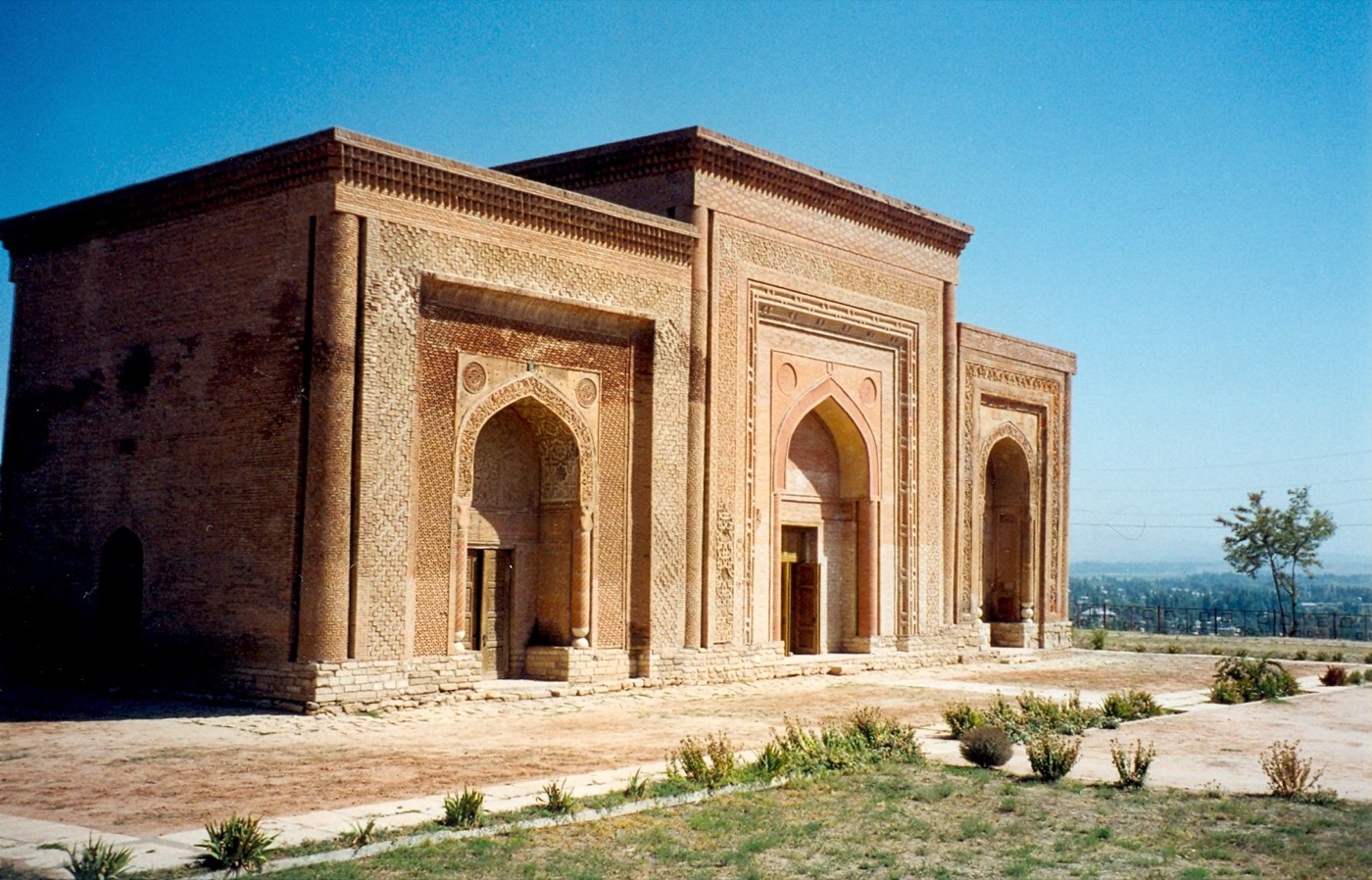
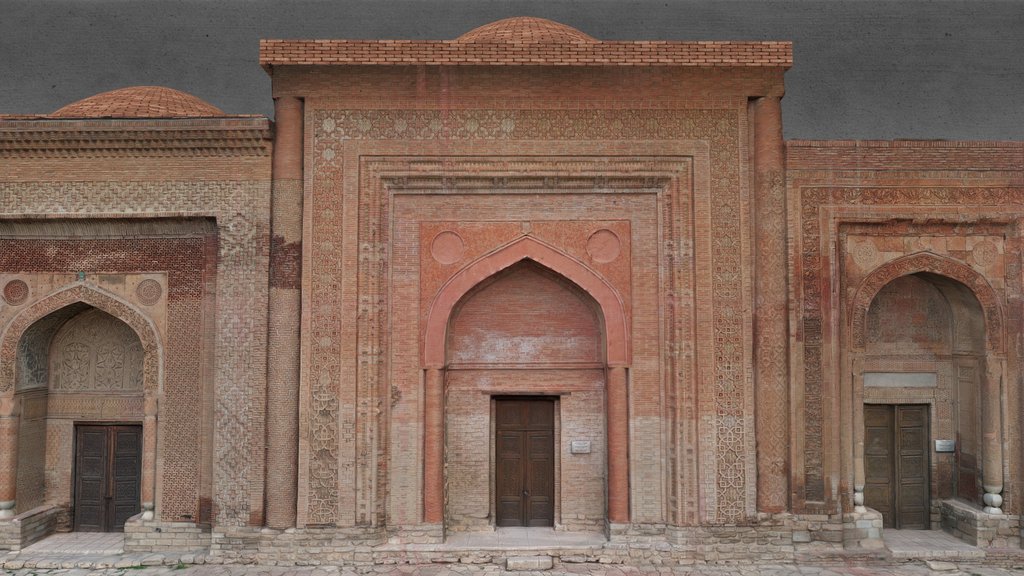
The tombs stand side by side on a north-south line, each a square domed chamber of fired brick behind a large portal facing west1,3. Their façades carry carved brick, terracotta (some of it incised) and carved plaster, with wide inscription bands in Kufic, naskh and thuluth scripts set among plant ornament1,3. On the façade of the middle tomb, Archnet sees early versions of the patterns known as girih3. UNESCO’s tentative-list text calls the decoration an “encyclopedia of ornament” of the Karakhanid era and the group “a model of evolution of architecture in premongolian period”1.
The middle tomb, the largest according to Archnet, is roofed by a dome on squinches, and its front portal carries dense geometric and plant ornament in carved plaster, an emphasis that Archnet calls new at the time3,4. The northern tomb measures 10.2 by 12.2 m outside; lozenge-patterned brick colonnettes frame its portal, and incised terracotta covers the flanking columns, the inside of the portal and the underside of its arch3. The southern tomb is the smallest, and Archnet calls it the most ornate: its portal combines naskh and Kufic panels with stars, crosses and floral motifs, among them a winding vine3. The Center for Museum Initiatives, funded by the U.S. Ambassadors Fund for Cultural Preservation, began conserving the roof of a twelfth-century Karakhanid mausoleum at Uzgen in September 2015 and completed it by October 20199.
Intérieur
Each tomb is a square domed room behind a west-facing portal3. Archnet describes the room of the middle tomb as largely ruined, with doorways on three sides and a niche on the fourth, and notes carved plaques and inscription friezes inside it, some with pre-Islamic motifs3. Its dome rests on squinches, arches set across the corners of the square room4. According to a 2023 archaeoseismological study, an earthquake wrecked the middle tomb, which was later heavily renovated; the upper part of the northern tomb was shifted south off its base, and the south-west wall of the southern one is ruptured7.
À observer
- Naskh and Kufic panels, stars, crosses and a winding vine on the southern tomb’s portal3.
- Wide inscription bands in Kufic, naskh and thuluth scripts across the façades1.
- Early forms of girih patterns on the middle tomb’s façade, as Archnet describes them3.
- The lozenge-patterned brick colonnettes and incised terracotta of the northern tomb’s portal3.
- The brick minaret to the north-west, dated by UNESCO’s tentative-list text to the mid-11th century1.
Visite
- The tombs belong to the Uzgen archaeological and architectural complex, which is on Kyrgyzstan’s UNESCO Tentative List within “Silk Roads Sites in Kyrgyzstan” (2010) and “Silk Roads: Fergana-Syr Darya Corridor” (2025)1,2.
- UNESCO’s 2010 tentative-list text names the Sulaiman-Too museum complex as the body responsible for it1. According to reports by the 24.kg news agency, the Cabinet of Ministers created the Ozgon museum-reserve in 2022 to take over from Sulaiman-Too, and a 2025 amendment placed the three tombs, the minaret and parts of the old town under it10,11.
- The minaret stands to the north-west of the tombs1.
Informations officielles: Uzgen State Historical and Cultural Museum-Reserve (“Ozgon”), set up by Kyrgyzstan’s Cabinet of Ministers in 2022ItinéraireOuvrir dans OpenStreetMapVisites guidées : Ouzgen