Esta parte ainda não foi traduzida, por isso aparece em inglês.
História
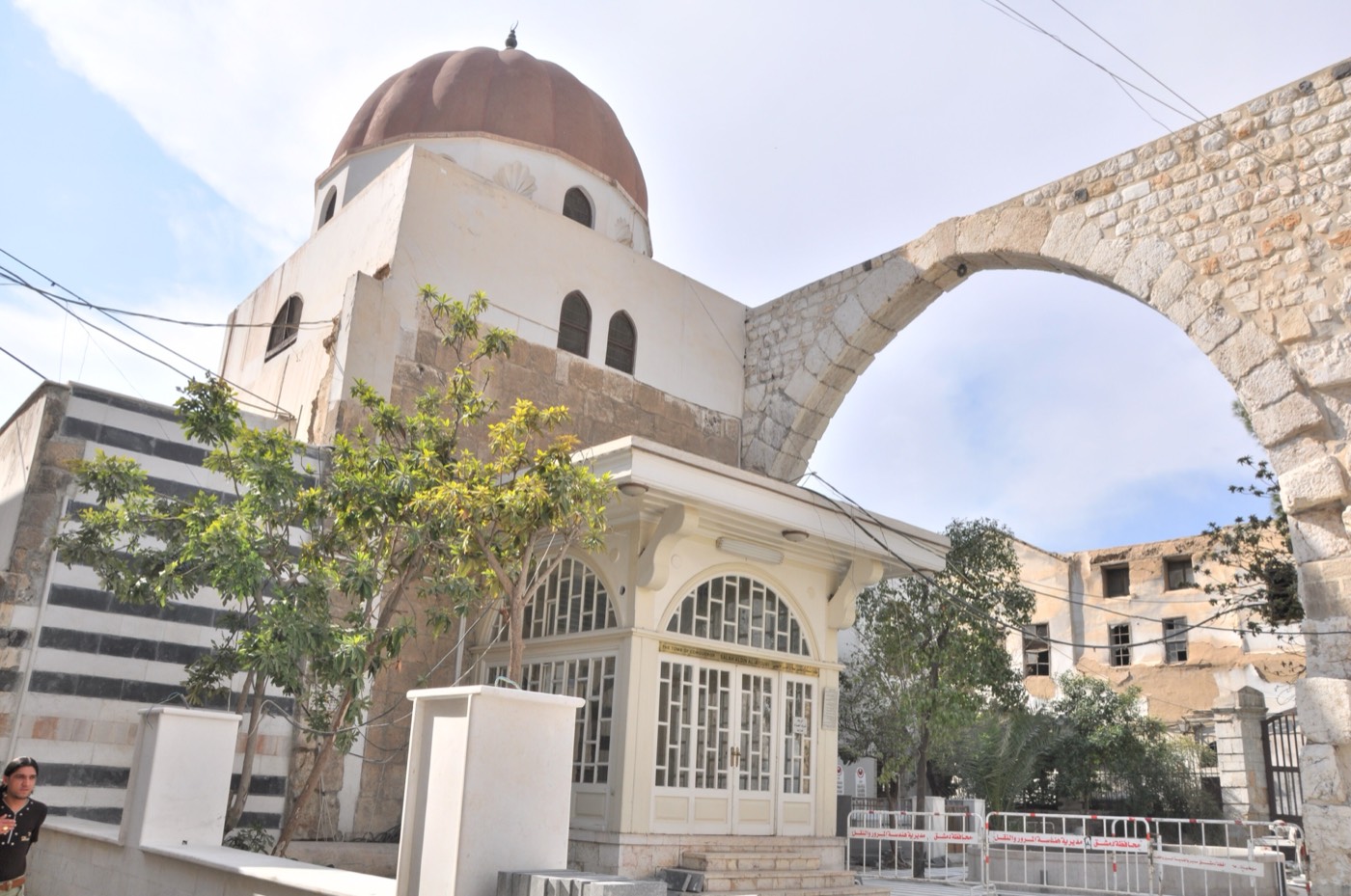
Saladin (Salah al-Din Yusuf ibn Ayyub) declared the end of the Fatimid caliphate and founded the Ayyubid sultanate in 11716. He died in 1193 and was first buried in the Citadel of Damascus2. His son al-Malik al-Afdal Nur al-Din 'Ali, then ruler of Damascus, built a mausoleum for him facing the north wall of the Umayyad Mosque, and the body was moved there on the holy day of 'Ashura in 592 AH (1195)2. These events are known from the eyewitness account of Saladin’s confidant 'Imad al-Din al-Isfahani (d. 1201)2. Soon afterwards another son, al-Malik al-'Aziz 'Uthman, ruler of Egypt, attached a madrasa to the tomb, the Madrasa al-'Aziziyya2.
Blue and green Ottoman tiles of the 17th century were later added to its walls2. In November 1898 the German emperor Wilhelm II visited the tomb during a state visit to the Ottoman Empire4. A photographer’s caption in the Syrian Heritage Archive Project, Berlin, says the tomb had been badly neglected until Wilhelm had it restored, as an inscription in the chamber records3. A gilt bronze wreath placed on the tomb during that visit was removed in 1918 and given to the Imperial War Museum in London4,5. UNESCO inscribed the walled city around it in 1979 and placed it on the List of World Heritage in Danger in 20131.
Arquitetura
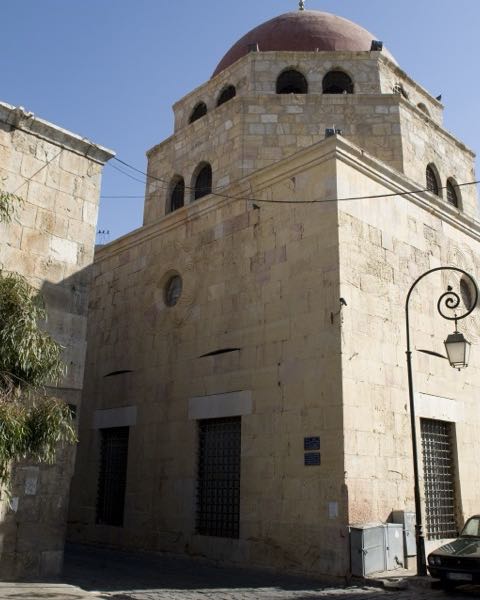
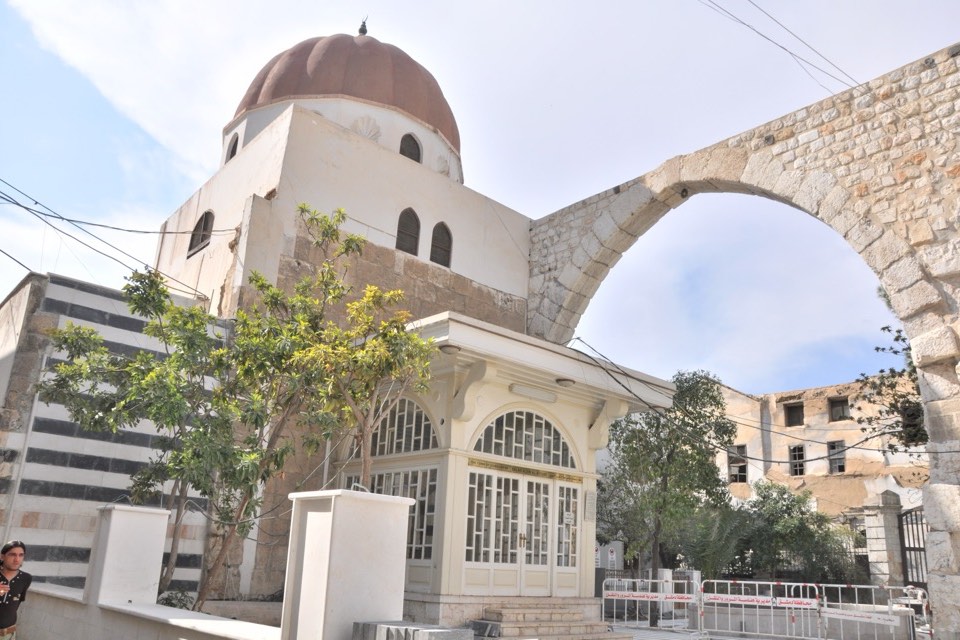
The mausoleum follows the usual Damascene type: a square chamber with ablaq walls, in alternating light and dark stone, and four arches that carry a dome2. The transition from the square to the dome is made by a drum in two stages, first octagonal and then sixteen-sided2. Little of the original exterior survives, and little remains of the Madrasa al-'Aziziyya that adjoined the tomb2.
Interior
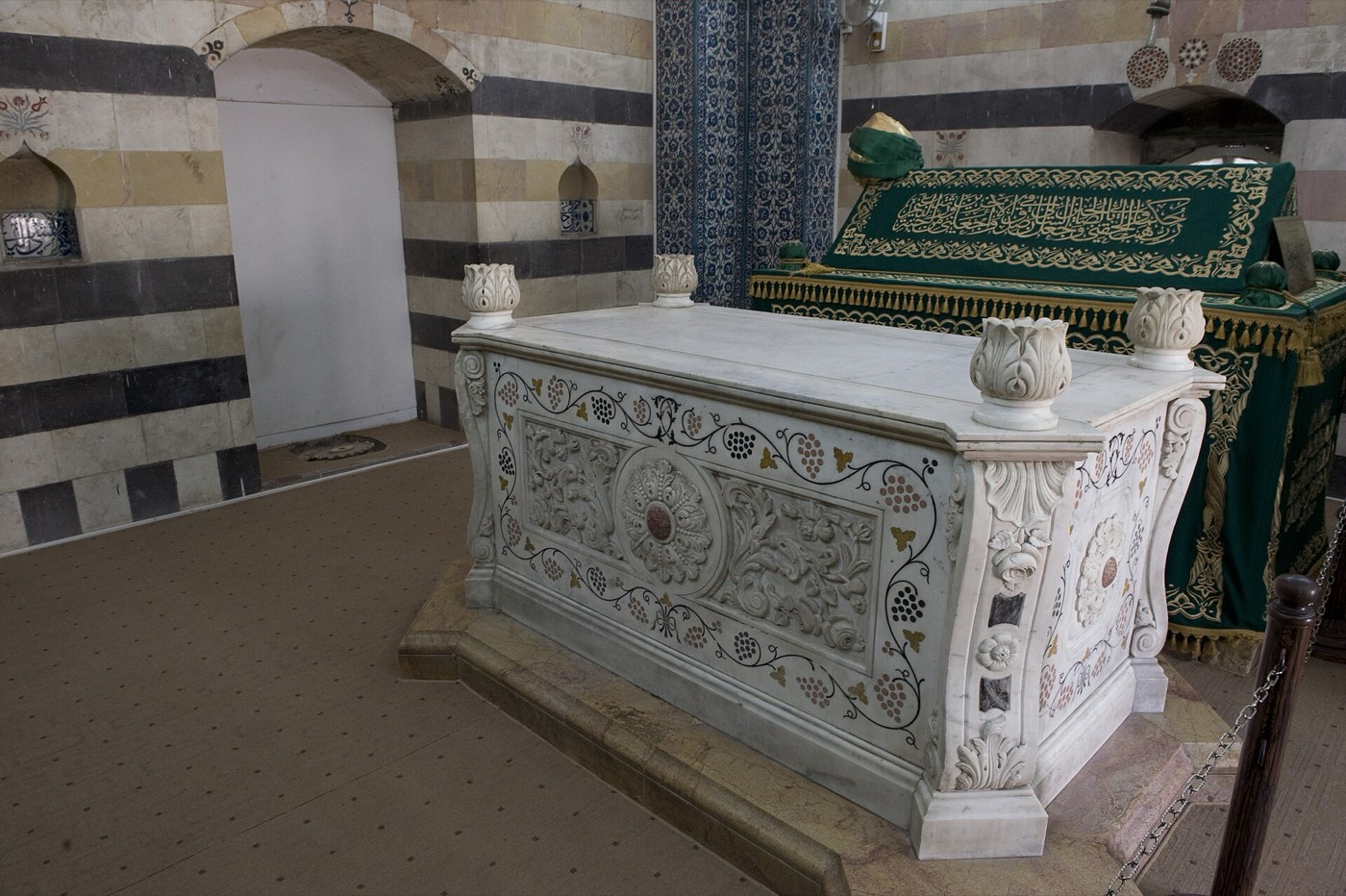
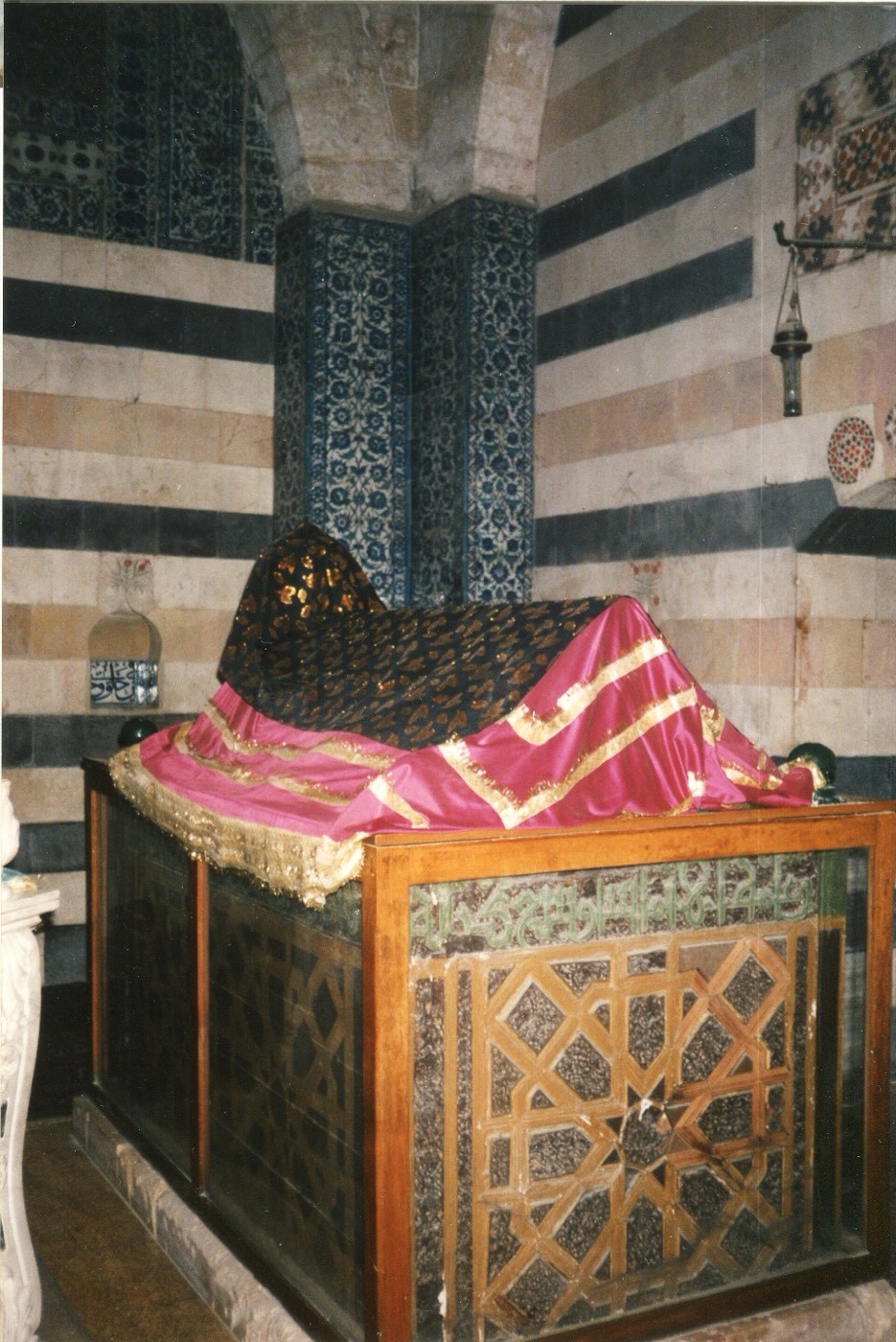
The domed tomb chamber, in the south-west corner of the building, has walls of striped ablaq stone with blue and green Ottoman tiles of the 17th century2. Two cenotaphs stand side by side in the middle2. The original Ayyubid one is of wood, carved with geometric, star-shaped, floral and vegetal patterns, and is largely hidden under covers2,3. Beside it stands a white marble cenotaph of disputed origin2,3,4. Discover Islamic Art calls it a gift of Wilhelm II on a visit it dates to 1903, and a Syrian Heritage Archive record says he gave it during his journey of 18982,3. The historian Jonathan Phillips instead describes a recent Ottoman marble shrine of 1878 that was already in place when the emperor came4.
O que observar
- The original Ayyubid wooden cenotaph, carved with geometric, star and plant patterns2.
- The white marble cenotaph beside it, of disputed origin: Wilhelm II’s gift or an Ottoman work of 18782,3,4.
- The blue and green Ottoman tiles of the 17th century on the chamber walls2.
- The dome set on a two-stage drum, octagonal then sixteen-sided2.
- The inscription that, according to a Syrian Heritage Archive record, commemorates Wilhelm II’s restoration of 18983.
Visita
- The mausoleum stands beside the north-western corner of the Umayyad Mosque, facing its north wall2.
- It lies inside the old city walls, which form the boundary of the World Heritage property1.
- The wooden cenotaph is largely hidden under covers; the white marble one stands beside it3.
Informações oficiais: Syria’s Directorate-General of Antiquities and Museums (DGAM), which shares responsibility for the old city with the Commission for Safeguarding the Old Town (as described by UNESCO)Como chegarAbrir no OpenStreetMapVisitas guiadas: Damasco