Esta parte ainda não foi traduzida, por isso aparece em inglês.
História
Jahangir, who reigned from 1605, died in late 1627 near Rajauri while travelling from Kashmir back to Lahore6,7. His body was brought to Shahdara, across the Ravi from Lahore, and buried in the Bagh-i Dilkusha, a walled garden belonging to his wife Nur Jahan3,5,6. The World Monuments Fund (WMF) says the emperor, a lover of nature, had wished to be buried there4. Shah Jahan's court historian Abd al-Hamid Lahauri records that Shah Jahan built the tomb as his father wished, for an orthodox Sunni burial, over ten years and for ten lakh (one million) rupees6. The historian Mehreen Chida-Razvi argues that Nur Jahan also had a strong part in its design and funding6.
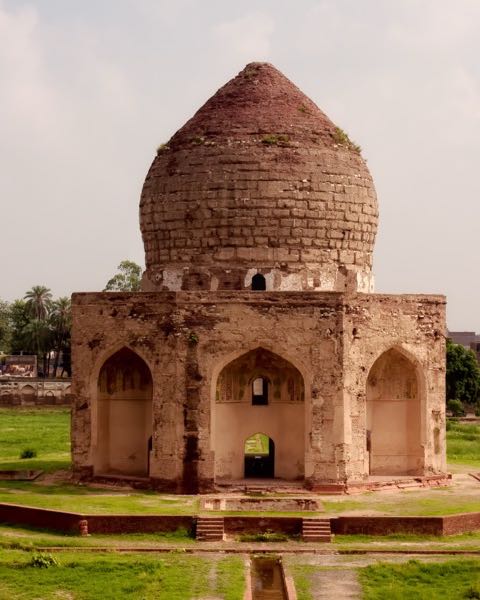
The tomb was completed in 16373,4. Shahdara became a royal burial ground: Asif Khan, Nur Jahan's brother and Shah Jahan's father-in-law, died in 1641 and was buried nearby in a tomb built by Shah Jahan, and Nur Jahan was buried in her own tomb there in 16453,6. Between Jahangir's tomb and Asif Khan's lies the Akbari Sarai, which Lahauri called the court attached to the tomb1,3. Under Sikh rule much of the decoration and the marble railing of the roof were stripped3. The Ravi washed away part of the site in the 19th century and flooded the tomb for days in 19884. In 2022 the WMF placed it on its World Monuments Watch4.
Arquitetura
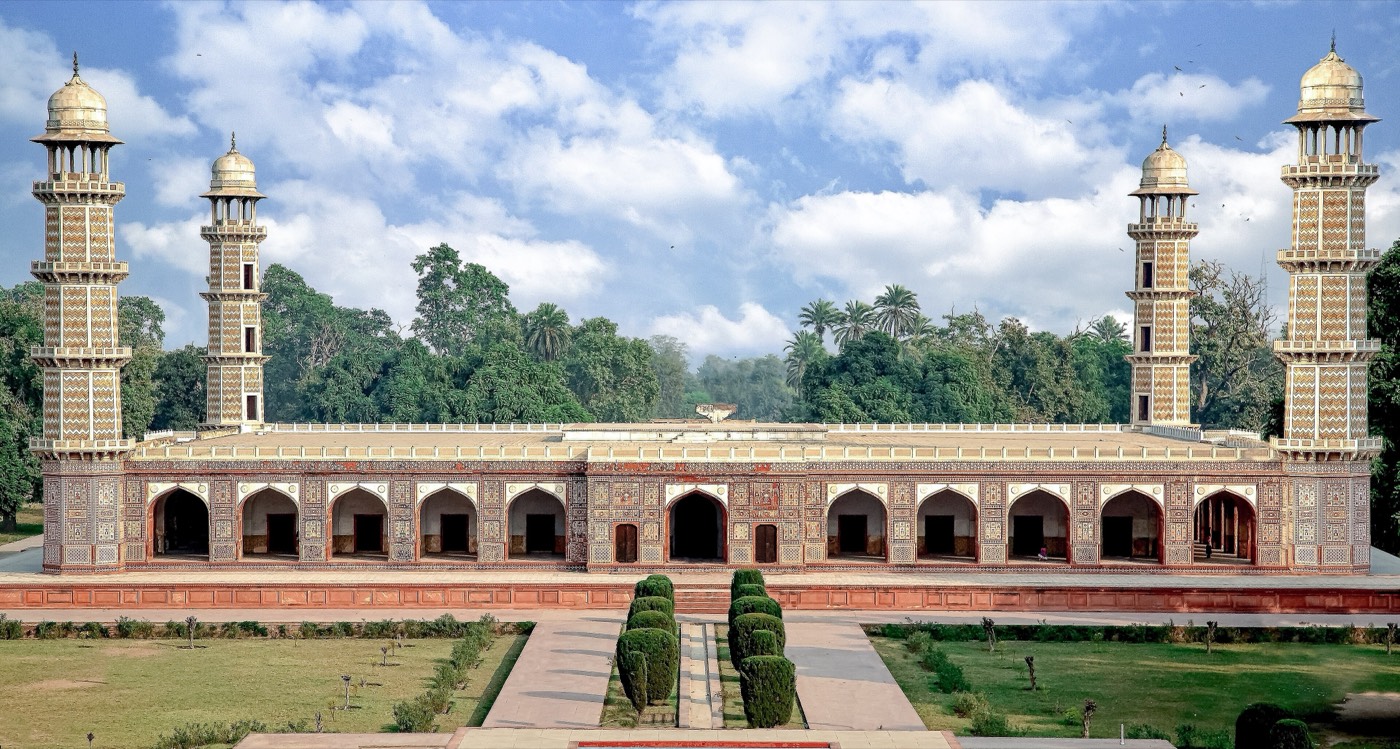
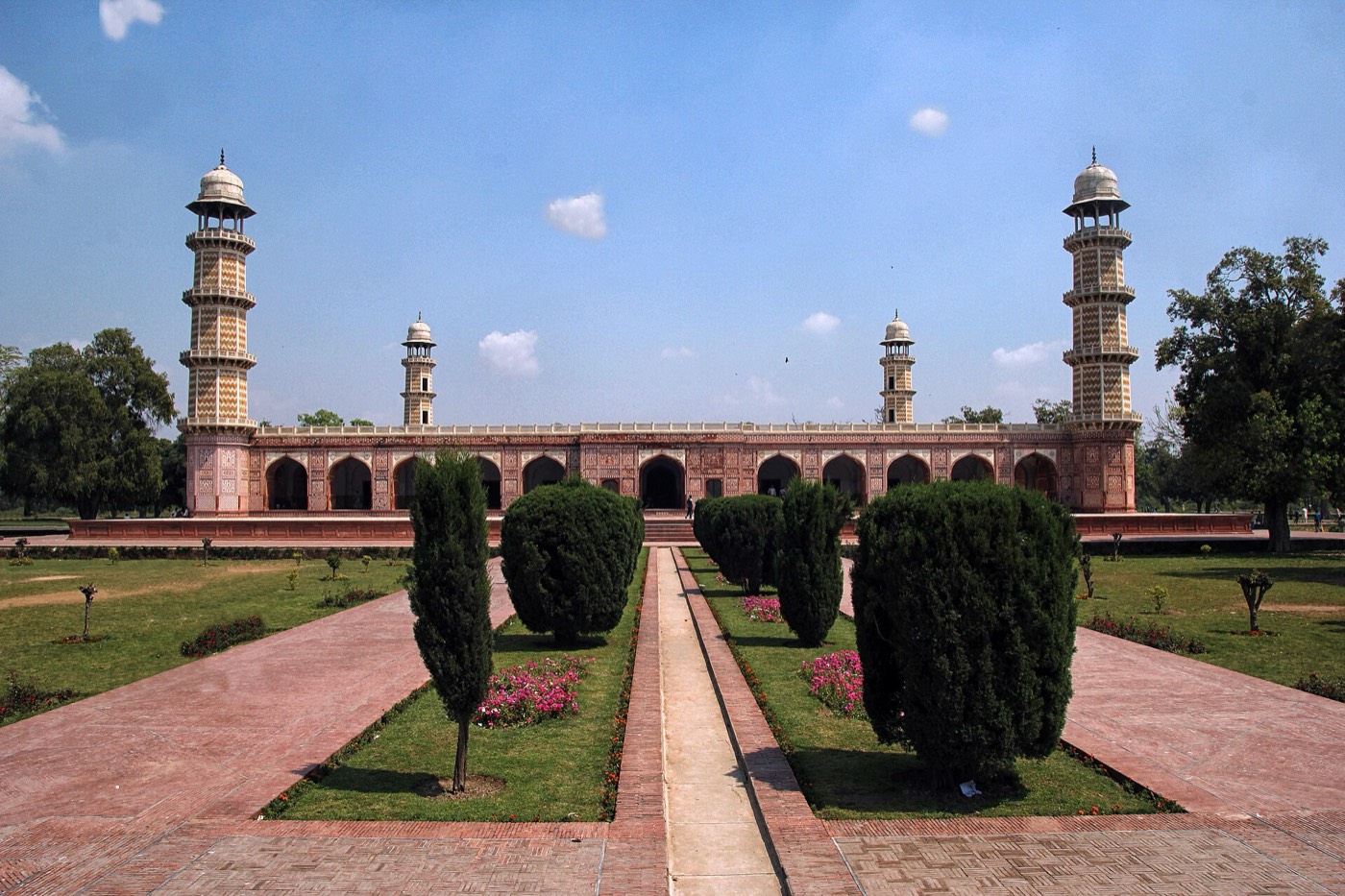
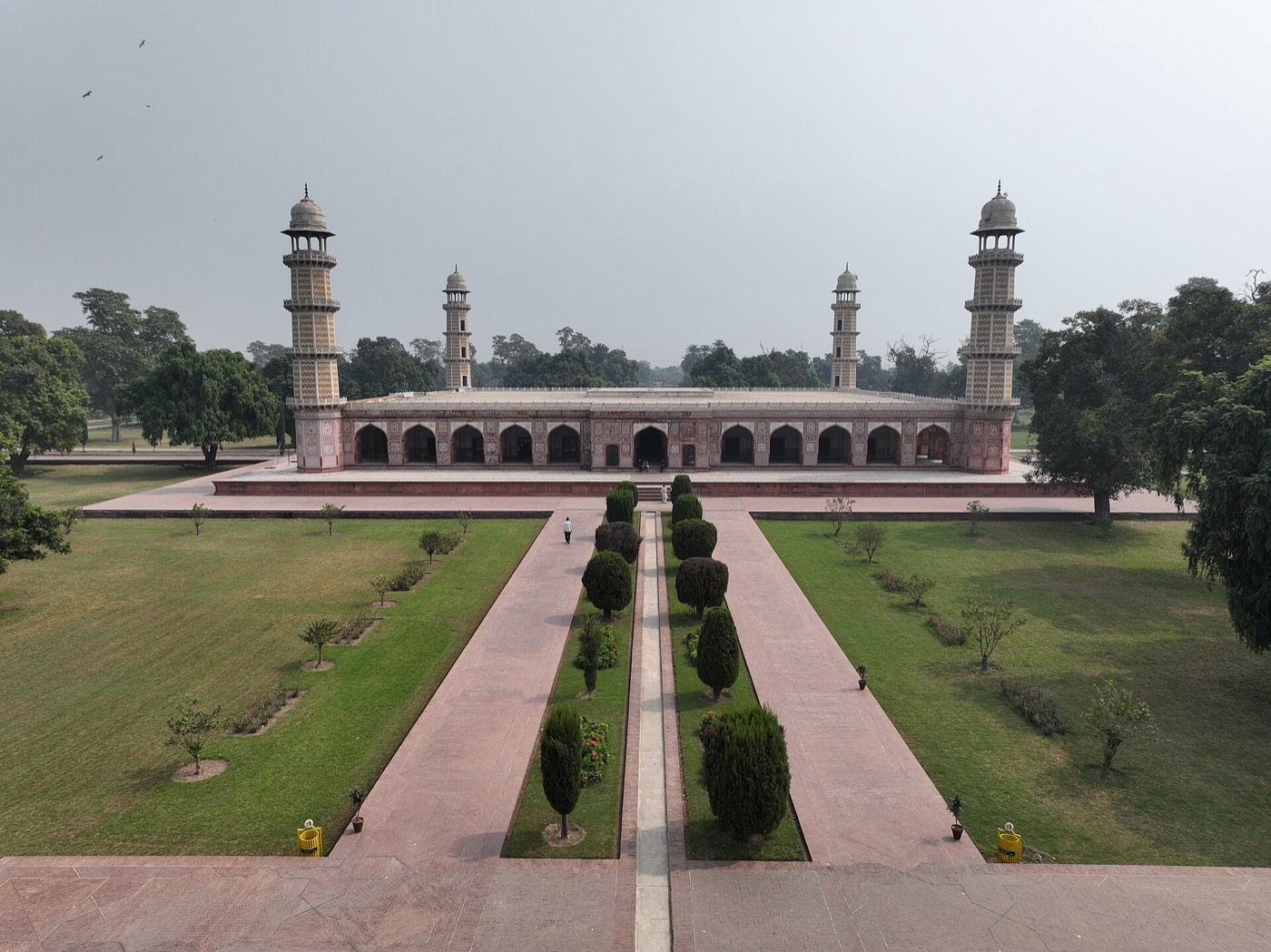
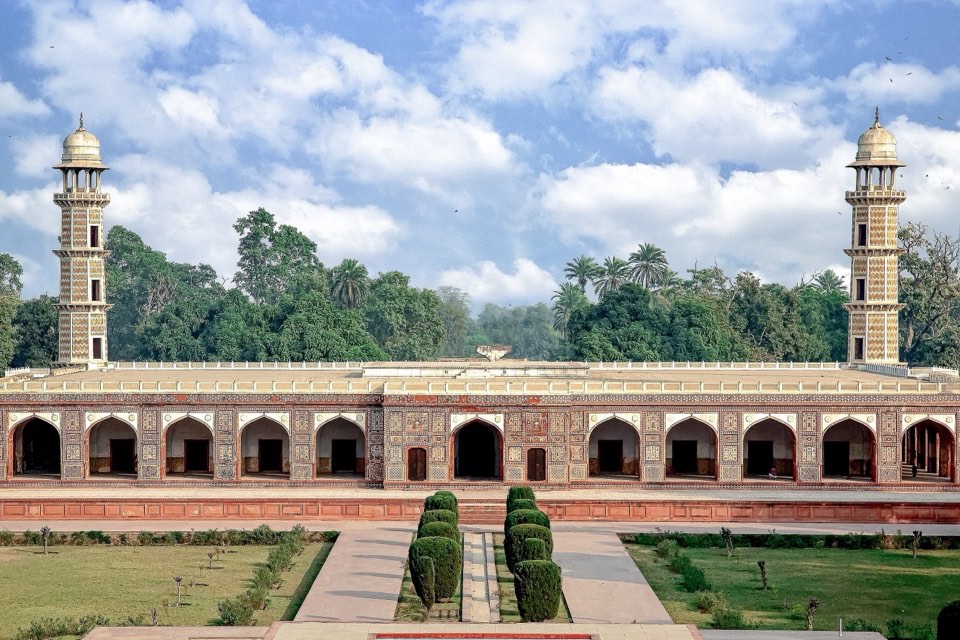
The tomb is a single-storey square platform tomb (takhtgah), 81.3 m on each side, with an arcaded verandah round all four sides and a projecting entrance bay in the middle of each1,2,6. Four octagonal minarets stand at the corners; they rise in five stages to about 100 ft (30 m) and end in white marble cupolas1,5. The facades are faced with red sandstone from Sikri and inlaid with white marble panels and motifs1,4,5. The minaret shafts carry zigzag bands of marble, white and yellow in UNESCO's description and pink and white in Archnet's1,5. Chida-Razvi notes that this platform-tomb type was favoured by Jahangir and Nur Jahan, and that his is the largest of them6.
The tomb stands at the centre of a walled charbagh of about 55 acres, divided into quarters, and each quarter again into four, by water channels and paved walks with fountains where they cross4,5. Water raised from wells outside the walls ran in channels built into the tops of the enclosure walls and flowed down by gravity to the fountains4. Chida-Razvi notes that the building is incomplete today: an upper storey on the roof terrace once held the emperor's cenotaph within some form of pierced railing6. Archnet describes the surviving platform with remains of a marble screen and traces of a second cenotaph, and records the belief that Jahangir, like Babur, wanted his tomb open to the sky5.
Interior
From the middle of each side a long vaulted corridor leads to the central burial chamber2,3,5. The ceilings and walls of these bays are painted with floral frescoes, the lower walls carry tile mosaic, and the floors are laid with cut pieces of different stones, including black and white marble1,3. In the chamber a white marble cenotaph on a platform marks the grave below3,4,5. It is inlaid with precious and semi-precious stones in floral designs, and its black inscriptions give the 99 names of God and the date of Jahangir's death1,3,5.
O que observar
- The four minarets, rising in five stages with zigzag white and yellow marble and white marble cupolas1.
- The white marble cenotaph inlaid with flowers, the 99 names of God and Jahangir's death date1,5.
- Floral frescoes and tile mosaic in the vaulted corridors leading to the burial chamber1,3.
- Red Sikri sandstone facades inlaid with white marble panels and motifs1,4.
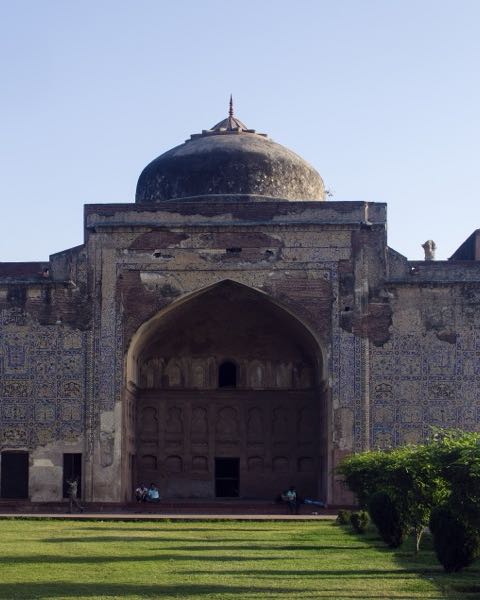
- The Akbari Sarai, with its gateways and three-domed mosque, between the tombs of Jahangir and Asif Khan1.
Visita
- The tomb, the Akbari Sarai and the tomb of Asif Khan have been on Pakistan's tentative list for World Heritage since 14 December 19931.
- The garden is entered through the Akbari Sarai, which also leads to the tomb of Asif Khan4.
- Shahdara lies on the right bank of the Ravi, opposite the city of Lahore3.
Informações oficiais: Government of Punjab, Pakistan: the Punjab Walled Cities & Heritage Areas Authority (PWCA) presents the Shahdara Complex on its official website; the tomb is a protected monument under the Antiquities Act 1975Como chegarAbrir no OpenStreetMapVisitas guiadas: Lahore