Esta parte ainda não foi traduzida, por isso aparece em inglês.
História
Gazi Husrev-beg was born around 1480 in Serres, in present-day Greece; his father Ferhad-beg came from Herzegovina, and his mother, Selçuk Sultan, was a daughter of Sultan Bayezid II1,6,8. He governed the Ottoman Sanjak of Bosnia three times, in 1521-1525, 1526-1534 and 1536-15416,8. Between 1529 and about 1543/1544 his endowment raised close to 300 buildings in Sarajevo, among them the mosque (completed in 1530/1531), a madrasa, a Sufi lodge (khanqah), a public kitchen, a bath, a covered market and inns1. He died on 18 June 1541 and was buried in the tomb in the mosque courtyard; TDV and the Gazi Husrev-beg Library say he died in Sarajevo and had built the tomb in his lifetime5,6,8.
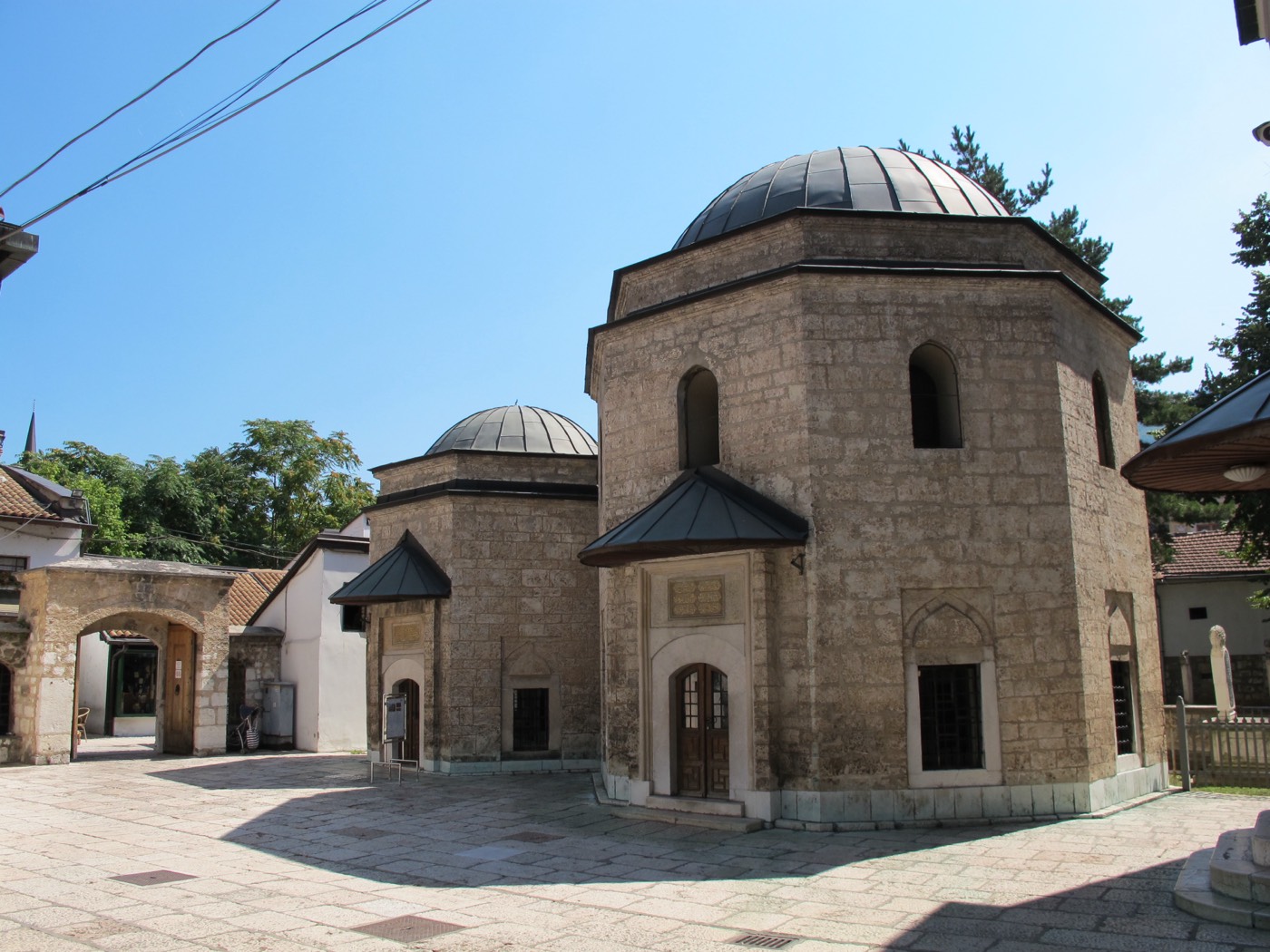
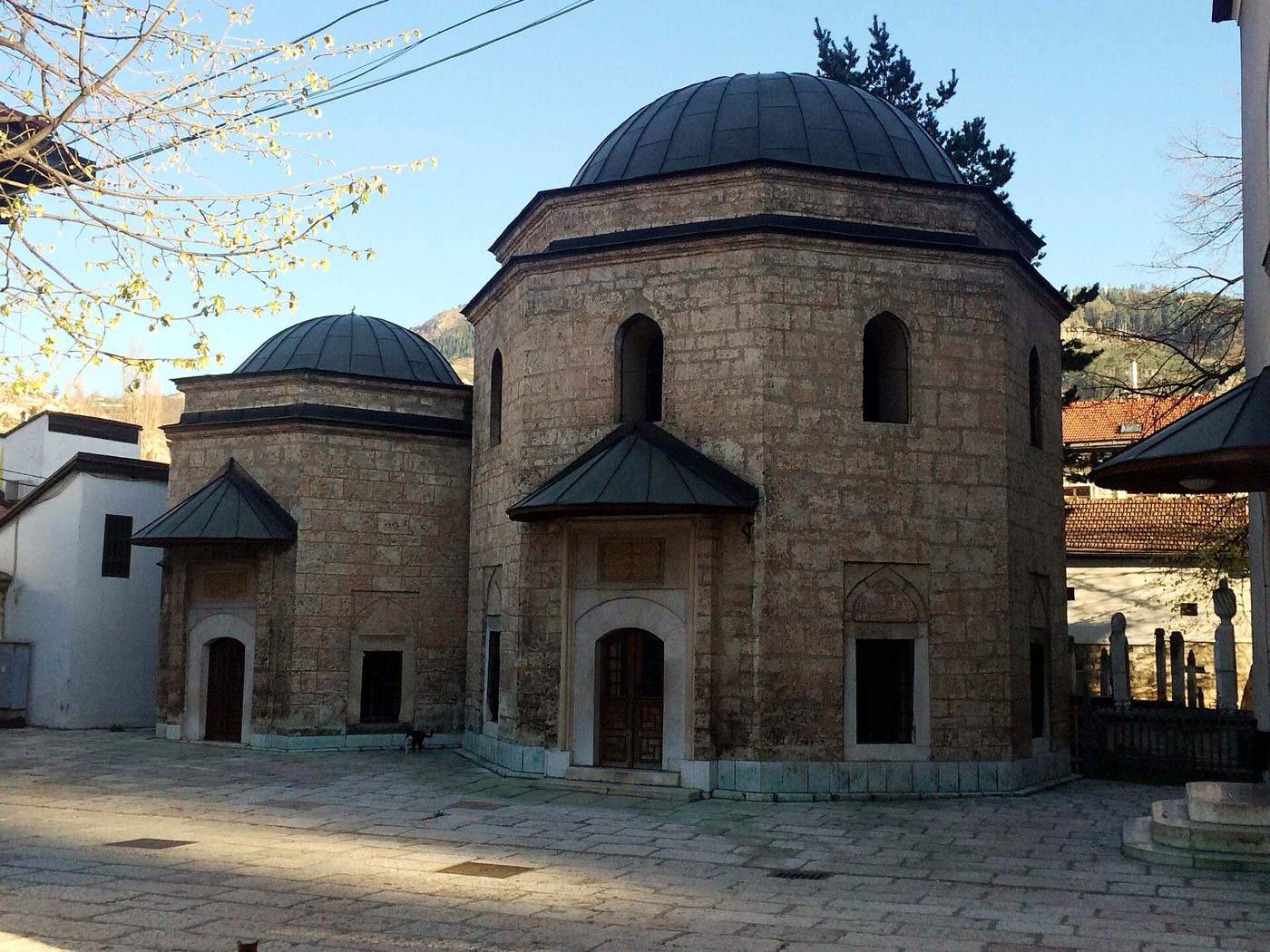
The tomb's Arabic inscription, three couplets in gold on a green ground over the door, ends in a chronogram giving the year of his death, 948 AH (1541)1,4,6. The smaller tomb beside it holds Murat-beg Tardić, his steward (kethüda), governor first of Klis and then of Požega, and the first administrator of the endowment, who died in 952 AH (1545/1546)1,3,4,6. Fires struck the endowment many times, the worst, according to the Commission, in 1697, when Austrian troops under Prince Eugene burned Sarajevo; fires also destroyed the tomb's original wall painting1,7. In 1875 Sultan Abdülaziz sent relics associated with the Prophet Muhammad, which are kept in the tomb1,6. Both tombs were restored and conserved in 20027.
Arquitetura
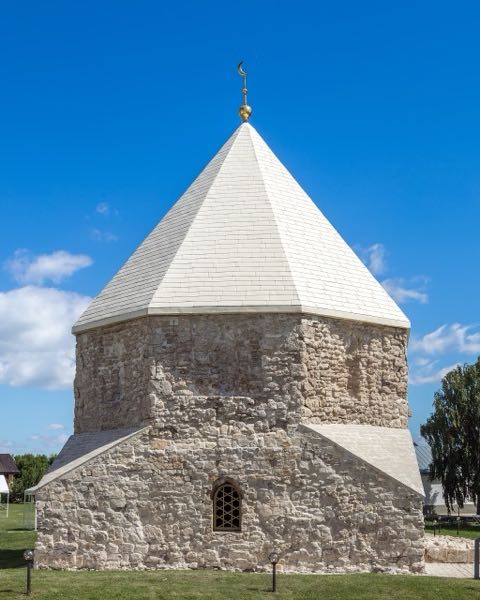
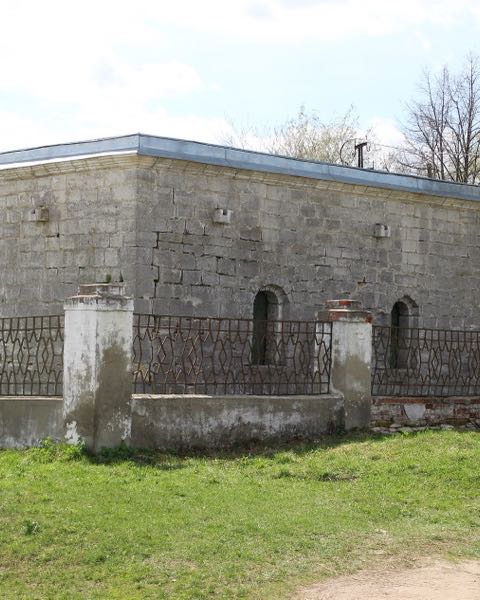
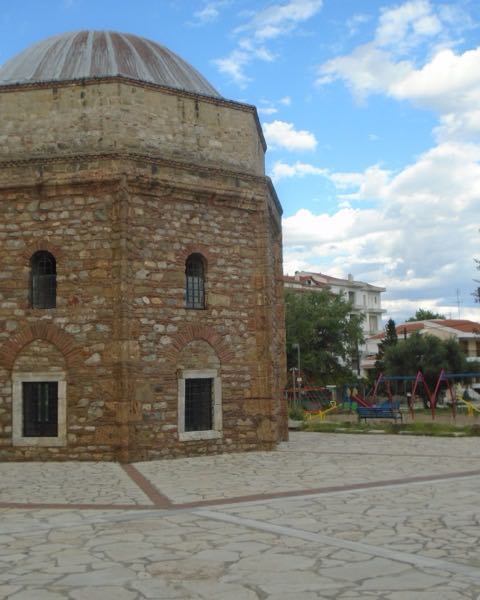
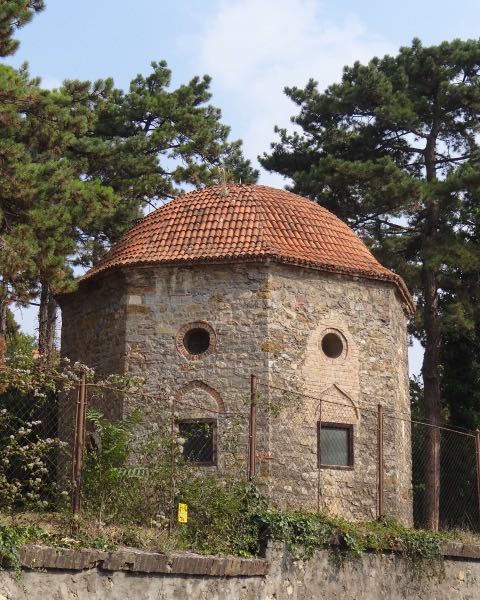
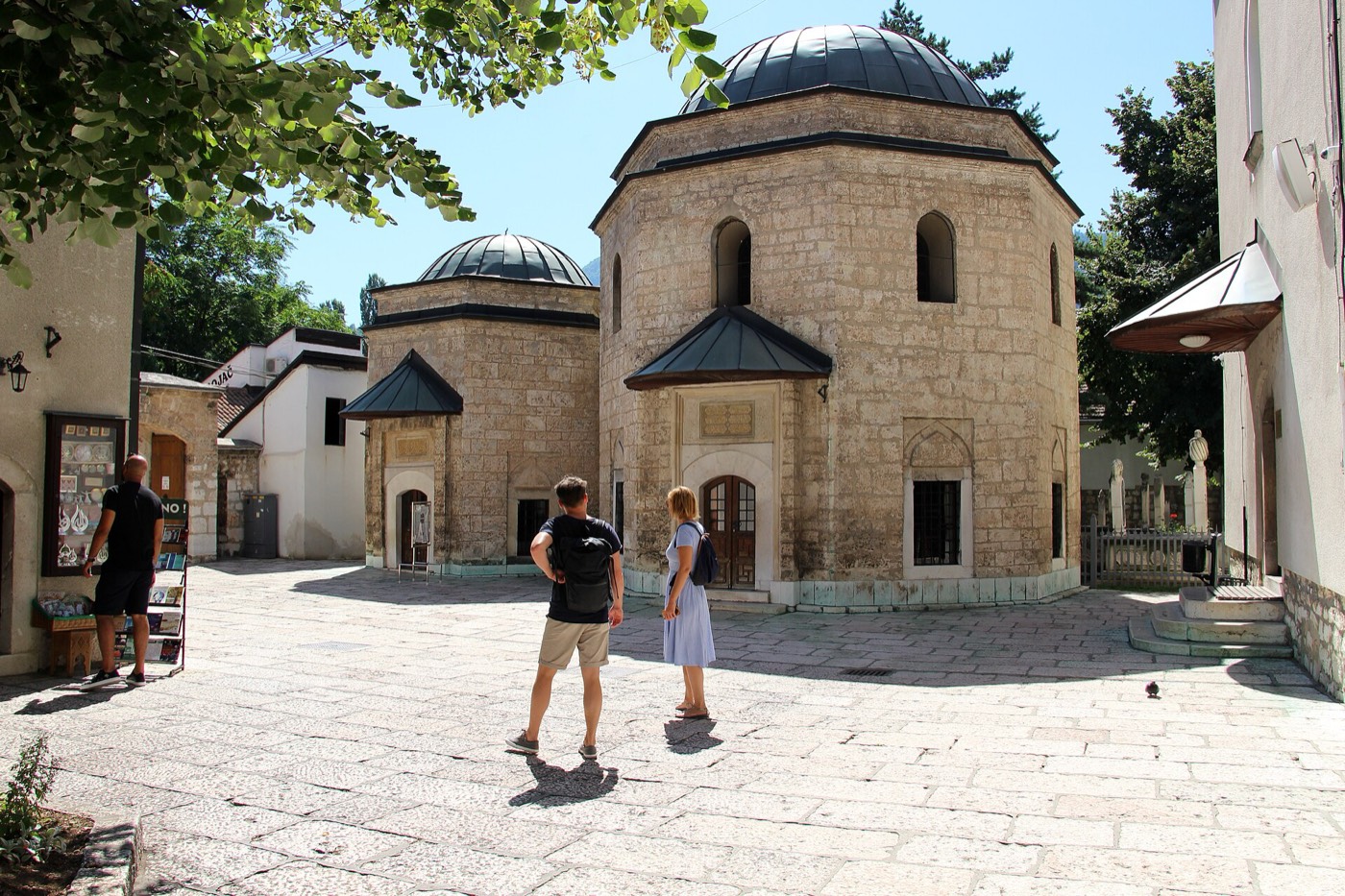
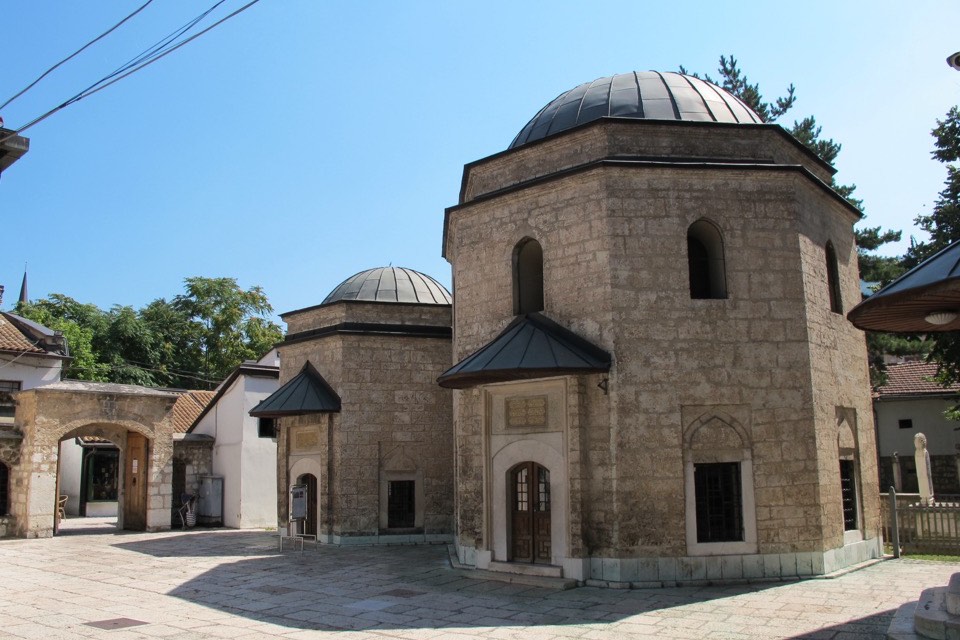
The tomb stands east of the mosque, next to Murat-beg's smaller tomb1,3. It is built of cut stone on a regular octagonal plan; the Commission gives each inner side as 2.53 m, and TDV gives the sides as 3.30 m on average1,4. It has two rows of windows, two on each face: rectangular below, each with a blind panel above it, and pointed-arched above1. The walls end in a simple moulded cornice, above which an octagonal drum carries the dome, covered with lead1,6. The inscription plaque sits over the entrance door1,4. Murat-beg's tomb, of the same stone, is hexagonal and has only lower windows1,3,7.
On stylistic grounds, Dervišević places both tombs in the transition from the early Istanbul style to the classical style of Ottoman architecture and assigns them, like the design of the mosque, to the workshop of the chief court architect Acem Esir Ali7. The mosque, completed in 1530/1531, is a domed building with an open portico under small domes and a stone minaret; the Commission to Preserve National Monuments calls it one of the most beautiful works of Ottoman-period architecture in Bosnia and Herzegovina1. Its 2006 decision protects the mosque, both tombs, the courtyard with its graves, the ablution house with its hot-water taps, the şadırvan (fountain), the muvekkithane (time-keeper's house) and the site of the old school as one ensemble1.
Interior
Gazi Husrev-beg's grave takes the form of a sarcophagus enclosed by cut-stone blocks and covered with a richly decorated cloth, which some accounts date to his death; the headstone is wrapped in cloth in the shape of a kavuk (turban)1. The painted walls date from the Austro-Hungarian period and were restored after the 1992-1995 war1. Calligraphic panels in jali thuluth script, made in 1893-1895, run in three tiers7. Above the windows, gold letters on white quote the salla, the call that announced a death, beginning 'Death is a drink that all people will drink'1,7. Roundels in the middle tier carry Qur'anic verses and prayers1,7. Under the dome Ali Faginović wrote the names of God, the Prophet Muhammad, the first four caliphs, Hasan and Husayn; below the panel with Husayn's name he signed simply 'Ali' and added the date 1311 AH (1893/1894)1,7. The Commission also reports Iznik tiles inside, which it calls unique in Bosnia and Herzegovina, and a carved stand holding a large-format Qur'an; TDV also mentions tiles in the interior1,4.
O que observar
- The gold-on-green Arabic inscription over the door, whose chronogram gives Gazi Husrev-beg's death year, 948 AH (1541)1,4.
- Two rows of windows: rectangular below with blind panels, pointed-arched above1.
- The lead-covered dome on an octagonal drum above a plain moulded cornice1,6.
- Ali Faginović's signed calligraphy of 1893/1894 under the dome, naming God, the Prophet, four caliphs, Hasan and Husayn1,7.
- Murat-beg Tardić's smaller hexagonal tomb next door, whose Turkish inscription dates his death to 952 AH (1545/1546)1,3,4,6.
Visita
- The tomb stands in the walled courtyard of the Gazi Husrev-beg Mosque in Baščaršija, east of the mosque; the courtyard has four gates, two from Sarači street, one from Mudželiti Veliki and one from Čizmedžiluk1,3.
- The Gazi Husrev-beg Waqf asks visitors to the complex to report to its information centre in the mosque courtyard; tourist visits to the mosque take place outside prayer times9.
- The mosque, both tombs, the courtyard with its graves, the ablution house, the şadırvan and the muvekkithane are protected together as one National Monument1,2.
Informações oficiais: Gazi Husrev-beg Waqf (Gazi Husrev-begov vakuf), which runs the mosque complex; the ensemble is protected as a National Monument by the Commission to Preserve National Monuments of Bosnia and HerzegovinaComo chegarAbrir no OpenStreetMapVisitas guiadas: Sarajevo