Dit deel is nog niet vertaald en wordt daarom in het Engels getoond.
Geschiedenis
Gawhar Shad, wife of the Timurid ruler Shah Rukh (r. 1405-1447), laid the foundations of a large complex outside Herat in 14172. Her madrasa was built between 1417 and 1438, according to its foundation plaque, and her congregational mosque, or musalla, probably followed in 14262,5. The researchers Sandra Aube, Thomas Lorain and Julio Bendezu-Sarmiento call the complex one of the major foundations of the Timurid capital3. The mausoleum, at the madrasa's western corner, was completed in 1432, and her son Baysunghur was buried there a year later5. Gawhar Shad herself and seven other Timurid princes are believed to have been buried here too5.
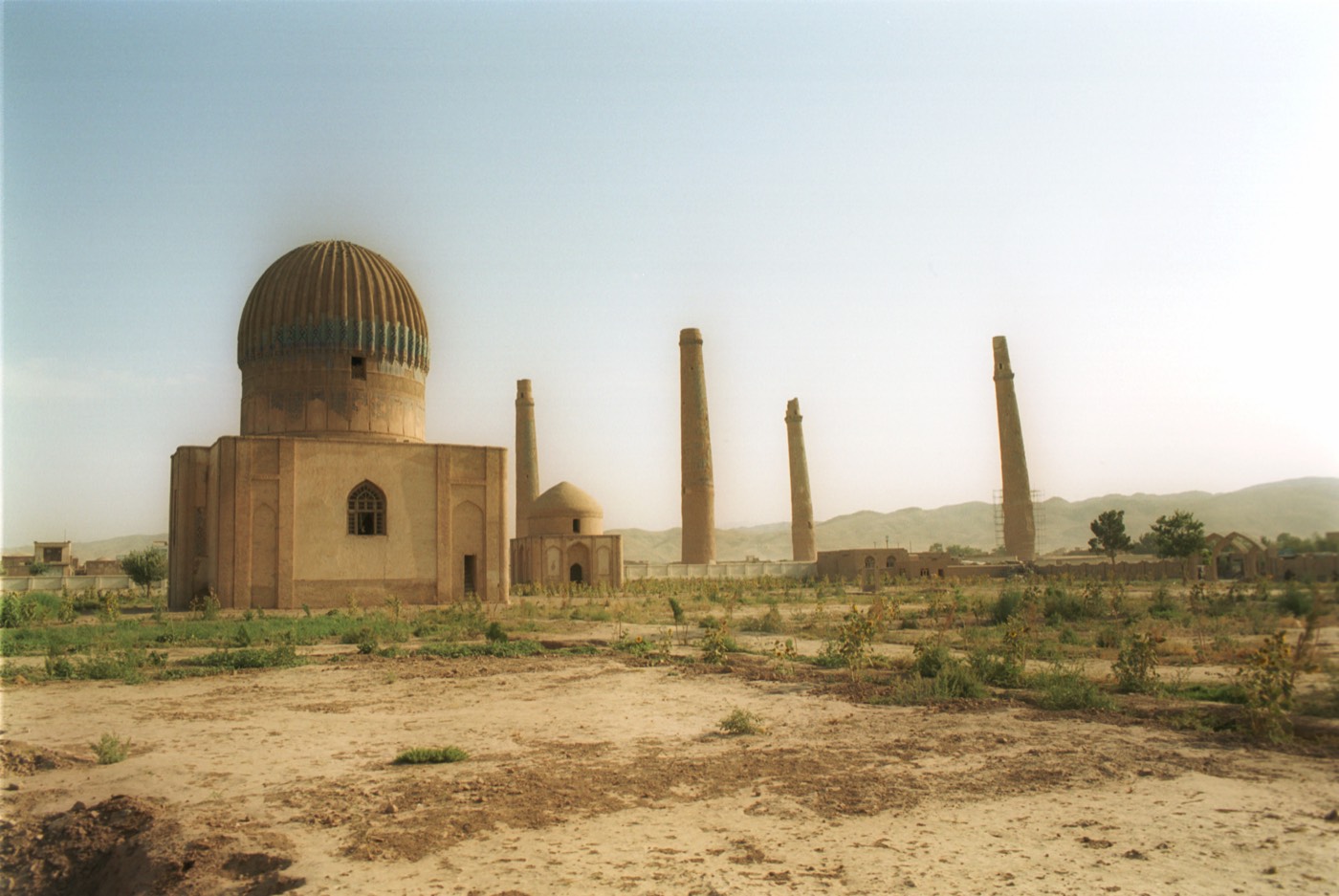
In 1863 artillery fire destroyed the tops of the minarets, and in 1885 Amir Abdur Rahman had the ruins razed so that a Russian army could not use them; only the minarets and the mausoleum were left standing2. Two of the mosque's minarets fell in an earthquake in 19322. The mausoleum was damaged in fighting in the early 1990s but kept its ribbed, tiled dome1. In 2001 the Society for the Preservation of Afghanistan's Cultural Heritage (SPACH) built protective walls around it and replanted its garden, and in 2003 a UNESCO project tied the leaning madrasa minaret with cables2,5. In October 2014 an Italian-funded UNESCO mission began conserving the mausoleum's remaining Timurid tilework4.
Architectuur
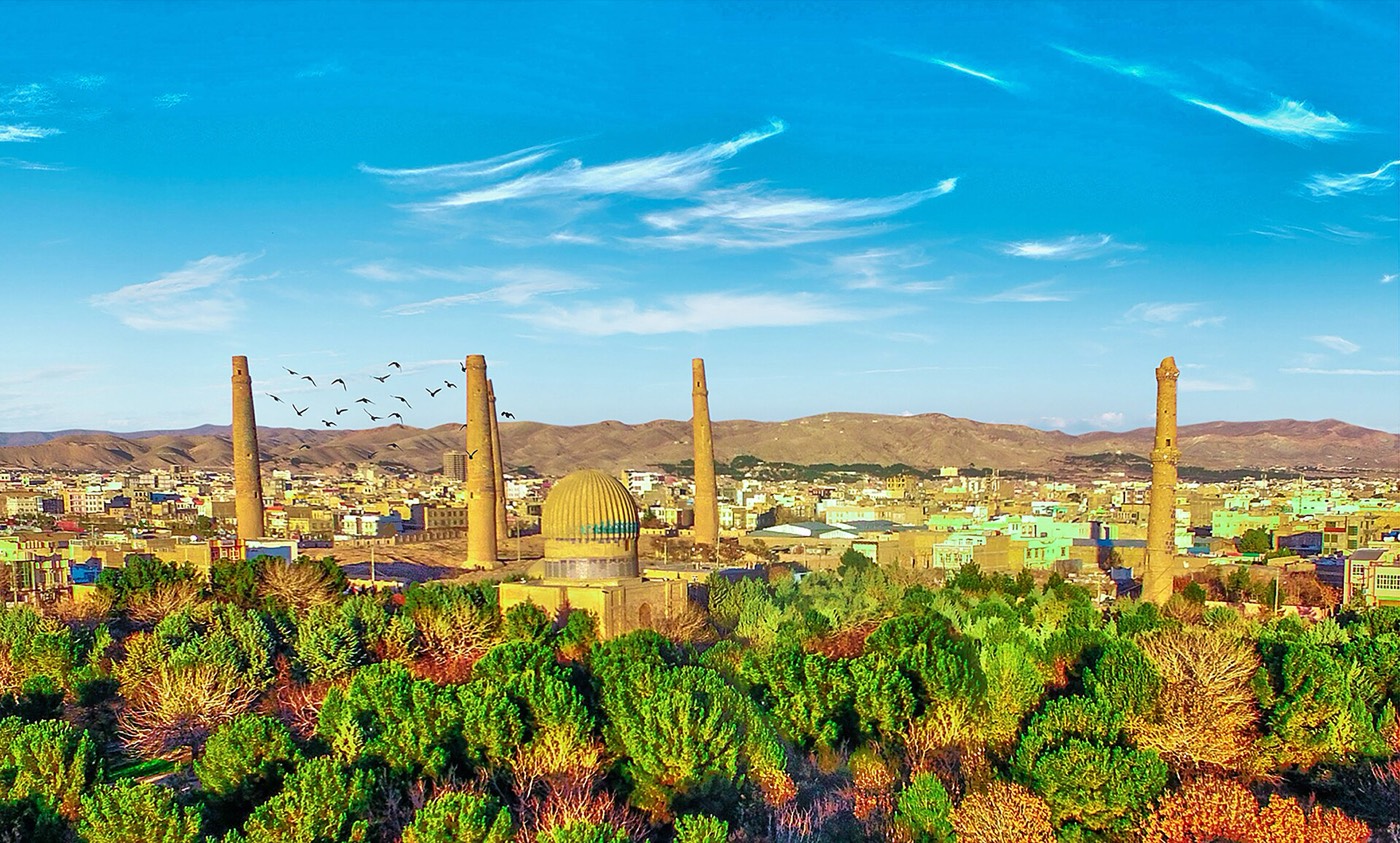
The mausoleum stood in the westernmost corner of Gawhar Shad's madrasa and now stands alone, in a garden south of an irrigation canal that crosses the Musalla site2,5. Its chamber is cruciform, about 9.5 m on each side, with a five-sided qibla bay projecting to the south-west5. The ribbed dome is covered in tiles and rises on a high drum also covered in tile decoration, both carrying Quranic inscriptions and abstract patterns1. To the east stands the madrasa's last minaret, with two balconies on muqarnas supports and a brick shaft faced with a diamond pattern of blue tiles, floral bands and Kufic inscriptions2,5.
North of the canal, four minarets mark the corners of the madrasa built by the Timurid sultan Husayn Bayqara, most likely around 1493, and the small domed tomb of the poet Mir Ali Shir Nava’i stands near the entrance to Gawhar Shad's mausoleum2. Aube and her colleagues published recent surveys of the site and a first study of the ceramic tiles collected there, which were moved to the National Museum of Herat in 20153. UNESCO's 2014 mission chose original tiles from the mausoleum, kept in Herat's citadel, for analysis in Italy so that matching tiles could be made4.
Interieur
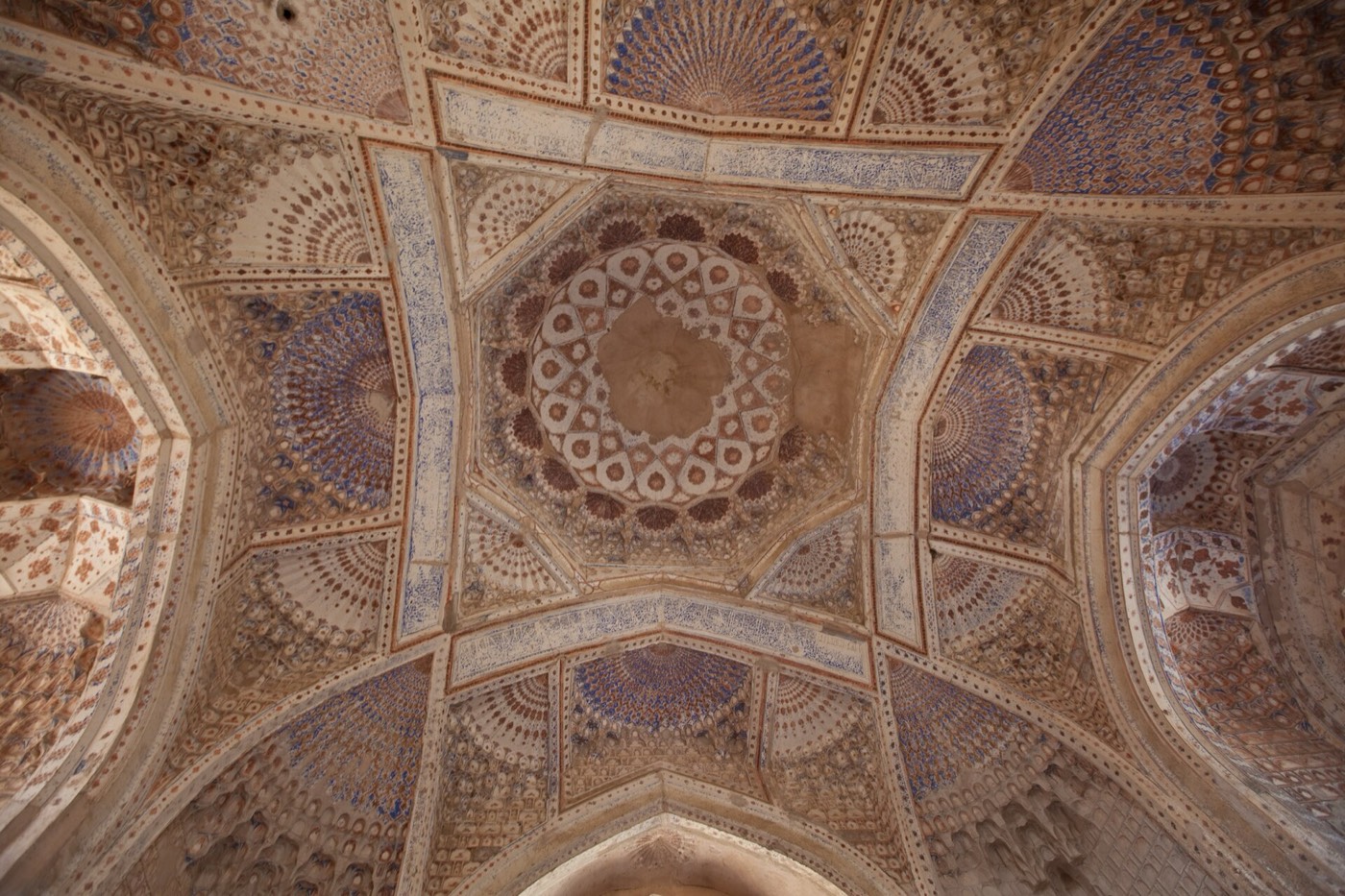
Inside, four arched niches fill the recesses of the cruciform chamber, set within four great arches that meet at the corners of the dome chamber5. Squinches lead from the corners to an eight-pointed star, then to an octagon and a sixteen-pointed star, rising to a thirty-two-sided star at the apex; this squinch-net vault is painted with floral motifs and inscriptions picked out in gold5. The madrasa's foundation plaque is kept in the mausoleum5. UNESCO's tentative-list entry of 2004 says the tombstones of Gawhar Shad, Baysunghur and other members of the family survive here, while Archnet reports that the queen's own tombstone, seen by the Russian agent Nicholas de Khanikoff before 1860, is now missing1,5.
Waar u op kunt letten
- The ribbed, tile-covered dome on its high drum, with Quranic inscriptions and abstract patterns1.
- The painted squinch-net vault, rising through star patterns to a 32-sided star at the top5.
- The Timurid tombstones in the chamber, and the madrasa's foundation plaque housed in the mausoleum1,5.
- The lone madrasa minaret to the east, with blue-tiled diamonds and two muqarnas balconies5.
- The four minarets of Husayn Bayqara's madrasa across the canal to the north2.
Bezoek
- The mausoleum stands in a garden on the Musalla site, with the minarets of Gawhar Shad's and Husayn Bayqara's madrasas close by2.
- Landmines limited access to the Musalla site for decades; tiles collected there were moved to the National Museum of Herat in 20153.
- The City of Herat, including the Musalla, has been on Afghanistan's tentative list for World Heritage since 17 August 20041.
Officiële informatie: Afghanistan's Ministry of Information and Culture, which submitted the City of Herat to UNESCO's tentative list in 2004RoutebeschrijvingOpenen in OpenStreetMapRondleidingen in Herat