Dit deel is nog niet vertaald en wordt daarom in het Engels getoond.
Geschiedenis
The Kyrgyz epic of Manas tells of a hero who, in legendary tradition, brought the Kyrgyz back from the Altai to the Tien Shan, united them and defended them against Chinese raids; its classic version took shape in the 18th century2. In 2013 UNESCO inscribed the trilogy of Manas, Semetey and Seytek on its Representative List of the Intangible Cultural Heritage of Humanity2,3. Folk belief placed Manas’s headquarters, his ordo, in the Talas valley, and in one version of the epic his widow Kanykei has a tomb built for him by a master brought from Rum2,6. The 14th-century mausoleum on the Kenkol River, near where it joins the Talas, came to be popularly regarded as Manas’s grave1,2.
Archnet, following the Soviet scholars M. E. Masson and G. A. Pugachenkova, dates the building to about 1334, under the Chaghatayid khans1. Its portal inscriptions name Kenizek-Khatun, daughter of the emir Abuka: the Great Soviet Encyclopedia calls the building her tomb, while Archnet calls her its patron1,7. Its burials, like those of the Burana and Uzgen mausoleums, lay in pits oriented north-south, the usual Muslim arrangement5. Soviet researchers began systematic work in the Talas valley in the 1930s and 1940s2. A literary and ethnographic museum opened here in 1976, becoming a state museum-reserve in 1990; its rebuilding began in 1995, when Kyrgyzstan celebrated the epic’s 1000th anniversary under UNESCO’s auspices, and the Manas Ordo complex opened in 1996, gaining national status in 20012.
Architectuur
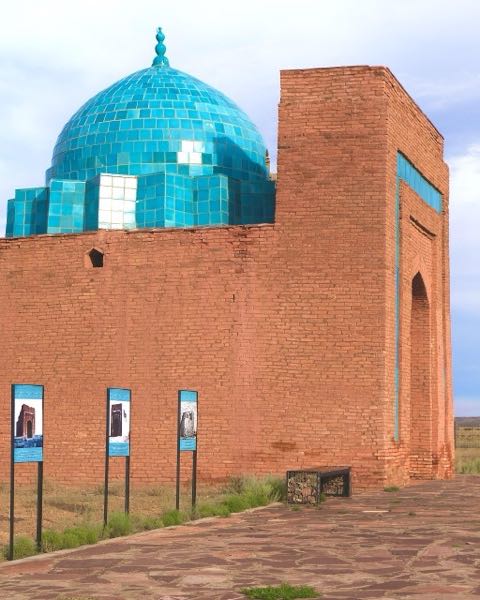
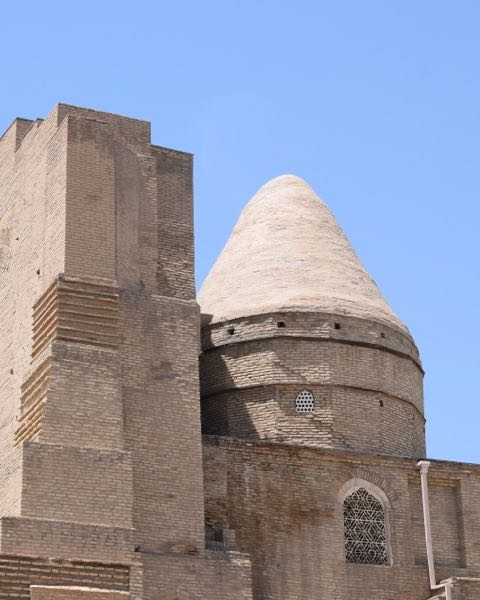
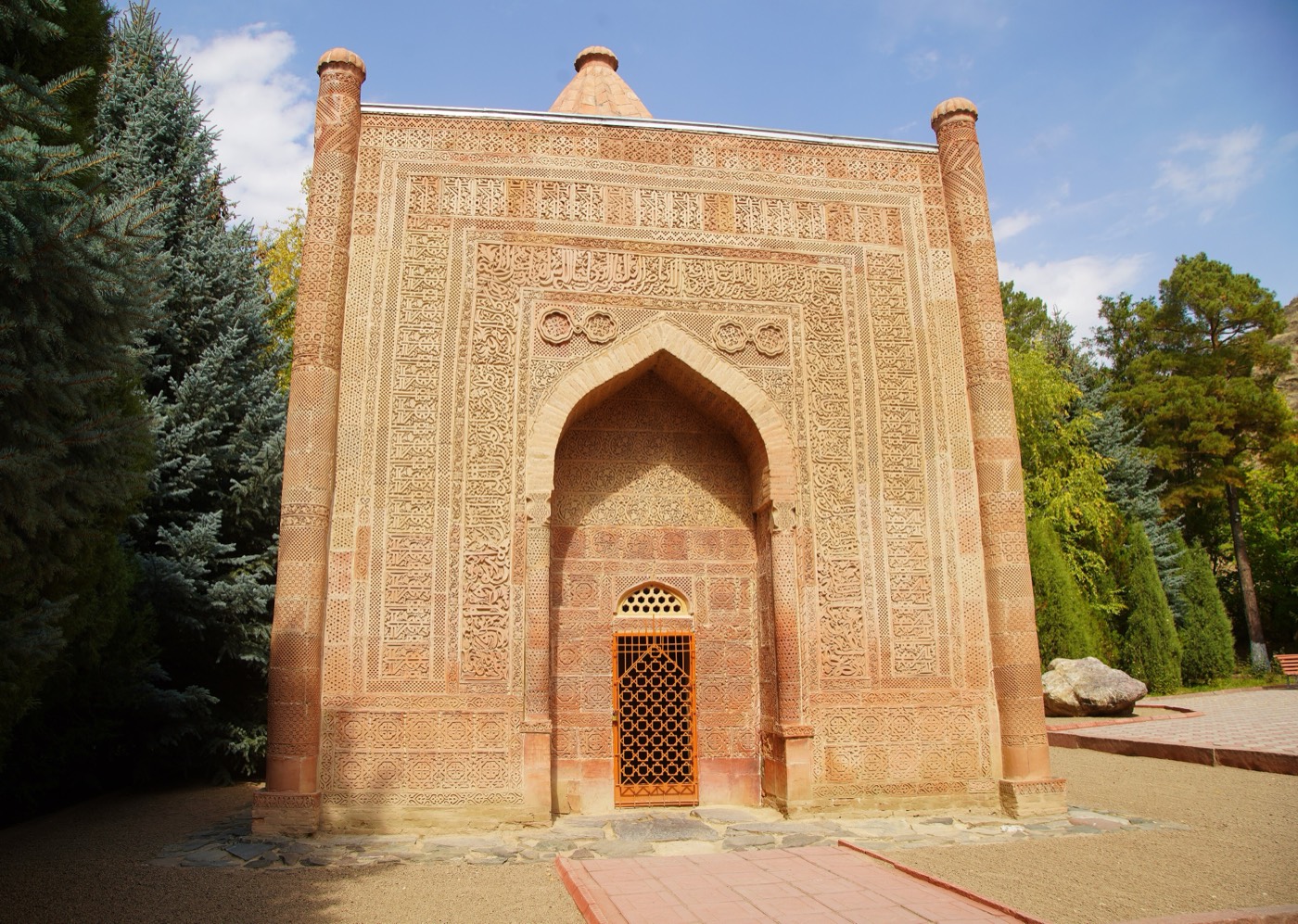
The mausoleum is a small, near-square building of baked brick laid in clay mortar, whose façade is dominated by a large portal (pishtaq) and a pyramidal dome1. The outer dome, sixteen-sided and ribbed, hides an inner dome with a pointed (lancet) profile1. The Great Soviet Encyclopedia notes that this ribbed outer roof was restored in 1969-19707. Engaged columns topped by small cupolas frame the portal, which is covered with carved terracotta slabs, while the side walls are plain1. Four eight-petalled medallions fill the spandrels of the portal arch, and the terracotta frames carry geometric patterns and inscriptions in Kufic and a cursive script1.
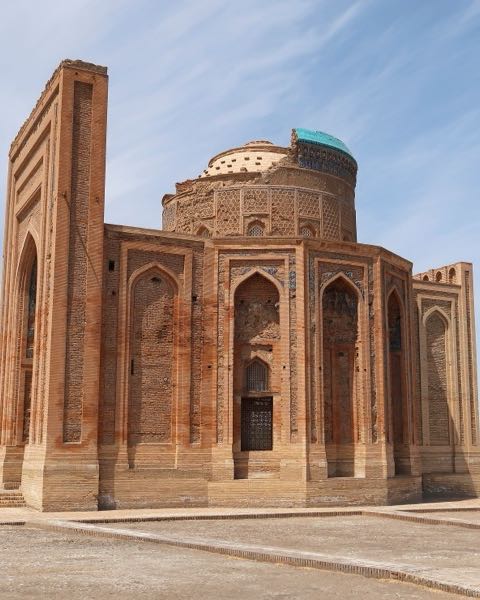
Archnet sees in it the influence of earlier tombs of the Talas valley, such as that of Babaji-Khatun1. A 2025 study of Chaghatayid architecture names Manas Gumbez and the tomb of Tughluq Timur near medieval Almaliq, in China, as the best-known Chaghatayid monuments4.
Interieur
Waar u op kunt letten
Bezoek
- The mausoleum is the centrepiece of the Manas Ordo complex, which opened in 19962.
- It stands on the bank of the Kenkol River near its confluence with the Talas, along the Kyrgyz (Kirghiz) Range1.
- Since the 1990s the complex has been one of Kyrgyzstan’s main symbols of nation and statehood2.
RoutebeschrijvingOpenen in OpenStreetMapRondleidingen in Bij Talas