Dit deel is nog niet vertaald en wordt daarom in het Engels getoond.
Geschiedenis
Hüdavend Hatun was a daughter of the Anatolian Seljuk sultan Rükneddin Kılıç Arslan IV1,4. Niğde's culture directorate writes that her father was killed with the consent of the Ilkhanid ruler Abaqa, that in 1276 she went to the Ilkhanid court as Abaqa's daughter-in-law, and that she came home after the death of her husband Arghun in 12914. The inscription over the portal says that she ordered the building of “this blessed tomb” in the months of the year 712 of the Hijra, that is 1312-13132. TDV adds that this was under Sungur Ağa, the Ilkhanid governor1.
She died in 1332, and the head of her marble cenotaph reads “This is the resting place of the queen Huand Hatun”2. Two more people were buried with her later: Paşa Hatun, daughter of Emir Şücaeddin, who died in 1340, and Belkıs Hanım, daughter of an Ottoman governor of the Niğde district, who died in 15631. In 1967 the art historian Gönül Öney published a study of the tomb's figural reliefs, noting that they had not been examined before3. The General Directorate of Foundations, which owns the building, restored it in 1962, and Niğde's culture directorate notes that it keeps its original features despite some repairs4,5,6.
Architectuur
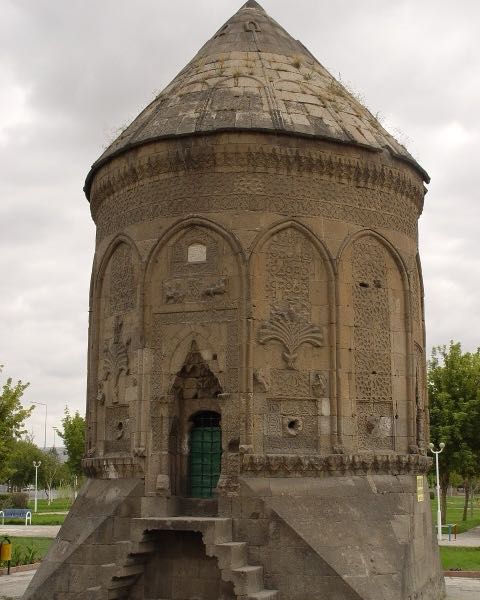
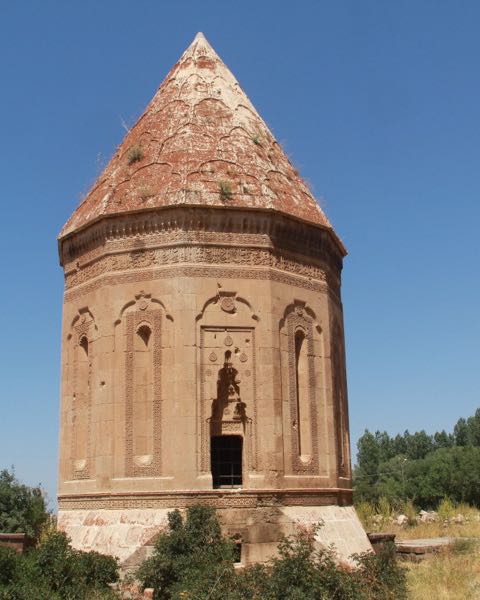
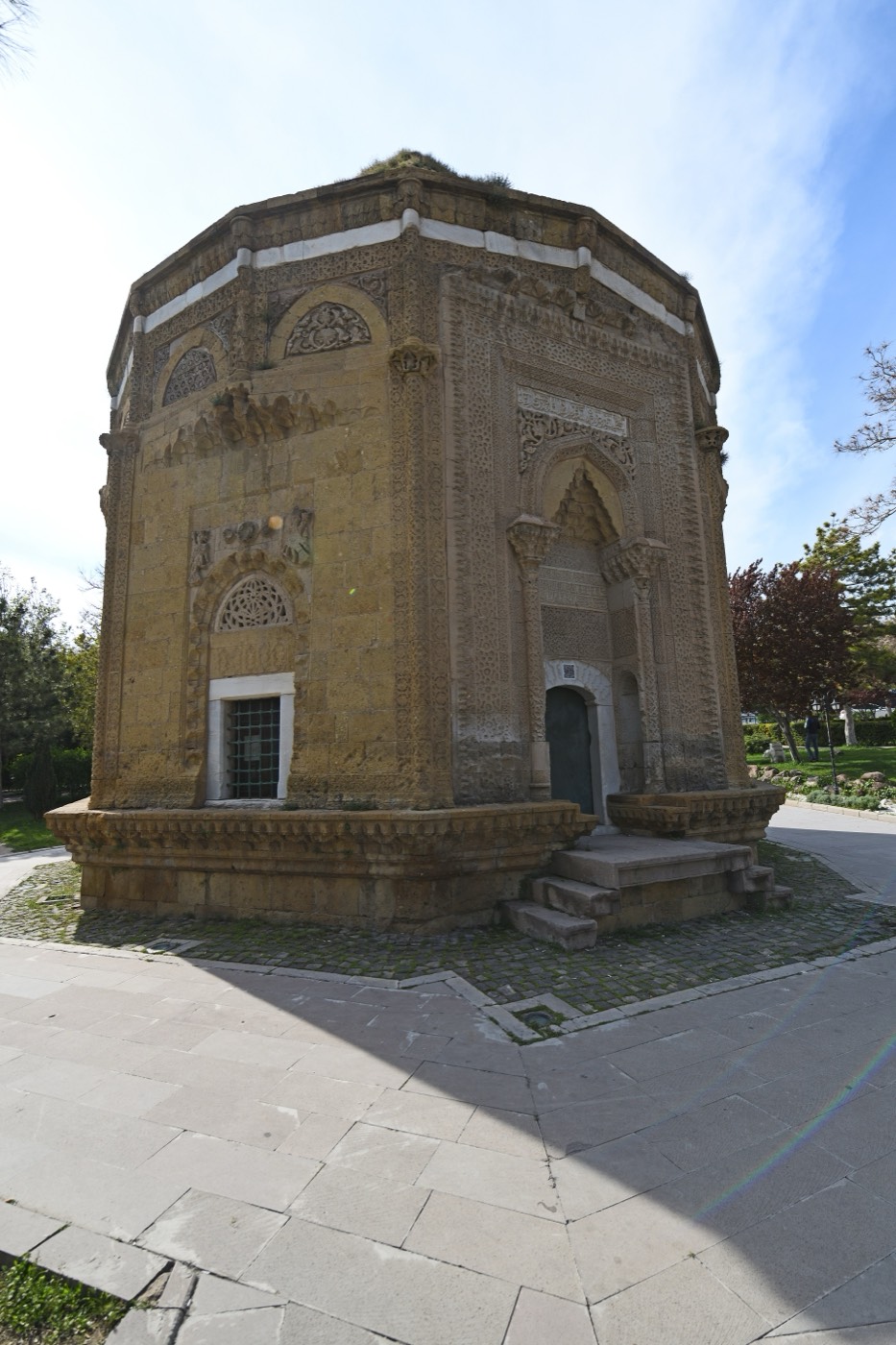
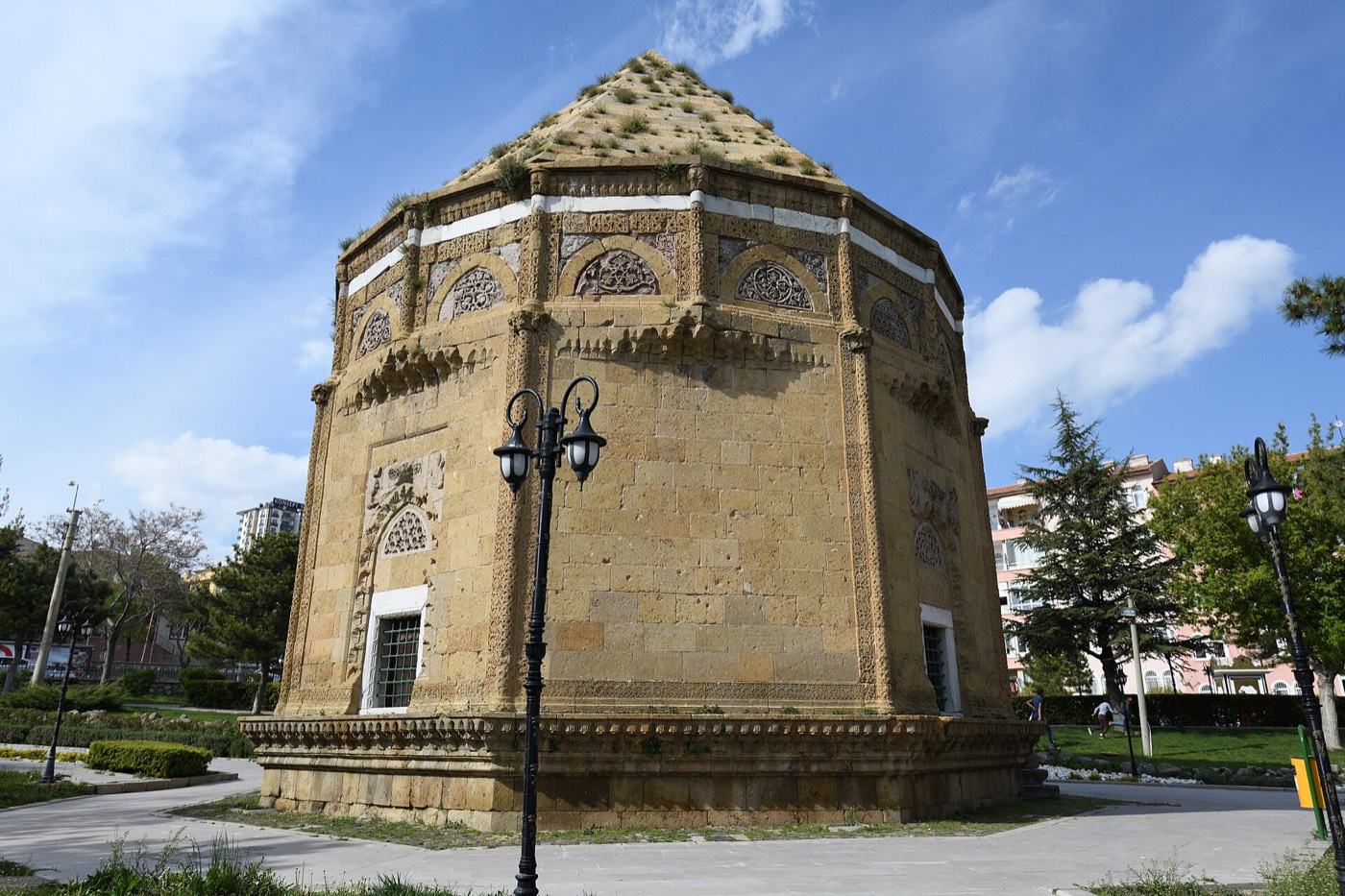
The tomb is built of yellow cut stone, with white marble for the lintels, arches, inscription plaques and cornice; Niğde's culture directorate names the stone as trachyte, with some black stone4,5. An octagonal body, its corners softened by carved colonnettes, rises from an octagonal base about 1.20 m high that ends in a muqarnas moulding1,5. At the top, small muqarnas triangles turn the octagon into sixteen sides, and a muqarnas frieze leads to an eight-sided pyramidal roof set on a sixteen-sided cornice1. The portal is on the east side, where three steps lead up to a low door, 1.75 m high; three other sides have rectangular windows, and every side except the entrance has two pointed-arch tympana in its upper part1,5.
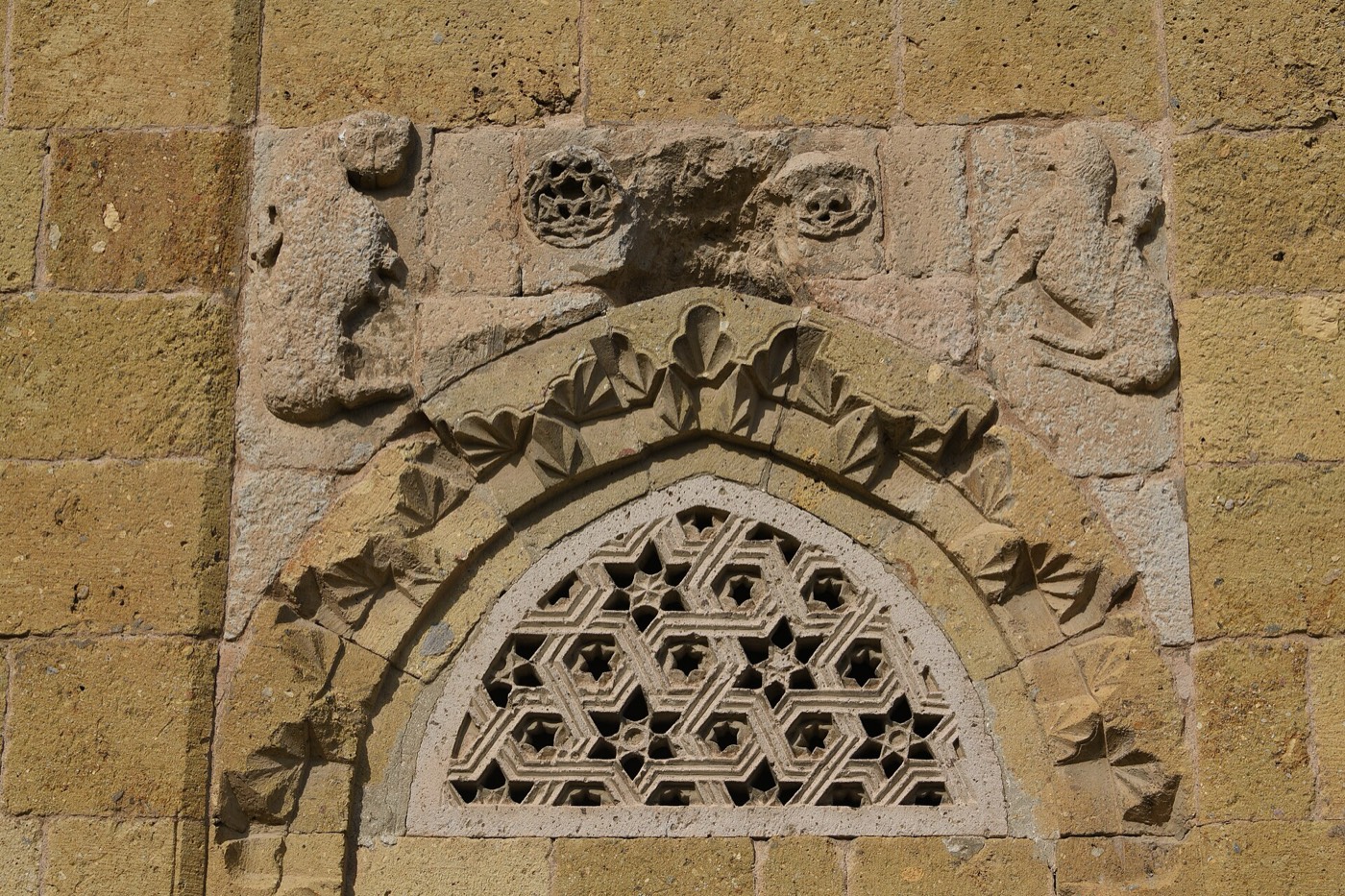
The portal niche has a muqarnas hood, and its surface carries borders of geometric star interlace and panels of rumi and palmette scrolls, with small human figures hidden in the foliage1. Figural high reliefs appear beside plant designs in the shallow window niches and in the tympana1. On the west side a double-headed eagle has wings that end in dragon heads, with a human head between its two heads; on the north side a head wearing a three-lobed crown hides among the scrolls1. Gönül Öney counted four sirens in high relief, two of them facing each other above a window on the south-east side with three rosettes between them, as well as pairs of lions, and Archnet also lists a gazelle3,5. Drawing on Central Asian shamanic parallels, she read the hidden masks as charms against evil spirits and the lions as guardians of the soul of the dead; TDV likewise links the reliefs to Seljuk funerary symbolism1,3.
Interieur
Niğde's culture directorate lists the tomb as closed to visitors4. Published descriptions show an octagonal room with a stone floor, entered through a door with a flattened arch; a muqarnas band runs around the walls at the height of the window tops, and pointed arches of dark stone make the transition to the dome1,2,5. A five-sided mihrab niche in the south wall, with a muqarnas hood, is framed by inscription bands and by borders of geometric and plant motifs; its inscription gives the profession of faith and the Qur'anic words “He sent him with guidance and the religion of truth”1,2,5. Three cenotaphs, each cut from a single block of marble, stand side by side on the stone floor; Hüdavend Hatun's has three-line inscriptions in thuluth script at its head and foot2.
Waar u op kunt letten
- The double-headed eagle on the west side, its wings ending in dragon heads1.
- Pairs of crowned sirens above the windows on the south-east and north sides1,3.
- Human masks hidden among the scrolls of the portal and the tympana1,3.
- The portal inscription of 1312-1313 naming Hüdavend Hatun as the one who ordered the tomb2.
- On the drum, a crowned, weeping head that Niğde's culture directorate reads as Hüdavend Hatun4.
Bezoek
- The tomb stands in a park on Türbe Sokak in central Niğde4.
- Niğde's culture directorate lists it as closed to visitors, so the carved facades are seen from the park4.
- The building belongs to the General Directorate of Foundations4.
Officiële informatie: General Directorate of Foundations (Vakıflar Genel Müdürlüğü), owner of the building, according to the Niğde Provincial Directorate of Culture and TourismRoutebeschrijvingOpenen in OpenStreetMapRondleidingen in Niğde