Bu bölüm henüz çevrilmediği için İngilizce gösteriliyor.
Tarihçe
Kunya-Urgench, the medieval Gurganj, was the capital of Khwarazm from the 12th century2. Genghis Khan’s army destroyed it in 1221, but it was rebuilt, and ICOMOS notes that it was then described as “the finest city of the Turks”2. After the Mongol conquest northern Khwarazm, with Urgench, belonged to the Golden Horde, and in the later 14th century an independent minor dynasty of Qongrat Turks, the Sufis, arose there2,3,8. Timur’s troops struck the city between 1372 and 1388; in 1388 Timur crushed Sulayman Sufi and razed Urgench2,8. Local tradition names the mausoleum after Turabek Khanum, wife of the Golden Horde governor Qutlugh Timur and patron of the khanaqah (Sufi lodge) of Shaykh Najm al-Din Kubra3.
No inscription records the patron or the date, and both are disputed3,5,6. A 2021 press report in Golden Age, the newspaper of Turkmenistan’s state news agency, cites Ibn Battuta’s account of Urgench to date the building to the 1330s, under Qutlugh Timur7. The ICOMOS evaluation of 2005 gives 1360-1380 with a question mark; Archnet and IRCICA date it to 1370 as the family tomb of the Sufi dynasty, and Archnet adds that it is thought to hold Husayn Sufi2,3,4. In 2011 Lisa Golombek argued in the journal Muqarnas that it is neither a foundation of the 1330s nor of the 1370s, but a rebuilding of Timur’s reign after 1388, about 1390-14055,6.
Mimari
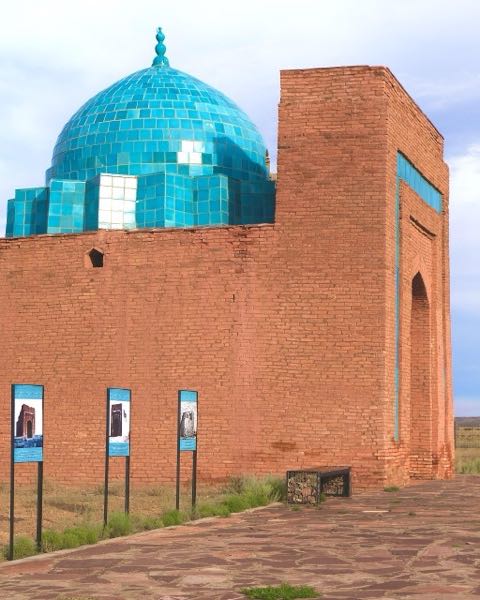
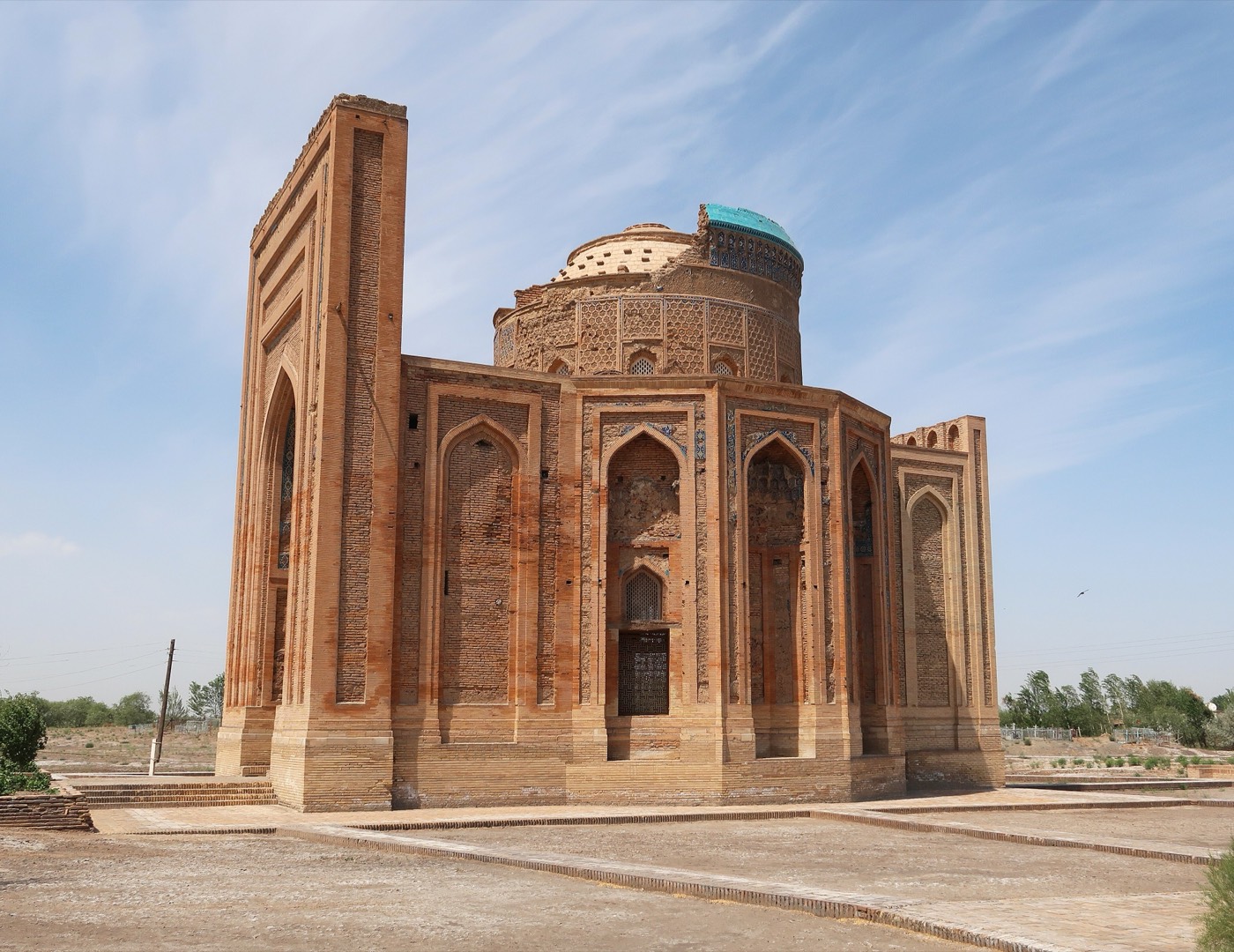
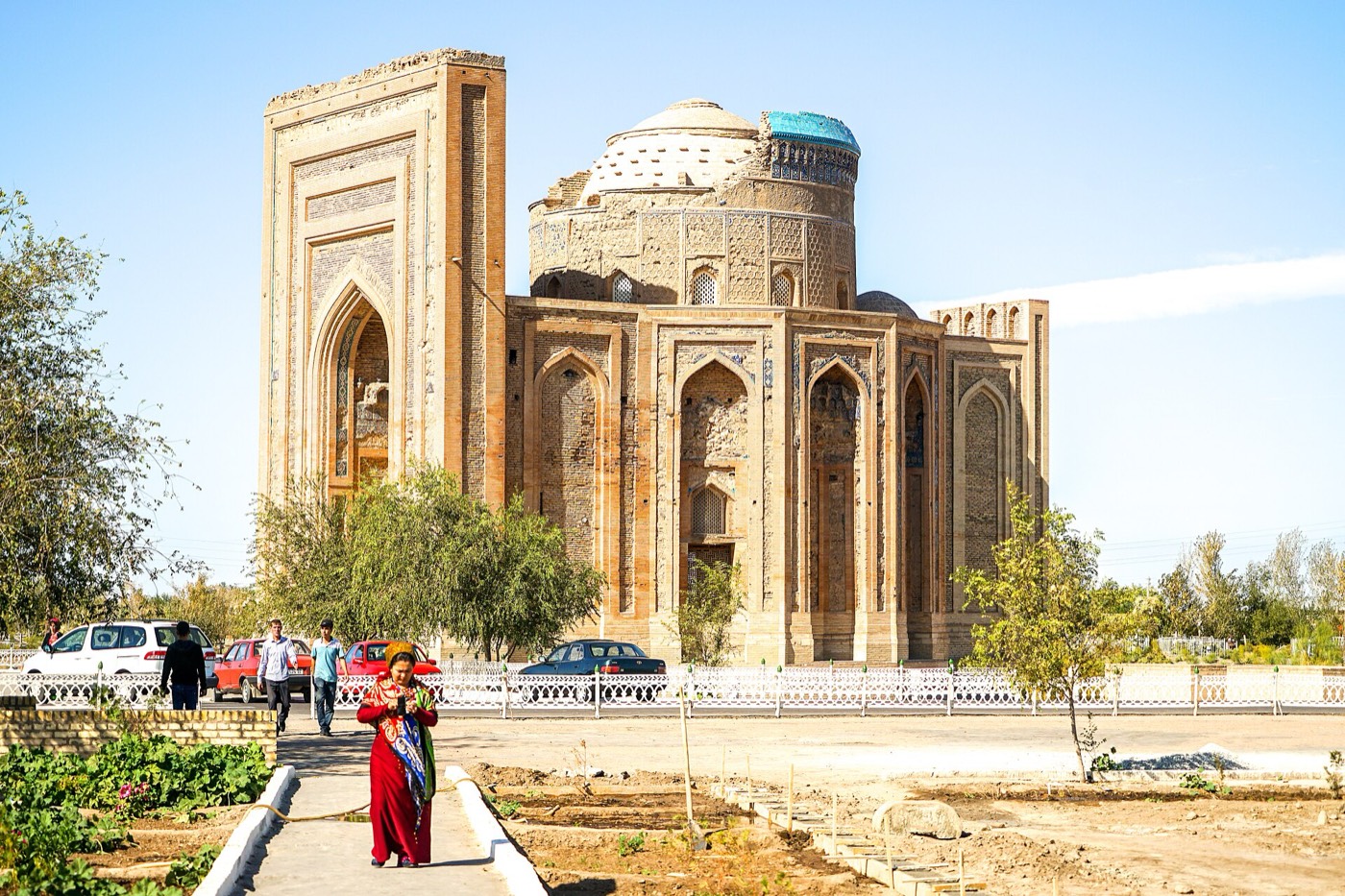
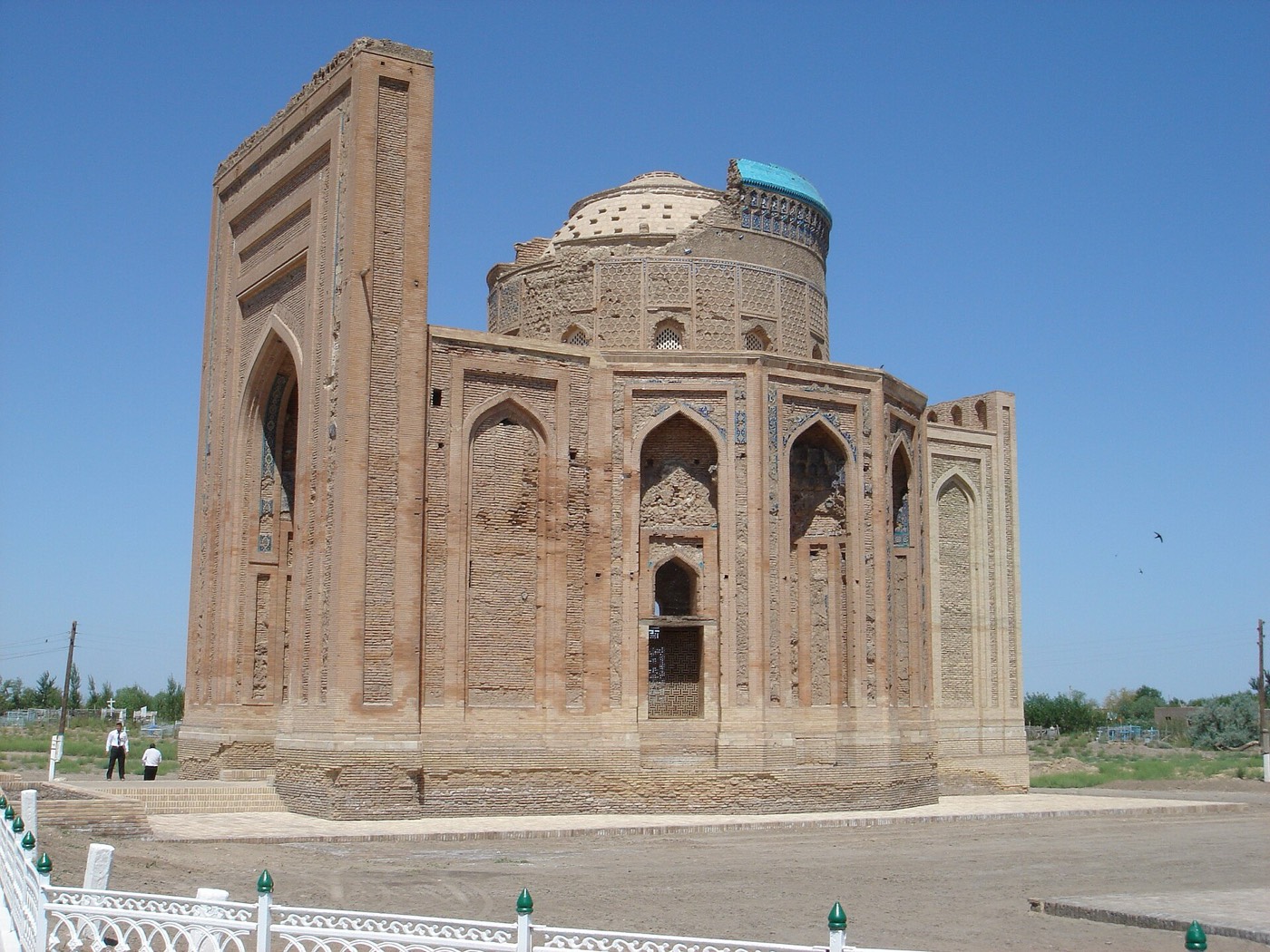
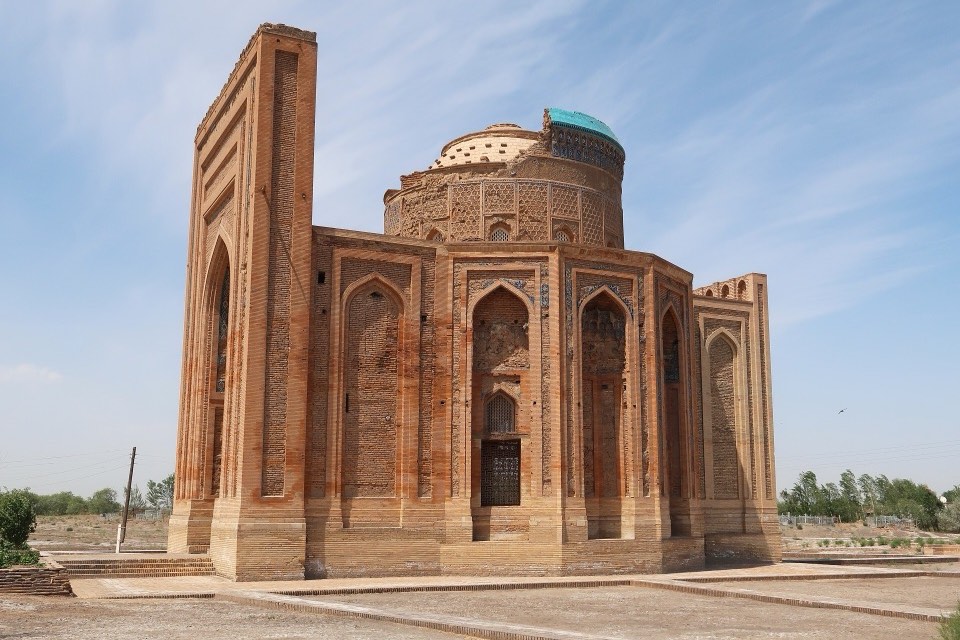
ICOMOS calls the mausoleum the largest at Kunya-Urgench and the most elaborate in architectural conception and decoration2. Its portal (pishtaq), about 25 m high according to Archnet, encloses a vestibule with smaller rooms on each side3. Behind it stands the domed hall, octagonal inside and twelve-sided outside, with tall niches opening outward2,3. A high drum, its arched panels filled with turquoise-glazed moulded terracotta, carried a double dome: the tiled inner dome survives, but the outer shell, conical according to ICOMOS, has collapsed except for a few turquoise segments2,3,4.
Archnet lists the double dome, the tile mosaic and the oversized portal as proto-Timurid features that, with the lack of inscriptions, feed the debate over its attribution3. Reviewing Golombek’s study, Sandra Aube notes that the building is generally seen as a forerunner because of the colour range and quality of its cut-tile mosaic; Golombek also documented tiles painted over and under the glaze and discussed the Iranian craftsmen deported to Khwarazm after Timur’s conquests6. Restoration began in the 1980s: in 1983-1993 the walls were repaired and the collapsed northern portal rebuilt, and in a UNDP-funded campaign of 1999-2000 the inner dome and the small side domes were restored and the roof partly rebuilt2.
İç mekân
From the portal, the vestibule leads into the main hall, a tall polygonal space under a dome about 9 m across3,4,7. The underside of the dome is lined with tile mosaic forming a net of stars and polygons with flowers, which ICOMOS describes as extremely refined blue-and-white geometric decoration2,4,7. Mosaic and muqarnas (stalactite) work also decorate the interior; in 2005 ICOMOS reported that these decorative elements still had problems, though the building’s general condition was stable2. The pierced wooden window screens (panjara) were restored and the missing carved wooden doors replaced in 1983-19934.
Dikkat çeken ayrıntılar
- The tile mosaic of the inner dome, about 9 m across, with its pattern of stars and flowers4,7.
- The portal, about 25 m high, with its vestibule and side rooms3.
- The few turquoise segments left from the collapsed outer dome3,4.
- Tiles painted over and under the glaze beside the cut-tile mosaic, studied by Golombek6.
- The twelve-sided outer wall of the hall, with tall niches opening outward2,3.
Ziyaret
- The mausoleum lies in the southern section of the World Heritage property, which also contains the Kutlug-Timur minaret and the mausoleums of Il-Arslan and Tekesh2.
- The old city was abandoned in the 16th century, and its site was later used as a graveyard2.
- UNESCO notes that Kunya-Urgench is still a pilgrimage centre and that most of its visitors are pilgrims from the region1.
Resmî bilgi: State Historical and Cultural Park “Kunya-Urgench”, with the National Department for the Protection, Study and Restoration of the Historical and Cultural Monuments in Turkmenistan, based in Ashgabat (as described by UNESCO)Yol tarifiOpenStreetMap haritasında açınKöneürgenç için rehberli turlar