این بخش هنوز ترجمه نشده است و به همین دلیل به انگلیسی نمایش داده میشود.
تاریخچه
Osman Shah Bey (Kara Osman Şah) was a grandson of Sultan Selim I through his daughter Hanım Sultan, and so a nephew of Sultan Süleyman I2,6,7. His endowment deeds name his father as İskender Pasha, a vizier executed in 15156,7. The chronicler Peçevi, Evliya Çelebi and the Ministry's record name (Kara) Mustafa Pasha instead, which Ünal and Değerli reject1,6,7. Made governor (sancakbeyi) of Bosnia at sixteen, he governed the Morea from 1520 and later Bosnia and Lepanto7. Evliya Çelebi, who visited Trikala in May 1668, tells a legend that Süleyman, uneasy at talk among the troops of making Osman Shah sultan, sent him and his mother to Trikala and granted him the province for life6,7.
In Trikala he founded a complex that Machiel Kiel counts among the largest of the Ottoman Balkans, with a domed mosque, madrasa, school, soup kitchen (imaret), caravanserai, double bath, stone bridge and his monumental tomb2,7. Değerli, from Ottoman decrees, dates his death to November or December 1570; the Ministry's record gives 1567/8, and Kiel shortly after September 15711,2,7. The endowment deed drawn up in 1571 by his nephew and heir Mustafa Bey says he built the tomb in his lifetime; it paid two keepers to guard it day and night6,7. When Trikala was rebuilt in the 1930s, Franz Babinger and Anastasios Orlandos saved the mosque and the tomb from demolition; both were restored in the 1990s2.
معماری
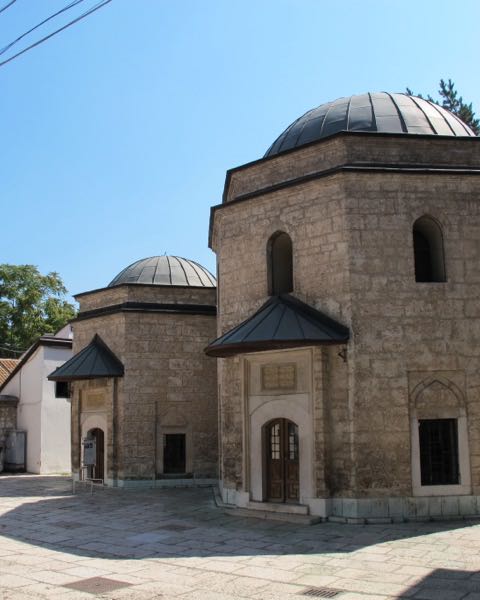
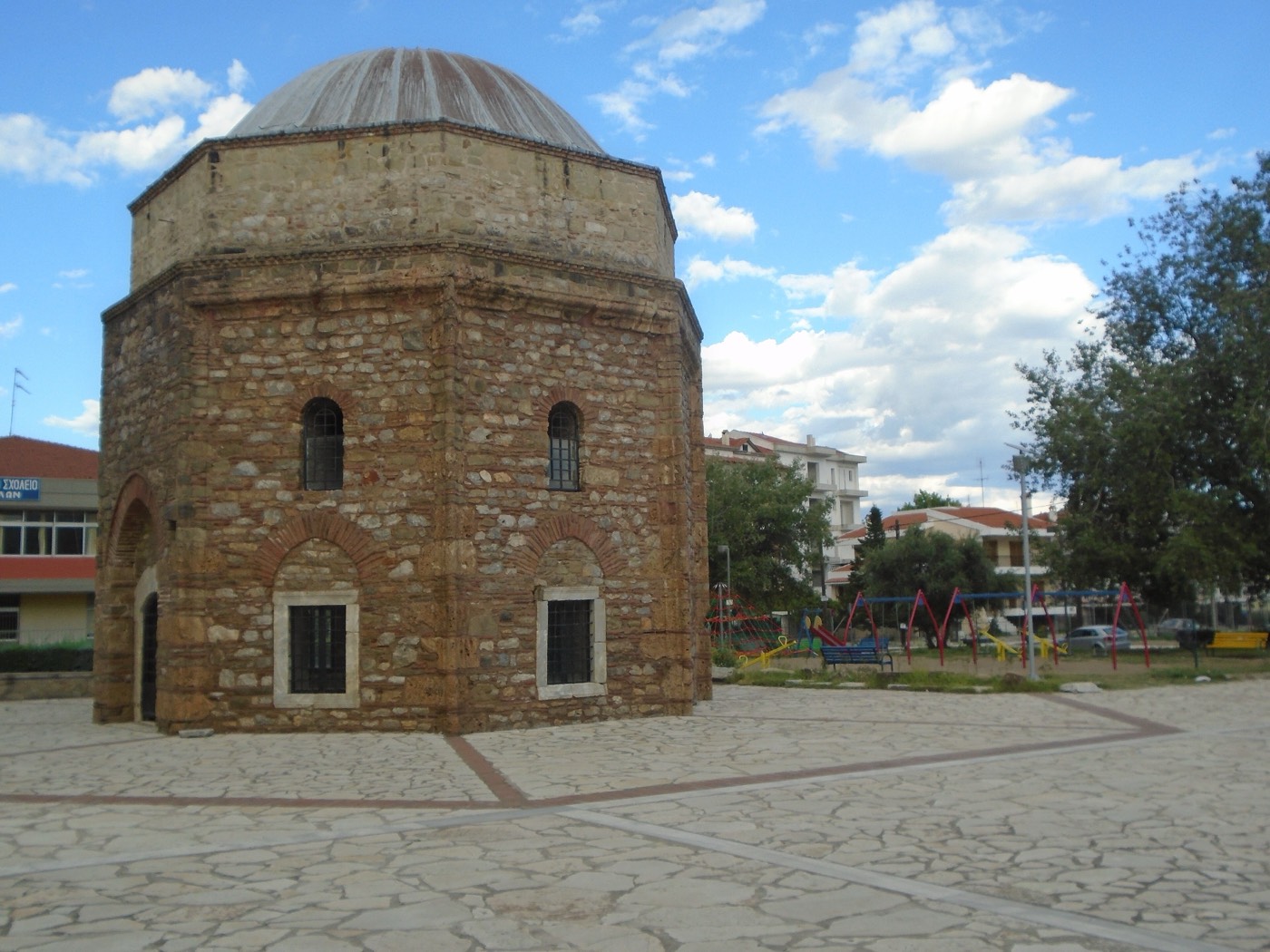
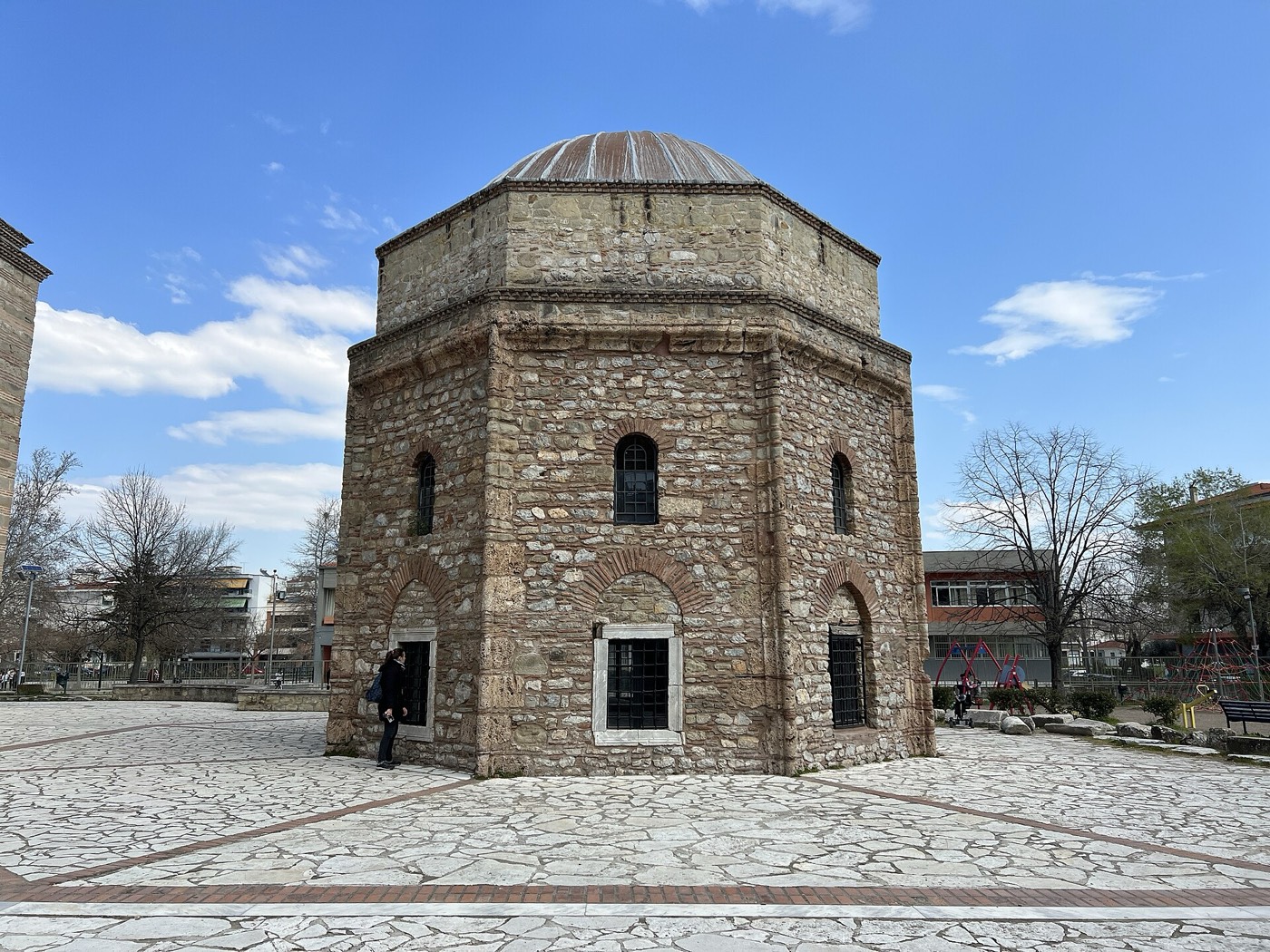
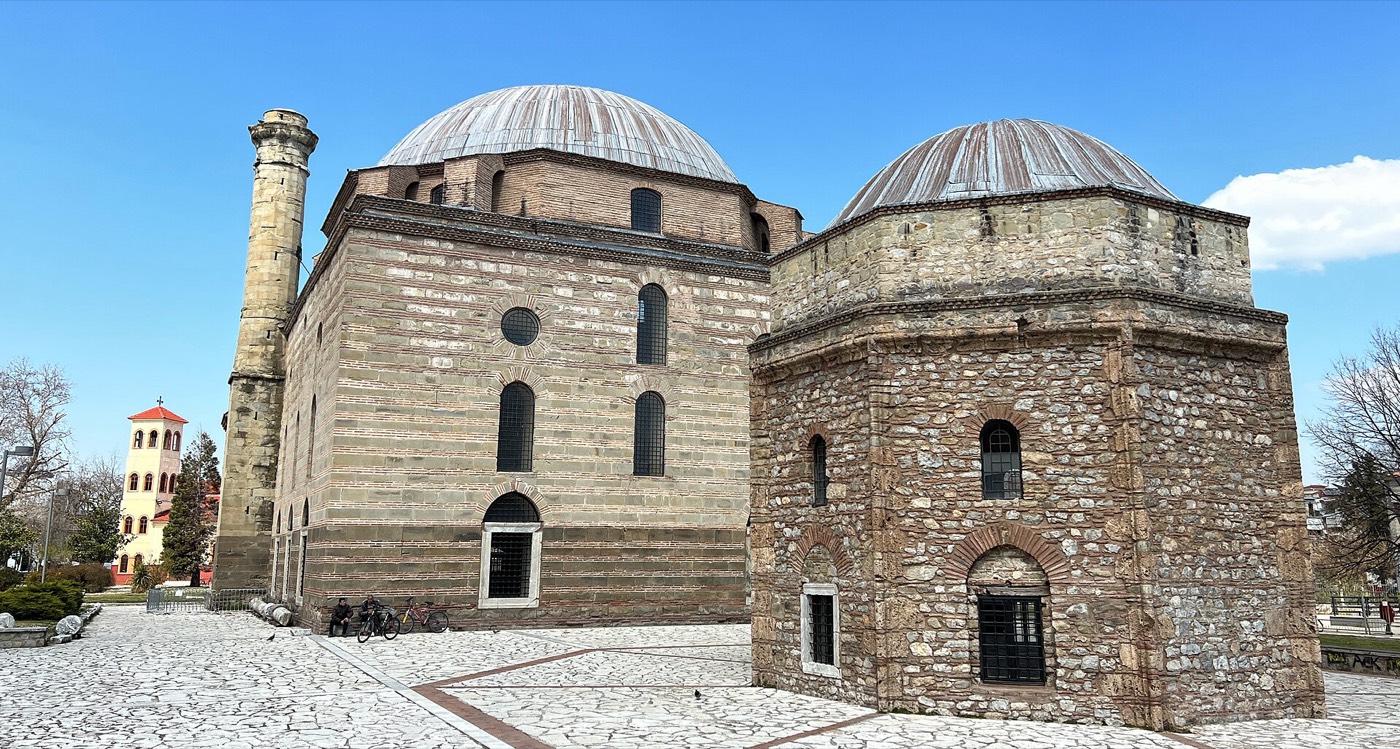
According to Orlandos, the tomb stands behind the mosque, 13.20 m from its east side; the Ministry's record places it south of the mosque1,3. It is a regular octagon in plan and, like the mosque, is covered by a hemispherical dome sheathed in lead1,3. Orlandos, who published its plan in 1929, noted roll mouldings marking the corners and framed wall faces; six of the eight faces have two tiers of windows, rectangular below and arched above3. Lead roofing gave the mosque its Turkish name, Kurşunlu or Kursum ('leaden'), and Evliya Çelebi saw every building of the complex covered in lead4,6,7.
The attribution to Mimar Sinan rests on the mosque: the lists of Sinan's works (tezkires) include it, Evliya Çelebi named Sinan as its builder, and in 1929, as Orlandos reports, Franz Babinger presented it to the Academy of Athens as Sinan's only work on Greek soil2,3,7. The title of an article by Babinger, as listed by the Ministry, also names the tomb: 'Moschee und Grabmal des Osman-Schah zu Trikkala. Ein Werk des Baumeisters Sinan' (Mosque and tomb of Osman Shah at Trikkala: a work of the master builder Sinan)8. Kiel (citing Evliya) and Değerli (citing the tezkires and Evliya) name Sinan for the mosque and say nothing of an architect for the tomb2,7. The mosque is a square prayer hall under a hemispherical dome 18 m across, with walls of large green stones laid in courses that alternate with three rows of red brick1,3.
درون بنا
In 1929 Orlandos could not establish how the interior was laid out, because the tomb was locked and in use, like the mosque, as a hay store and stable3. According to the Ministry of Culture, archaeological finds from the surrounding area are now kept inside it1,4. The mosque beside it is used as an exhibition hall and hosts small cultural events4,7.
آنچه باید دید
- The regular octagonal plan, with roll mouldings marking the corners and framed wall faces3.
- Two tiers of windows, rectangular below and arched above, on six of the eight sides3.
- The hemispherical dome sheathed in lead, like that of the 'leaden' Kursum Mosque beside it1,3,4.
- The mosque's walls: courses of large green stones alternating with bands of red brick3.
- The dome of the mosque attributed to Mimar Sinan, 18 m across3,7.
بازدید
- The tomb stands in the grounds of the Kursum (Osman Shah) Mosque on Karditsis Street, at the south-eastern edge of the town near the Lithaios river1,7.
- Its interior holds archaeological finds, while the mosque hosts exhibitions and small cultural events1,4,7.
- Of Osman Shah's other foundations, the double bath also survives; by 1891 it had been turned into a prison7.
اطلاعات رسمی: Ephorate of Antiquities of Trikala (Εφορεία Αρχαιοτήτων Τρικάλων), Hellenic Ministry of Cultureمسیریابیباز کردن در OpenStreetMapتورهای همراه با راهنما در تریکالا