이 부분은 아직 번역되지 않아 영어로 표시됩니다.
역사
Omar Khayyam, mathematician, astronomer and poet, was born and died in Nishapur; Britannica dates his life 1048-1131, though his death year is disputed5,6. Nezami Aruzi, who had met Khayyam at Balkh, relates that Khayyam predicted there that his grave would lie where flowers would shed their petals on it each spring; visiting Nishapur in 1135 or 1136, Nezami found it in the Hira cemetery at the foot of a garden wall, hidden under blossoms1,6. The tradition placing the grave beside the shrine of Imamzadeh Mohammad Mahruq is first recorded by the Scottish traveller James Baillie Fraser in 18211. Later visitors, among them the scholar A. V. Williams Jackson, described a plain brick grave without an inscription1.
Talk of a new tomb began in 1926, and in 1933-1934 Karim Taherzadeh Behzad raised a simple memorial over the old grave in time for Ferdowsi’s millennium: a stone column 4.2 m high, inscribed with verses by Malek-osh-Shoara Bahar, on a platform 5 m square1. It was criticised from the start, and a new design requested from André Godard and Maxime Siroux in 1937 was halted by the Second World War1. The Society for National Heritage revived the project in 1956 and gave it to Houshang Seyhoun1,3. After nearly four years of work the new tomb was inaugurated on 1 April 1963 in the presence of Mohammad Reza Shah1.
건축
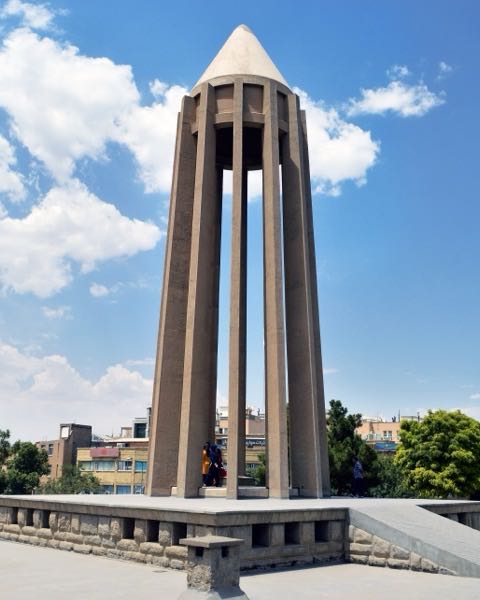
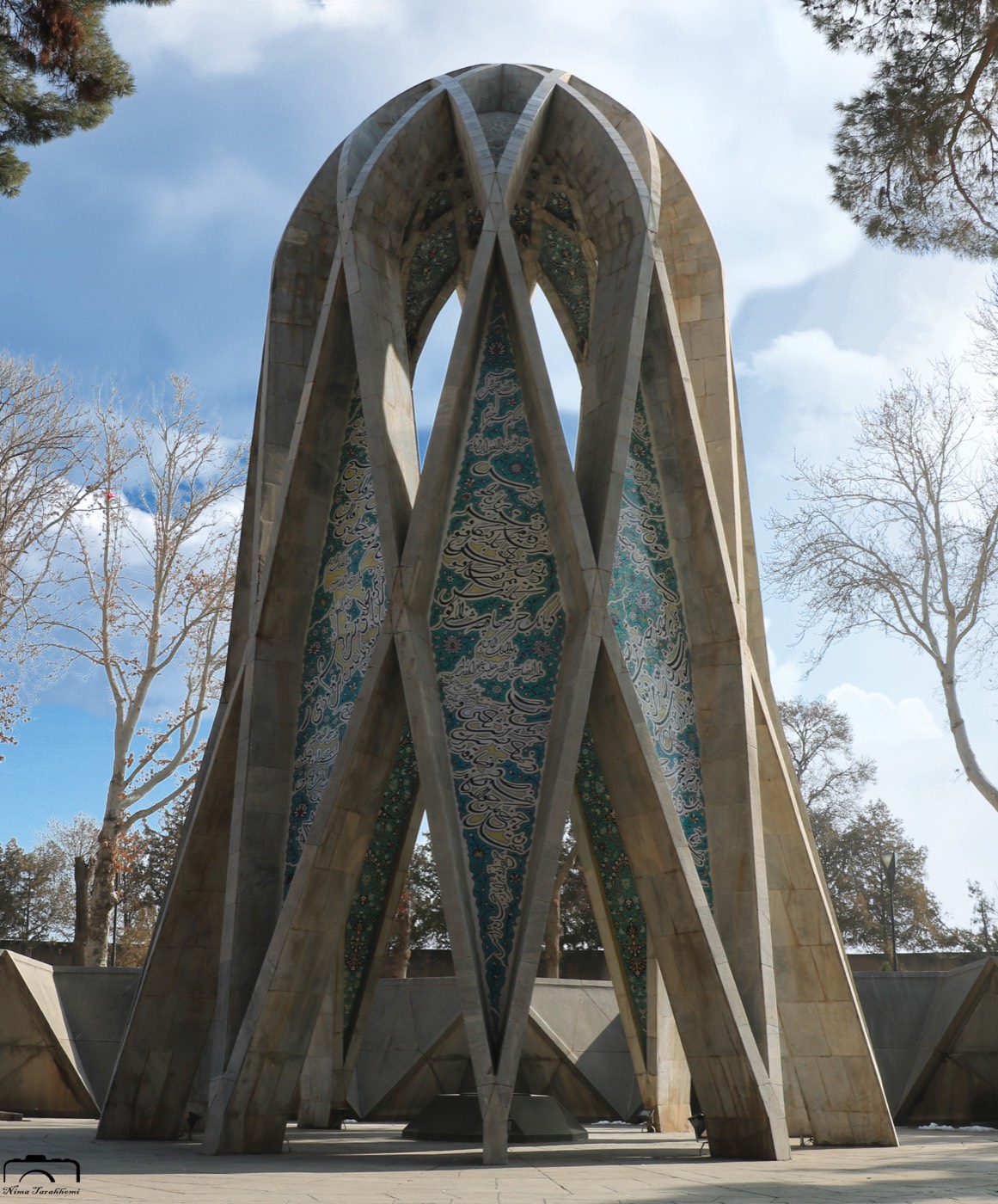
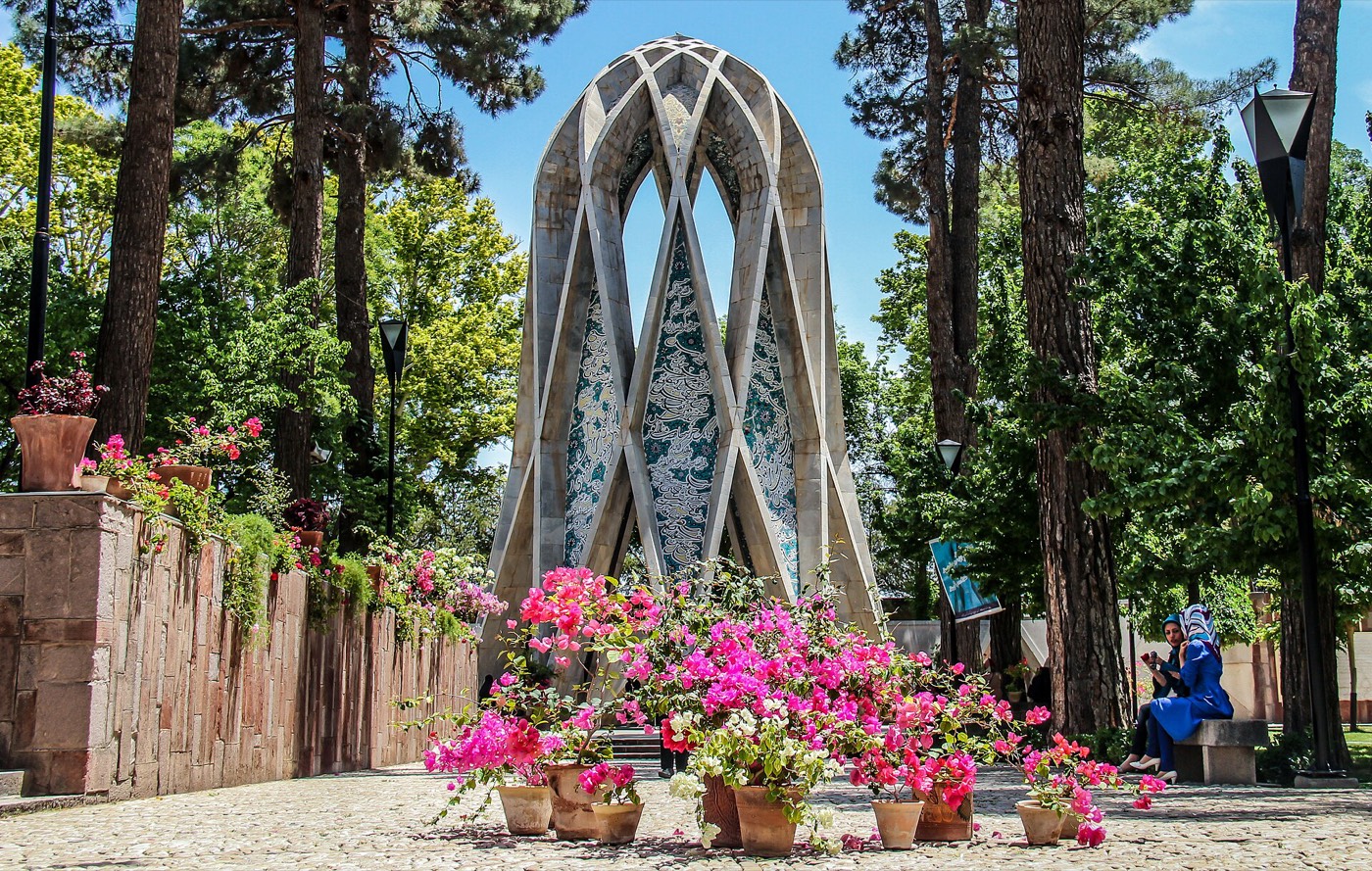
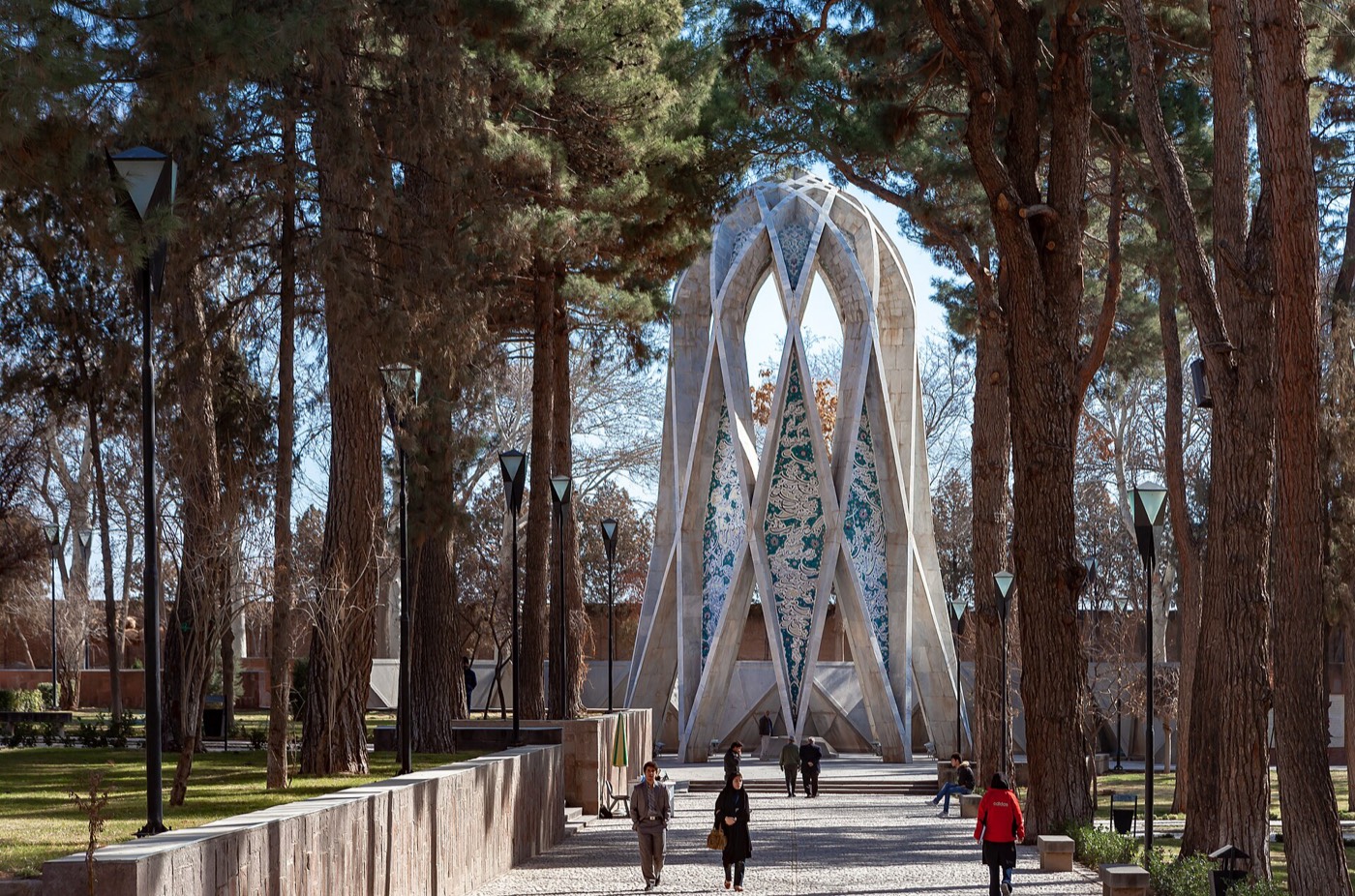
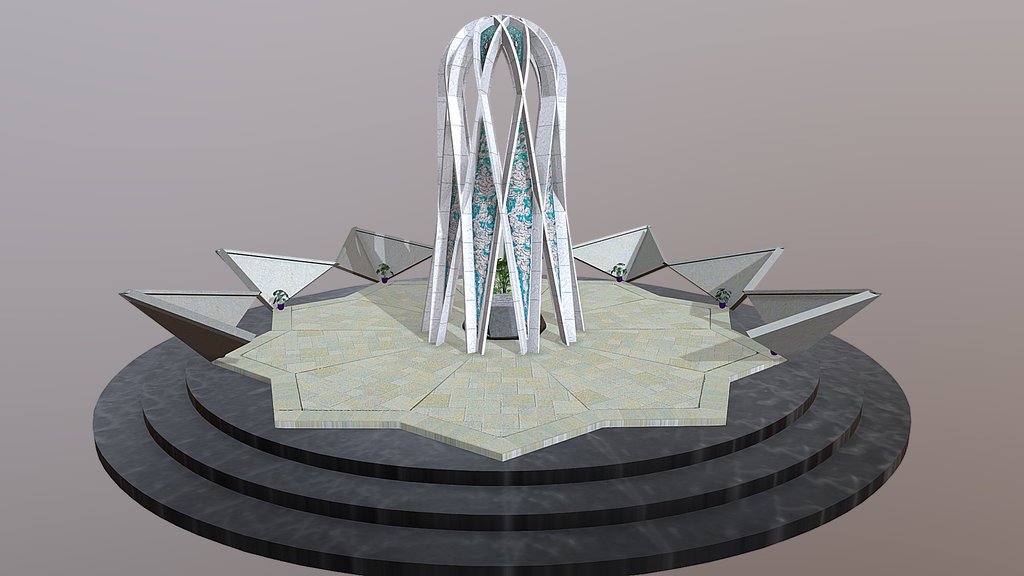
Seyhoun wrote that he set out to express three sides of Khayyam: the mathematician, the astronomer and the poet1,7. The tomb rests on ten piers, the number taken as a mathematical symbol; as they curve inward and continue up into the dome, their ribs form a lattice of lozenges that ends in a ten-pointed star, open at the centre to the sky in honour of the astronomer1,7. The poet is present in the tile panels set between the ribs, which carry his quatrains in calligraphy over abstract patterns1,2,7. The structure is a regular decagon about 5 m in radius and about 22 m high, built on a metal frame1.
Officials had complained that the 1934 memorial lacked presence beside the shrine, so Seyhoun moved the tomb to the northeast of the garden, into an orchard about 3 m lower than the shrine, and kept it below the level of the shrine’s platform and dome1. Citing Nezami Aruzi’s story, he wanted a grave open on every side, where spring blossoms would fall1. A new east-west avenue leads to it, and the garden was split between the tomb (about 20,000 m²) and the shrine (about 23,000 m²)1. Mozaffari and Westbrook consider the ribbed structure one of the inspirations for the Shahyad (now Azadi) monument in Tehran, on which Seyhoun was a collaborating architect2.
내부
The tomb is an open canopy, since Seyhoun meant the grave to be open on every side1. Standing beneath it, the visitor looks up at the ribs converging into the ten-pointed star, with the sky visible through its central opening1,2. Between the ribs, panels of coloured tile mosaic carry Khayyam’s quatrains in calligraphy1,2,7. At the centre lies the gravestone, which Seyhoun designed as a pentagonal, diamond-like block inspired by Khayyam’s geometry1. It records his death in the year 517 of the Hijra (1123-24), the date most researchers prefer according to Ebrahimzadeh Namvar and Jayhani, while Britannica gives 11311,5.
감상 포인트
- The ten-pointed star at the top, open to the sky in honour of Khayyam the astronomer1.
- Ten curved piers whose ribs weave a lattice of lozenges, a mathematical symbol1,7.
- Tile panels between the ribs carrying Khayyam’s quatrains in calligraphy1,7.
- The pentagonal, diamond-like gravestone designed by Seyhoun1.
- The neighbouring shrine of Imamzadeh Mahruq, whose garden was divided from the tomb’s in the 1960s1.
관람 안내
- The tomb lies in part of the old garden of the Imamzadeh Mohammad Mahruq shrine; since the 1960s the Khayyam garden has had its own entrance on the west side1.
- A museum next to the tomb displays astronomical instruments, pottery, manuscripts and paintings related to Khayyam7.
- The tombs of Attar and Kamal-ol-Molk are nearby, linked to the Khayyam garden by an avenue laid out in the 1960s1,7,8.
공식 정보: Iran’s Ministry of Cultural Heritage, Tourism and Handicrafts (official Visit Iran portal)길찾기OpenStreetMap에서 열기니샤푸르 가이드 투어