이 부분은 아직 번역되지 않아 영어로 표시됩니다.
역사
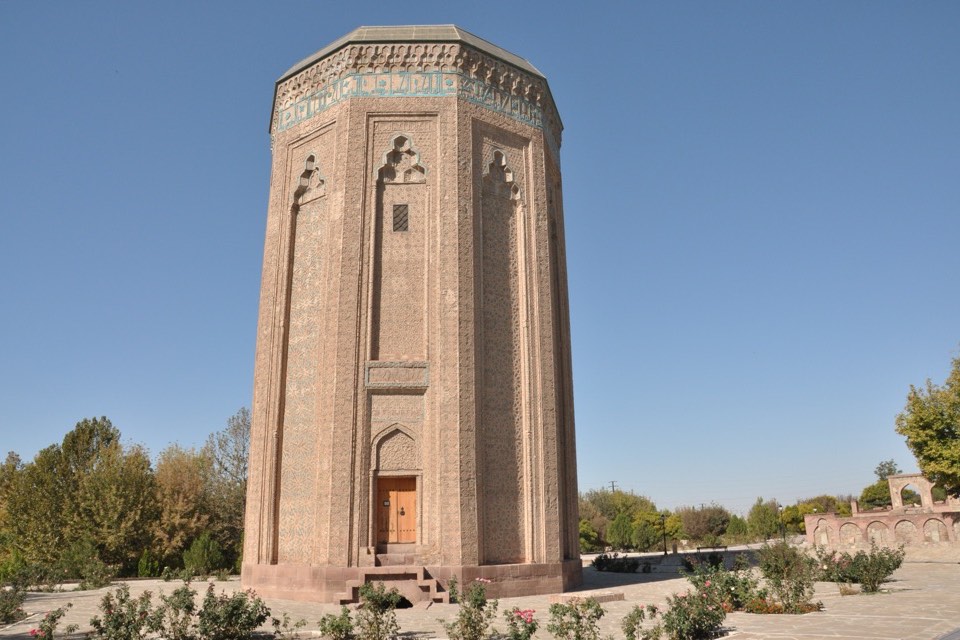
Nakhchivan was the capital of Shams al-Din Eldiguz, atabeg of the Seljuk sultan Arslan Shah, who held only the semblance of power; McClary dates Eldiguz’s effective control of Azerbaijan to 11725. Eldiguz died at Nakhchivan in 1174-1175, and his son Muhammad Jahan Pahlavan ruled until his own death in 1186-11875. The tomb honours Momine Khatun, Eldiguz’s wife and Jahan Pahlavan’s mother2,4. Its Kufic frieze names Jahan Pahlavan as the ruler who ordered “this mashhad” for her; the Presidential Library of Azerbaijan adds that Eldiguz had chosen to build over her grave and that his son completed the tomb in Muharram 582 (March-April 1186)2,4,6. The builder, Ajami ibn Abi Bakr of Nakhchivan, signed a panel over the door5.
Near its end the frieze carries a Persian couplet: “We pass on, and the world remains; we die, and this remains as a memorial”4,6. The tomb belonged to a group of Eldiguzid buildings, among them a palace, a congregational mosque, a madrasa and a portal with twin minarets, none of which survives; a report published in 1836 still describes a half-ruined mosque and the remains of twin minarets about 21 m high3,6. Christian Frähn of the St Petersburg Academy published the first reading of the frieze in 1837, from copies made by Frédéric Dubois de Montpéreux6. The crypt was restored in 20032. In 1998 Azerbaijan placed the Nakhchivan mausoleums on its UNESCO Tentative List1,2.
건축
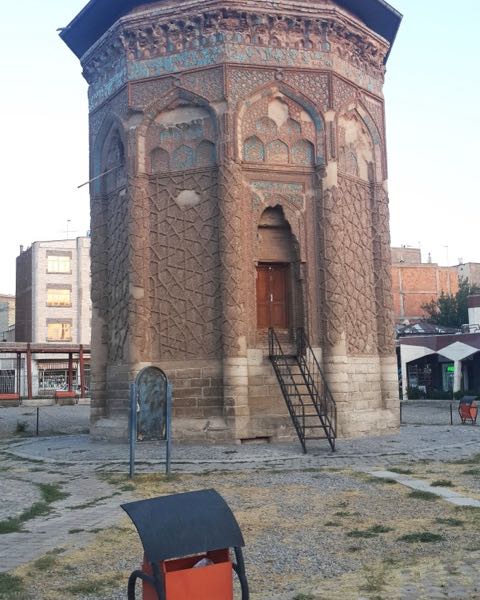
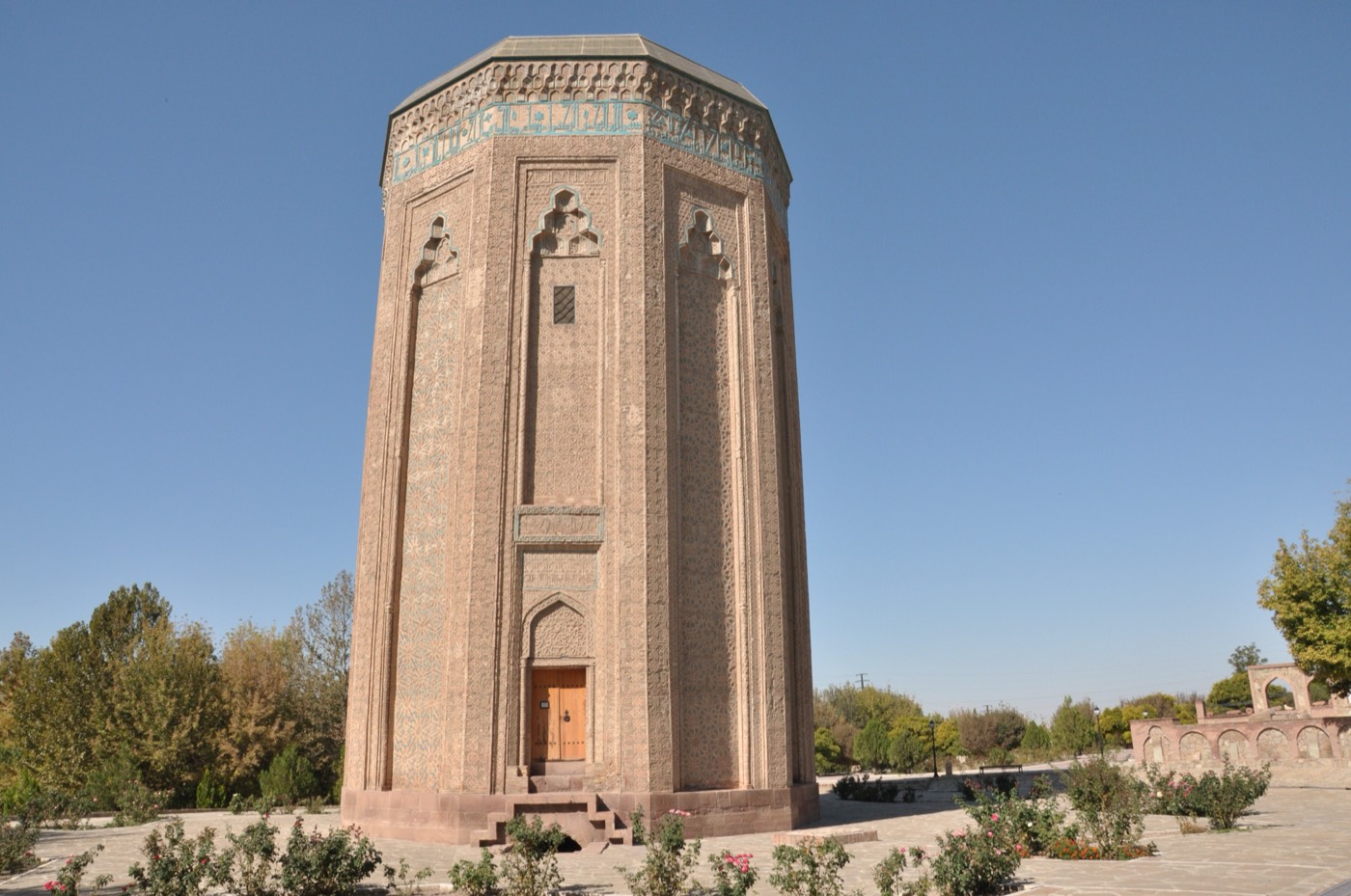
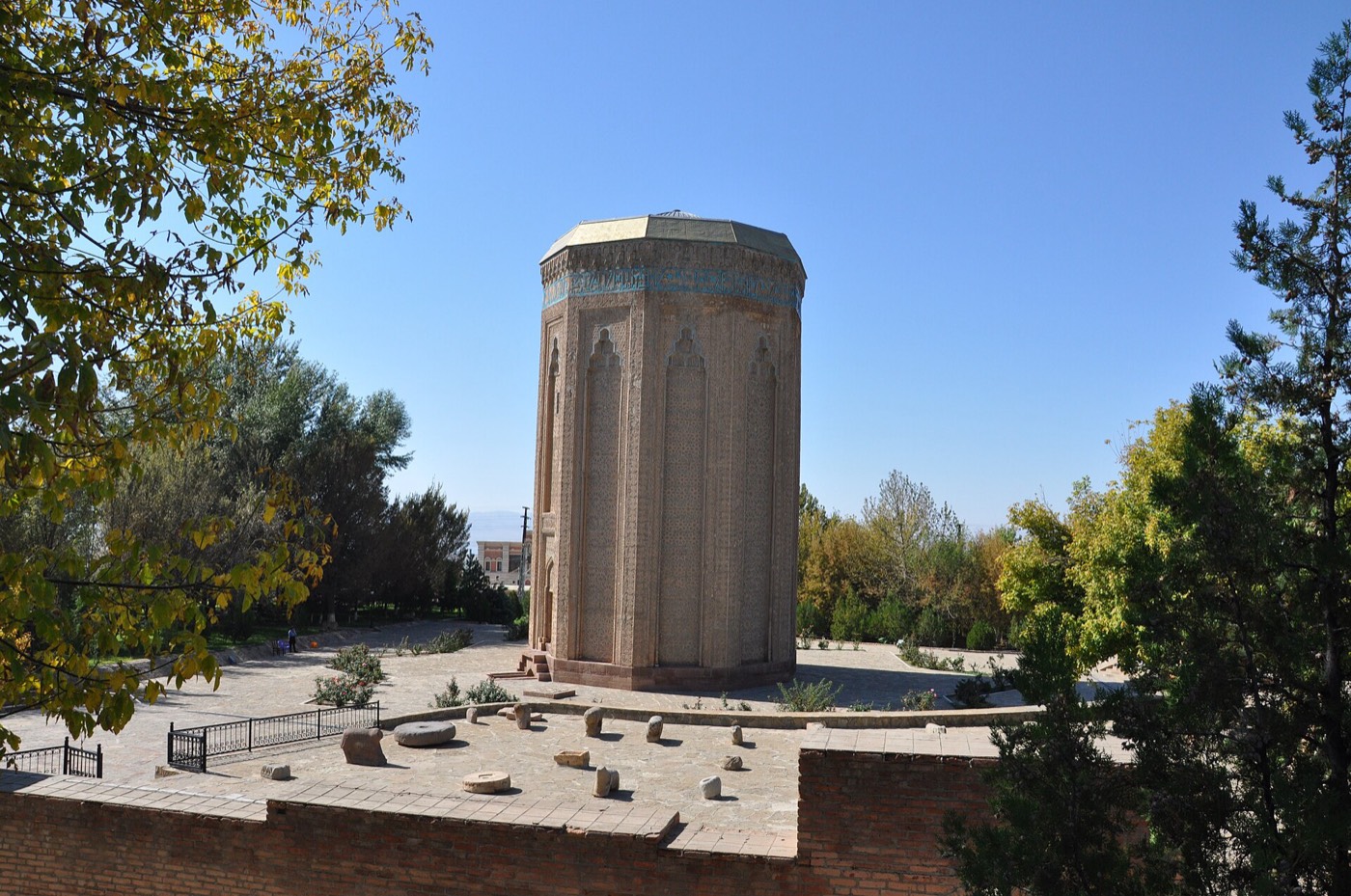
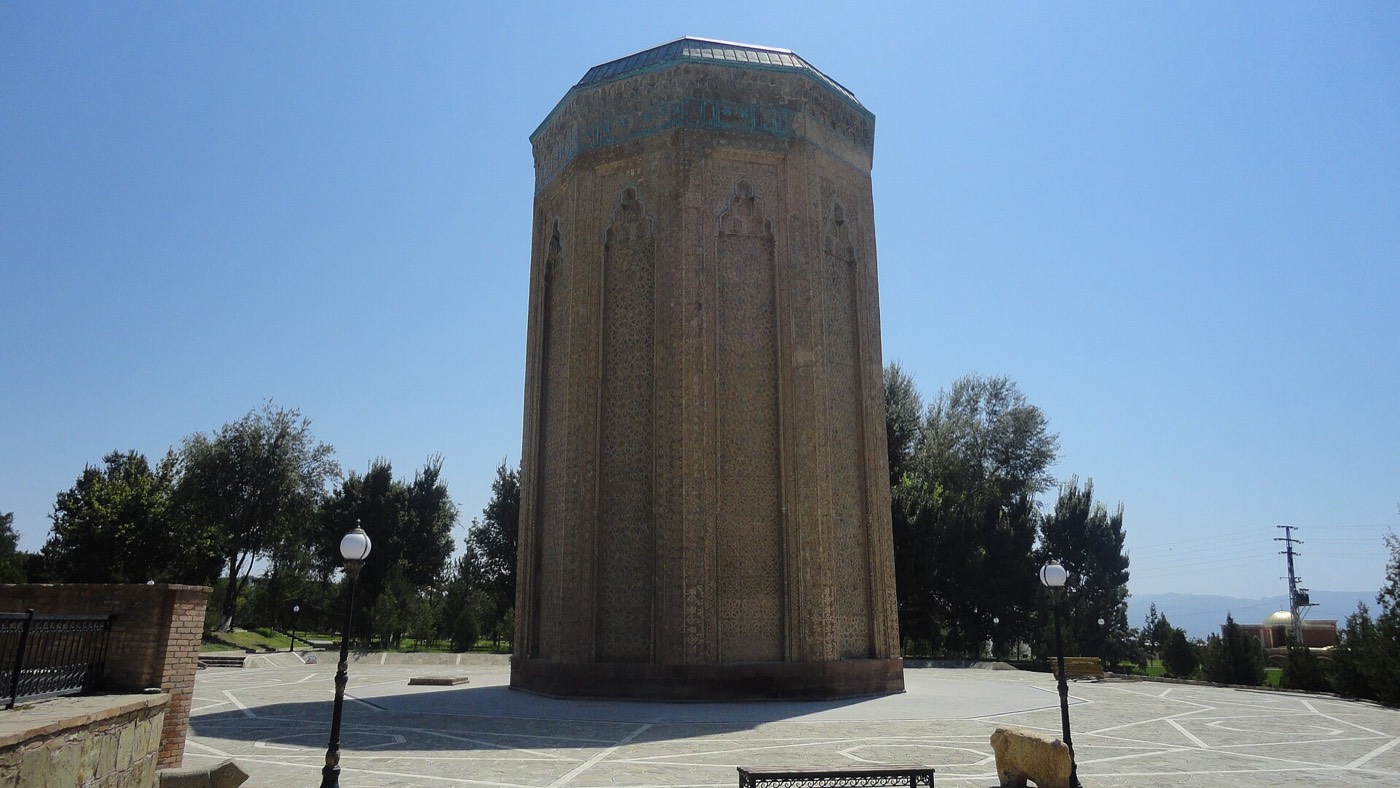
The tomb has two levels: a crypt below ground and, above it, a ten-sided brick tower that is round inside2,5. The tower now stands about 25 m high; with its lost pyramidal outer roof it reached about 34 m, and today an inner dome and a modern metal roof cover it2,4. Each of the ten faces holds a tall recessed panel filled with a different geometric strapwork pattern, laid in projecting bricks with carved plaster between them; some are picked out with turquoise-glazed pieces4,5. A Kufic frieze runs round the top of the shaft below the roof4,6. The west face, with the entrance, is treated differently: a doorway in an arched frame below, ornament above, and the inscription naming the builder and the date over the arch2,5.
Shchetnikov, who analyses the patterns face by face, notes that some Nakhchivan patterns are found nowhere else; one on this tomb, combining rosettes of 13 and 11 petals, is the only pattern of its kind in Nakhchivan4. Encyclopaedia Iranica treats the buildings of Maragha and Nakhchivan from the later 12th and early 13th centuries as a distinct regional group7. McClary sees the Nakhchivan tombs as the models for the brick tombs of eastern Anatolia, such as the Mengücek Gazi tomb at Kemah, built about 11905.
내부
The upper chamber is round inside, although the tower is ten-sided outside, and four round medallions in the dome carry the names of the caliphs2. Below lies the crypt, whose vault springs from a central column, an arrangement McClary sees as the source of the crypt of the Mengücek Gazi tomb at Kemah5. The tombstones that stood in the crypt were robbed; the crypt was restored in 2003, and the Presidential Library notes that some researchers believe Eldiguz and Jahan Pahlavan were also buried here2.
감상 포인트
- Ten faces, each filled with a different geometric pattern in brick and carved plaster4.
- Turquoise-glazed pieces picking out stars and octagons within the patterns4,5.
- The Kufic frieze below the roof, with its Persian couplet4,6.
- Ajami ibn Abi Bakr’s signature panel above the door5.
- A pattern of 13- and 11-petal rosettes, which Shchetnikov calls the only one of its kind in Nakhchivan4.
관람 안내
- The tower stands in a public park in the centre of Nakhchivan city4.
- Ajami’s earlier tomb of Yusif ibn Kuseyir (1162) stands less than a kilometre to the south-east3,4,5.
- Nakhchivan city lies on the east bank of the Araxes, near the point where Türkiye, Armenia and Iran meet5.
공식 정보: Authorities of the Nakhchivan Autonomous Republic, Azerbaijan길찾기OpenStreetMap에서 열기나히체반 가이드 투어